
You can find plenty of information on the internet and in books about both of these fascinating creatures, but the magnitude of Megalodon’s girth is mind blowing. The above photo depicts both species most exceptional sizes found in the fossil records.
Due to the multitude of unearthed shark teeth, scientists have been able to determine size, species and age of these amazing creatures. Surprisingly, scientists were able to determine that the largest Megalodons ‘”Otodus megalodon” were female, as with the Great Whites “Carcharodon carcharias” of today.
Sharks are important to all life on earth keeping the oceans clean of dead debris. Without them, our oceans would be overrun with bad bacteria killing all other ocean life which feed the world.
On average, Great White sharks have approximately 300 teeth, but lose dozens of them per month, which are readily replaced by several rows of backup teeth. In a single lifetime, these sharks can acquire over 20,000 teeth. This would explain why the average beachcomber can readily find volumes of shark teeth to add to their collections! Megalodon had almost as many teeth as the Great Whites, but considering Megalodon’s approximately 20 million-year-timespan on Earth, compared to Great Whites approximate 6 million-year-timespan, it’s not surprising Meg teeth are equally as common to find, if not more.

Comparing Shark Teeth Characteristics
In comparison, Megalodon shark teeth have larger, wider roots than the Great White sharks and typically display a medium to wide bourlette (chevron shaped space between the root and the crown of the tooth). Also, the Megalodon teeth displayed small, regular spaced serrations along the edges, while the Great White shows thicker, irregular serrations.
The tooth size is another way to tell these two species apart, depending if the tooth is from a juvenile Meg or an adult Meg. The largest Megalodon tooth ever found is just over 7 inches (18cm) long, filling a mans palm. The largest recorded Great White shark tooth is just over 3 inches (7.5cm) long.

Where can you find Megalodon teeth?
Megalodon shark teeth have been found on every continent except Antarctica. And in the United States, their teeth have been found in every state along the East Coast, especially Florida and the Carolinas. Their teeth have also been found in Texas, Louisiana, California, Washington, Hawaii, Michigan and some other Midwestern states. The best environments to find shark teeth are beaches, creek beds, dried riverbeds and abandoned dig sites.
Why did Megalodon become extinct?
Megalodon teeth fossils date from the early Miocene Epoch about 23 million-years-ago until the end of the Pliocene Epoch about 2.58 million-years-ago. Modern Great Whites evolved from the middle of the Miocene Epoch around 10 million-years-ago to the present. Consequently, the Great Whites lived toward the end of Megalodon’s tenure and scientists predict they competed with juvenile Megalodons for food making it more difficult for some Megalodons to reach adulthood. Also, changing ocean currents resulting in colder temperatures drove one of Megalodon’s essential prey of whales to colder climates, which Megalodon may not have adapted. A megaton creature needs megatons of food to survive and scientists predict the species was likely starved out of existence.

Extinct White Shark Comparisons
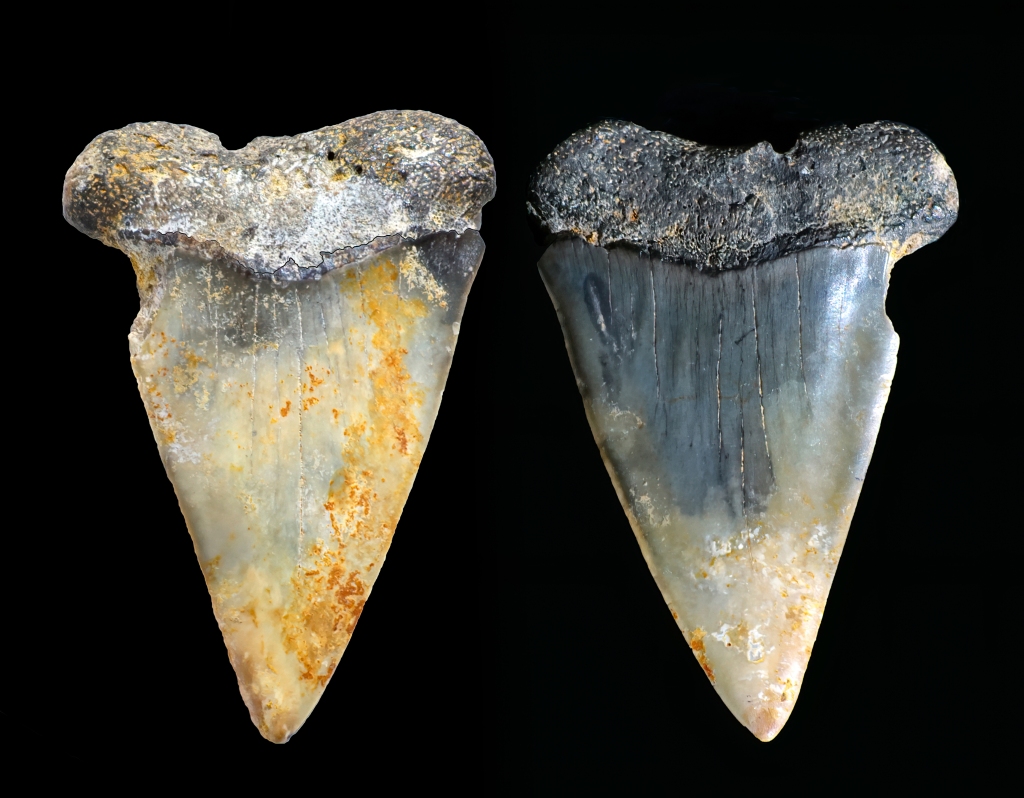
The above shark teeth belonged to a known extinct breed of large White Sharks, Carcharodon hastalis, a fast-swimming mackerel shark. This impressive species of sharks are considered ancestors to the modern day Great White Sharks, Carcharodon carcharias. The teeth of White Sharks have been found world-wide from marine deposits of the Miocene and Pliocene epochs, around 20 million to 3 million-years-ago. They dominated the Miocene seas and likely competed with Megalodon for food.
White Shark teeth are often found along with the teeth of Megs and on average measure from 1-3 inches (2.5 – 7.5 cm) long, topping out at 4 inches (10 cm) long, second only to Megalodon. Roots of these extinct White Shark teeth are large, but not as broad in comparison to Megs. White Shark teeth crowns also lack the edge serrations and chevron shaped bourlette between the crown and roots distinguishable in Megalodon’s.
White Sharks, Carcharodon hastalis, grew larger than today’s Great Whites, Carcharodon carcharias, reaching estimated lengths of 20 to 26 feet (6–8 meters). While modern Great Whites, typically max out around 20 feet.
All rights reserved © Fossillady 2022
 Fossil Lady