
Hypural Bone Fishtail Fossil Information and Interesting Related Facts

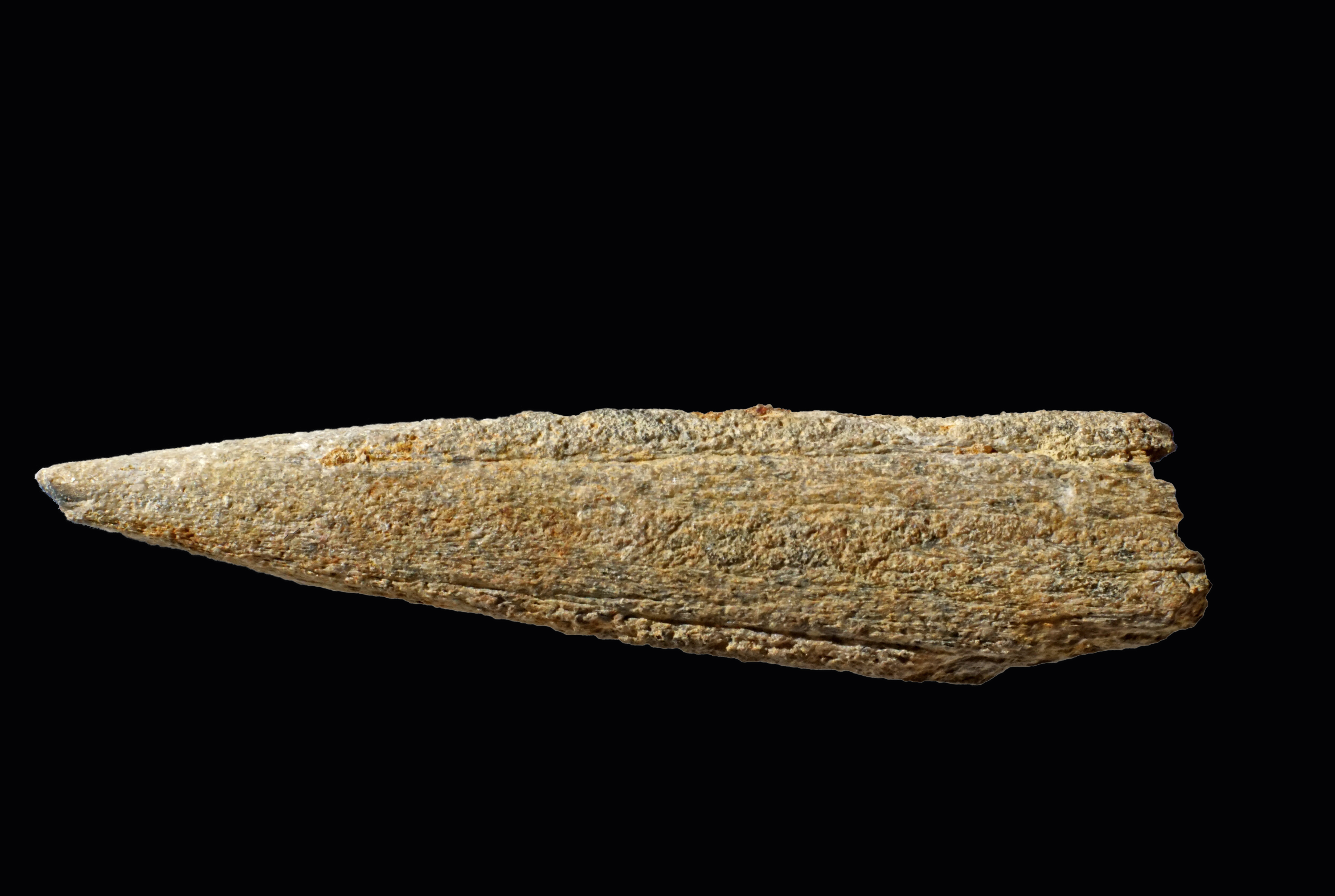
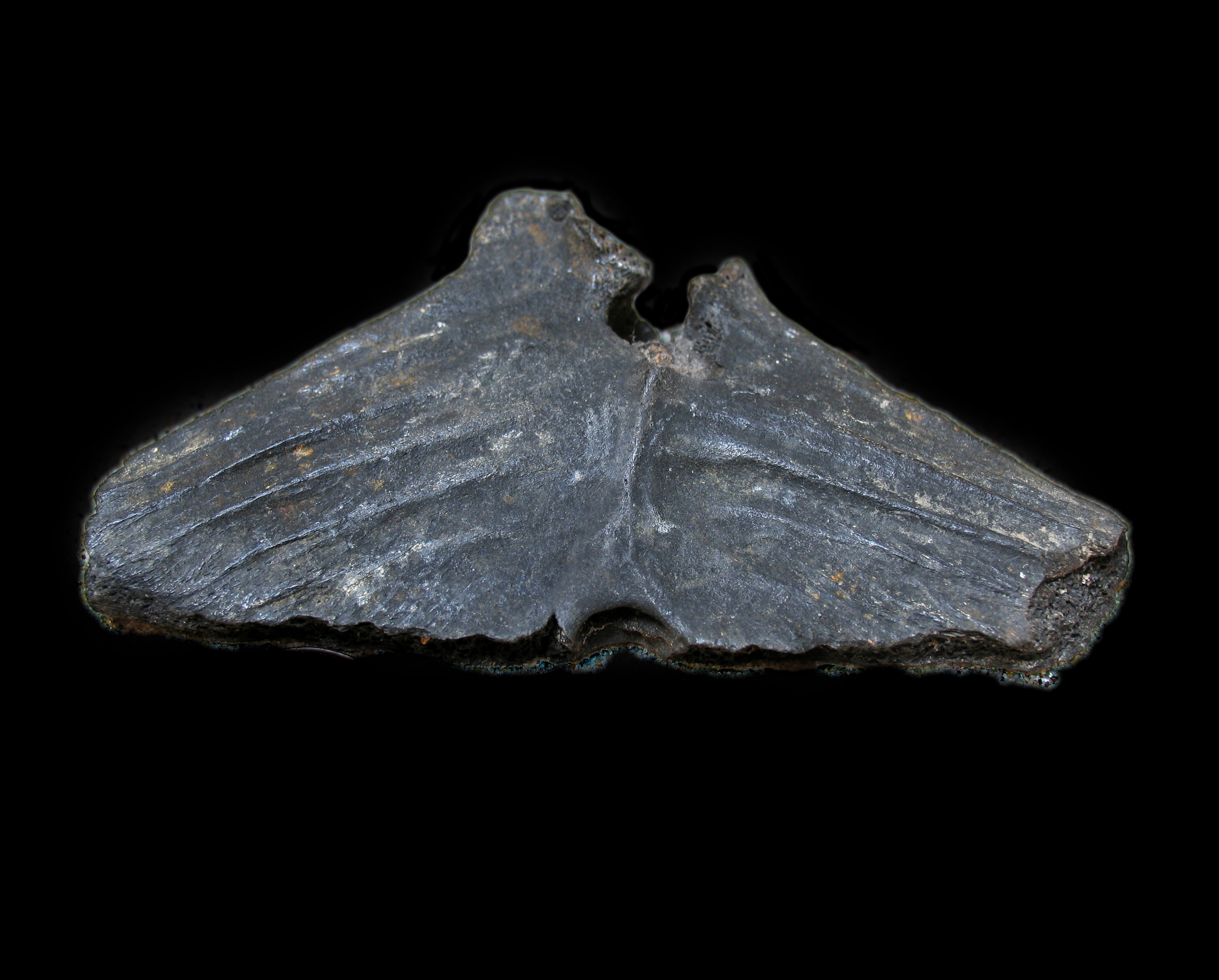
Hypural Fishtail Fossil Bone (4.5 inches (11.4 cm)
Cenozoic Time Scale

Hypural Bone Description, Body Location and Function

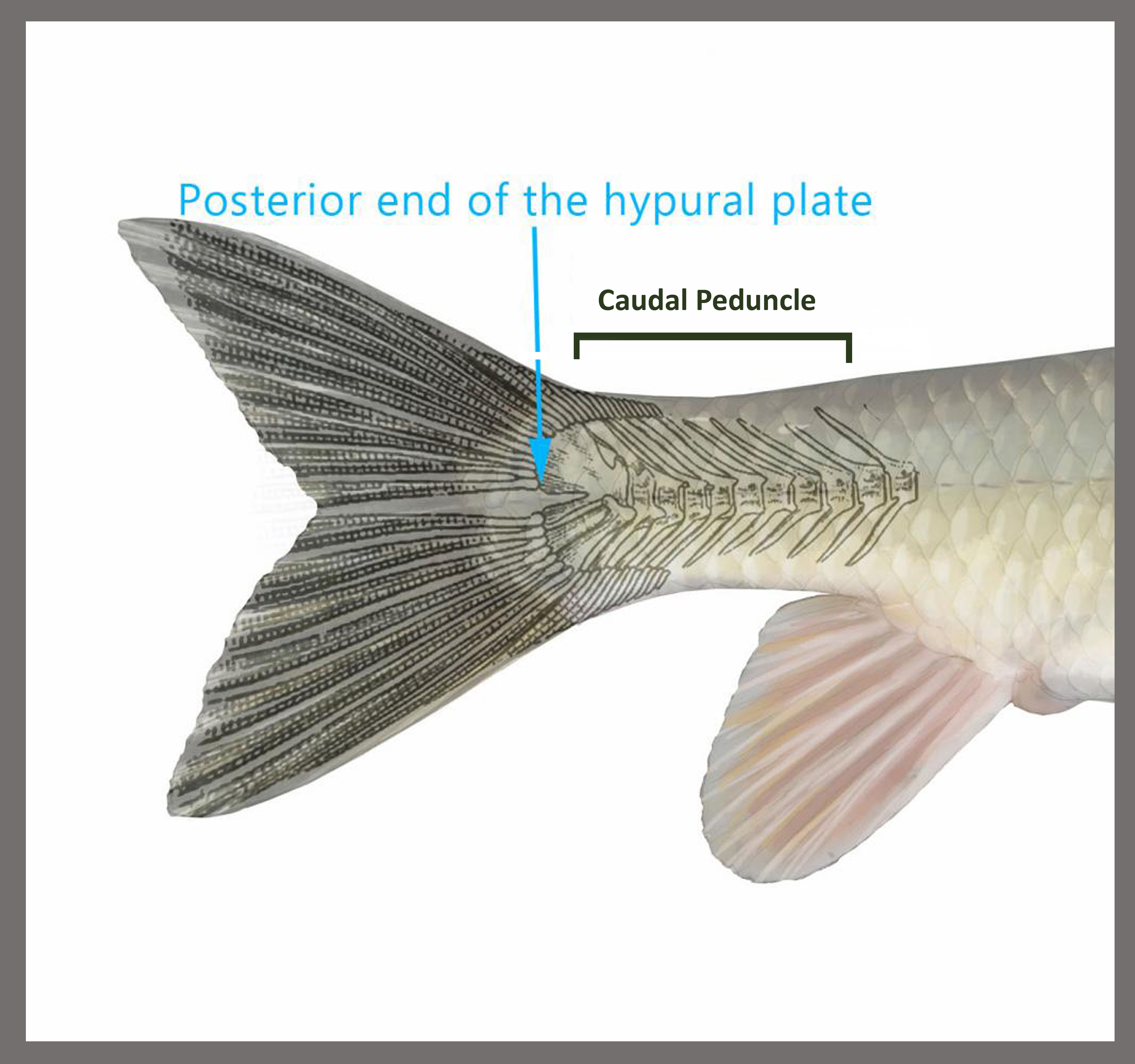
The hypural bone is a fan-shaped series of bones constituting an important part of the framework of ray-finned fish. The hypural bones are sometimes fused into one or two plate-like bones, such as with the case from my fossil collection, shown above. The hypural boney-plates join the last few vertebrae of the fish’s spine to the slender bony rays of the fish’s caudal fin. Caudal fin is a fancy scientific term for the tailfin. The caudal fin is attached to the end of the fish’s caudal peduncle by the hypural bone. The caudal peduncle is the narrow part of the fish’s body. The tailfin helps the fish steer, balance and propel. (See illustration below)

My hypural fossil was unburied in the Pungo River Formation, Aurora District, North Carolina, USA, dated from the early to middle Miocene Epoch around 23 to 14 million-years-ago. It is a large sample. I found a close match to the fossil of a tuna fish, Thynnus sp. posted by the Fossil Guy from the same location.
Tuna Facts

Tuna are a type of ray-finned bony fish belonging to the class or subclass of Actinopterygii. Ray-finned bony fish comprise over 50% of all living vertebrate species. The ray-finned fishes are so-called because their fins compromise webs of skin supported by slender bony spines (rays), as opposed to the fleshy, lobed fins that characterize the class Sarcopterygii (lobe-finned fish).

Tunas are teleost fish identified by their symmetrical forked tails with the upper and lower halves both exhibiting identical size.

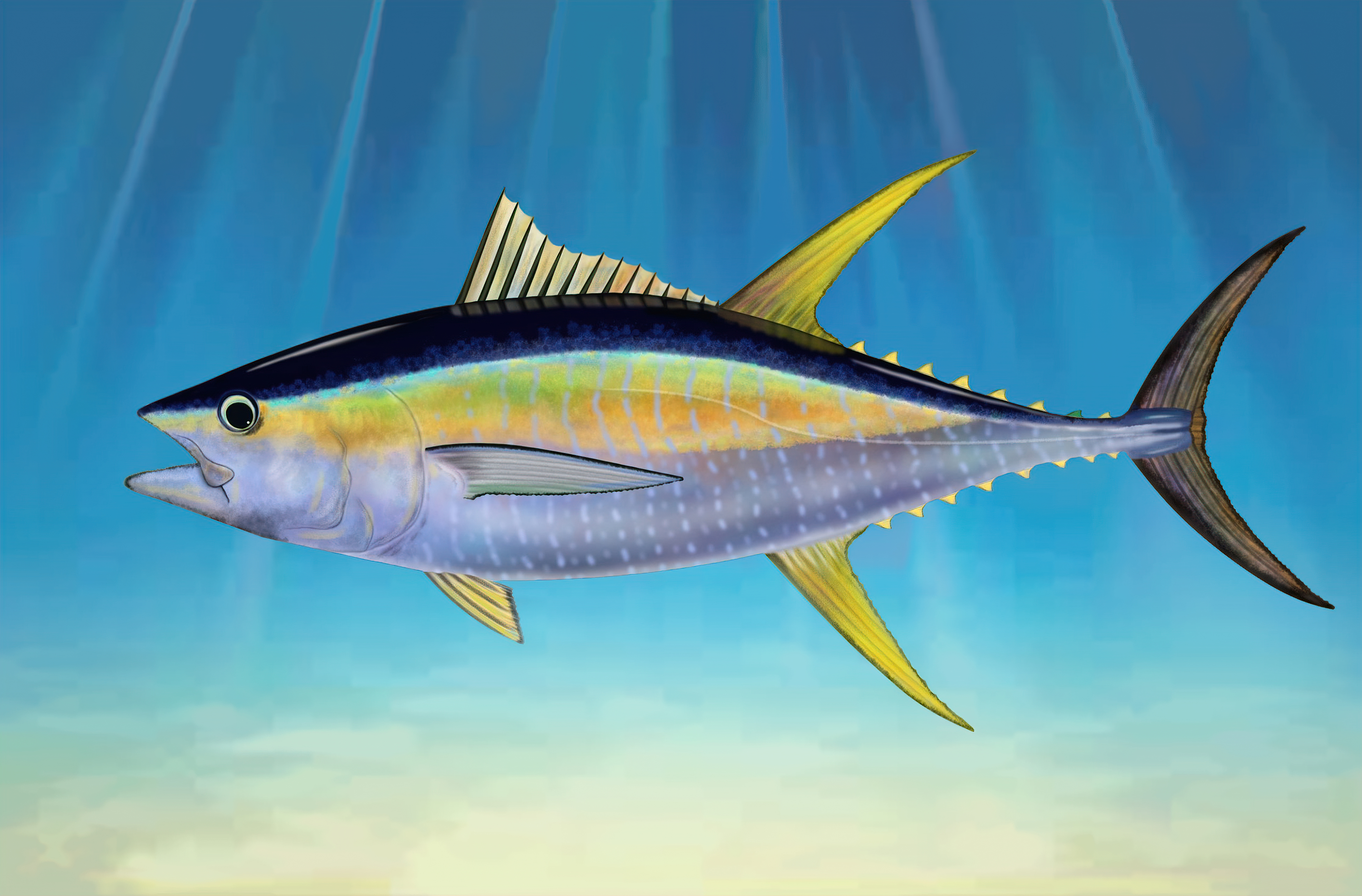
Check out the list of a few common east Atlantic USA tuna species beginning with the largest and possible matches to the hypural fossil. You can check out the links from NOAA, National Oceanic and Atmospheric Administration, for information about their range, life cycle, population status, appearance etc.

Atlantic Yellow Finned Tuna (Thunnus albacares)

Tuna Interesting Facts

In addition to the caudal fin, these high performance tuna fishes are equipped with finlets and keels. The finlets are small fins along the trunk that help the fish cut through the water. The keels can be described as a pair of lateral structures that rise slightly forward along the caudal peduncle which are a remarkable specialization in tunas, which, by the way, have also arisen in other fast-swimming marine animals.

  • Tuna are formidable predators with the ability to outmaneuver, outswim, and eat just about anything they can fit into their mouths!
  • Tuna can not only swim fast, but can reach remarkable distances as they migrate!
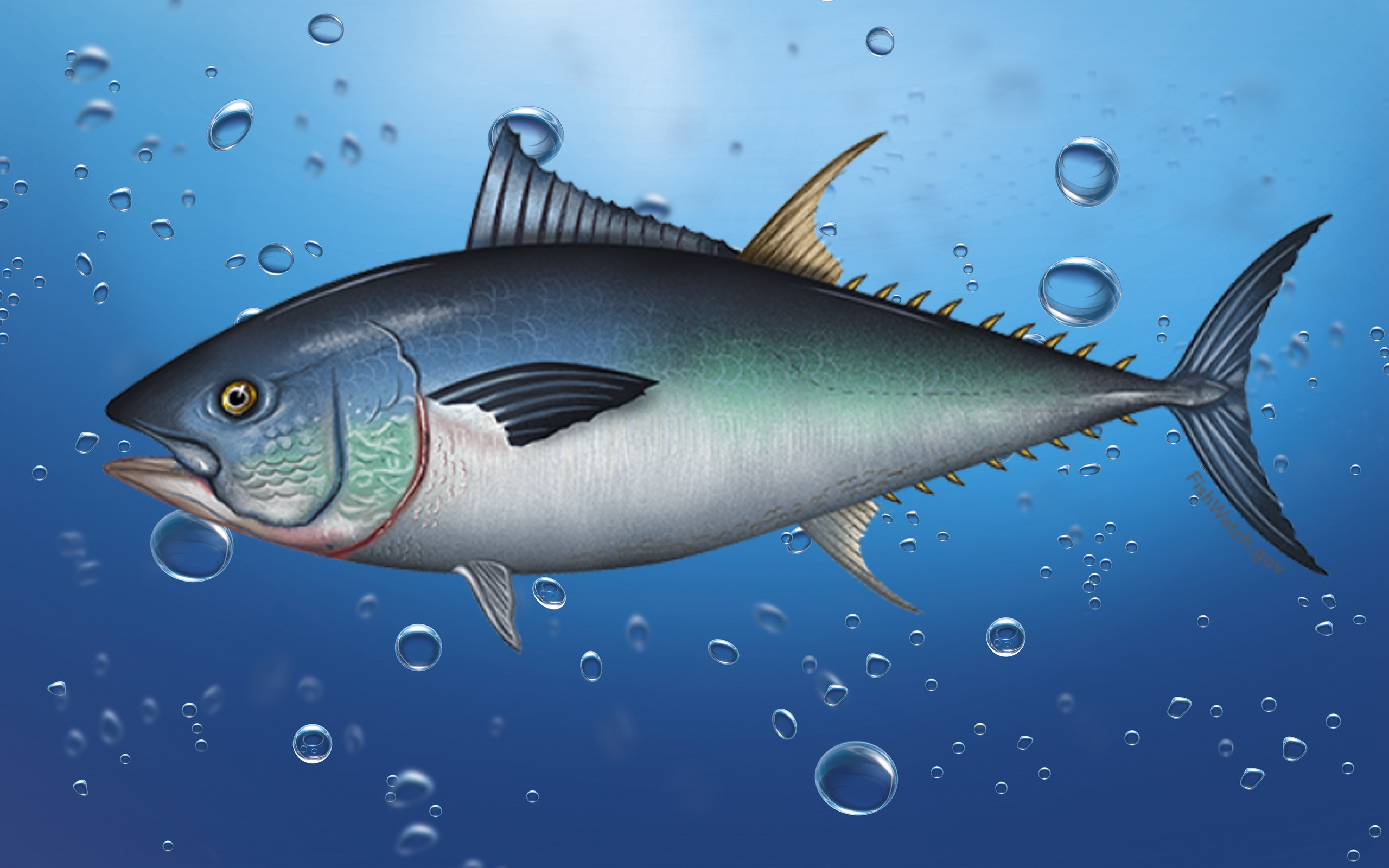
Western Atlantic Blue Fin Tuna (Thunnus thynnus)

Origins of the Bluefin Tuna and Evolution Development

The bluefin tuna originated from an exothermic ancestor. Exothermic means acquired heat source from the environment to stay warm. Earliest tuna fossils have been found in the Late Paleocene (65-55 mya) and Early Eocene (55-50 mya) epochs in the Tethys Sea deposits from the Middle East, southern Europe and the London clay formation. A close relative of the tuna, the earliest bonito fish, identified as Sarda palaeocenica were found in the region from the Early Paleocene. The extinct tuna-like fish, Paleothunnus parvidentatus, displayed characteristics common to both the tuna and the bonito, suggesting that the split of the tuna and bonito did not occur until the Early Eocene Epoch. Within 8-10 million years the two species diverged, forming the tuna genus Thunnus (Dickson and Graham).

Development of Endothermy in Tuna

As the oceans began to cool, warm waters began to compress into the tropics. In the Cenozoic Period, waters were the warmest at the end of Paleocene Epoch. The Tethys Seaway, a large tropical sea, began to shrink due to tectonic events and contributed to ocean cooling across the planet. Endothermy (body mechanisms other than shivering that generate heat internally) possibly evolved in tunas as a result of the need for migration and diving into colder waters for plentiful hunting grounds.

Because of the evolution of endothermy (internal heat sources) within the bluefin and other tuna, the fish are able to migrate across large distances. Dickson and Graham state that this has enabled the Atlantic Northern Bluefin Tuna to greatly expand its range and take advantage of the rich feeding areas in northern waters and warm spawning areas in the tropics, effectively expanding its thermal niche.

About Pungo River and Yorktown Formations

The Lee Creek Mine in Aurora, NC, is an open-pit phosphate mine operated by the Potash Corporation. The mine exposes two fossiliferous geological marine layers: the Pungo River Limestone (middle Miocene, Langhian age), and the Yorktown (lower Pliocene, Zanclean age) formations. The Pungo River Limestone and base of the Yorktown Formation are richly phosphatic and are commercially mined. These two units have yielded one of the most important assemblages of Neogene (between 23 and 2.6 mya) marine vertebrates in the world, including hundreds of species of sharks, rays, skates, bony fish, birds, sea turtles, estuarine crocodiles, seals, walruses, dolphins, and baleen whales. These fossils are found on-site as well as in reworked sediments in the spoils leftover from the mining. Unfortunately, the mine has been closed to the public since 2009.

Partial list of other Miocene bony fish fossils discovered in and around the U.S. Eastern Atlantic Coastline of South Carolina and North Carolina, as well as Maryland and Virginia.

  • Burrfish, Filefish, Tilefish, Pufferfish
  • Marlin, Sailfish, Boxfish, Sturgeon
  • Anglerfish, Bonita, Tuna, Bowfin
  • Catfish, Hake, Toadfish, Needlefish
  • Sea Robin, Bass, Bluefish, Barracuda
  • Boxfish, Goosefish, Toadfish, Pinfish

Fossil Fish Knightia

Fish Fossil Knightia Skeleton (3.5 inches (9 cm) long)

This Knightia fish skeleton was preserved by sediments dating around 50 million-years-ago during the sub-tropical to temperate Eocene Epoch when a large inland lake located near Kemmer, Wyoming, part of the Green River Formation, dried up. It was discovered by splitting the sandy layers of shale to expose it, then trimming and preparing it. The final step was to darken the skeleton and put a preservative on it to keep the skeleton from flaking off.

Extinct Knightia Fish Interesting Facts

  • Thousands of specimens of the small 6 to 10 inch (15 to 25 cm) long, prehistoric fish, Knighta, have been discovered in Wyoming’s Green River formation and in fact, Knightia, is Wyoming’s official state fossil.
  • In life, the fish assembled in vast schools throughout the fresh water lakes and rivers of Eocene North America, and were placed near the bottom of the aquatic food chain.
  • The scarcer and larger Diplomytus and Mioplosus, mentioned below, were likely sustained by Knightia’s abundance, evident from stomach analysis.
  • Befitting its small size, Knightia fed on tiny marine organisms such as plankton, insect larvae and diatoms.

I may have been a little too imaginative when I color penciled what I thought my fossil fish may have looked like in life, but I like how it turned out, anyway. At least the basic shape is accurate including its forward lower jaw and forked tail!

Fish Fossil Knightia Rendering Drawing

The Green River Formation

The following species are some of the most common extinct fish from the Green River Formation of Wyoming including, Knightia, similar to present day herring; Diplomystus, a large rib caged fish; Prisacara, a sun fish type fish; Mioplosus, a fierce bass like fish and Phareodus, a toothy piranha like fish. You can get a picture of all of these doing an internet search, very cool!

About the Green River Formation: Class Actinopterygii, the ray-finned bony fishes, comprise almost half of all known species of vertebrates, some 20,000 extant species. There are numerous locations worldwide that are noted for wondrous preservation of bony fishes, and the Green River formation that covers some 25,000 square miles of SW Wyoming, west Colorado and east Utah is one of the premier examples. The formation is one of the largest lacustrine (growing in lakes) sedimentary accumulations in the world, and spans the period from 40 to 50 million years ago during the Eocene Epoch.

All rights reserved © Fossillady 2026

Ray Fish Fossil; Dermal Denticle

Ray Fish Dermal Denticle Fossil (2.5 inches (6.35 cm) Long

What Are Dermal Denticles?

Chondrichthyans (Class of Cartilage Fish) including sharks, rays and skates, interestingly enough, have tooth-like scales called dermal denticles embedded in the skin. But in older texts, the term, placoid scales, literally meaning (plate-like) is customarily used. Today, most scientists prefer the more descriptive expression, dermal denticles, meaning (tiny skin teeth).

Denticles are similar to scales, but are actually just modified teeth with hard enamel coverings. These structures are often packed tightly together and grow with their tips facing to the rear of the fish. If you were to run your fingers from tail to head, it would feel very rough, but from head to tail, it would feel smooth. Dermal denticles provide protection for the fish, and in most cases, less resistance in the water.

Ray Fish Dermal Denticle Fossil (2.5 inches (6.35 cm) Long, Underside

Dermal denticles enfolding sharks are tiny and closely packed together resembling diamond shapes. My fossil is a large dermal denticle and is from a large ray fish such as a Roughtail Stingray which can grow 7 feet (2.1 m) across from wing tip to wing tip and 14 feet (4.2 m) long, including the tail. It can weigh as much as 660 pounds (300 kilograms).

Dermal denticles on ray fish are typically located along the mid-body lines and tails, plus around the eyes or on the wing tips, but also can be placed more sporadically. Shape and size of dermal denticles can vary greatly. Some may be quite thick, and some may be quite bumpy with furrowed edges, while others compose tiny sharp claw-like spines etc.

It is debated in the scientific community whether oral teeth evolved from dermal denticles that migrated into the mouth or the other way around. The earliest vertebrates, such as placoderm fish, possessed boney blades rather than teeth.

Various Dermal Denticle Fossils

Special Credit: The thefossilforum.com is a great site to help identify and learn about fossils. The above photo was provided by seasoned member “digit”.

Difficulty In Identifying

Dermal denticles are difficult to pin a specific ray family/genera/specie unless they are found in association with other identifiable ray fossils such as teeth or dental plates. Also, dermal denticles can vary widely on a specific individual ray depending on the location over the body. And, there are a lot of similarities between the dermal denticles of various extant ray fish which also make it very difficult to determine a specific genera/specie, let alone extinct species.

Possible Match with my Fossil

Below, I listed a few extinct ray fish possibly a match with my fossil shown at the beginning of this article according to age and location. These extinct species range in age from the Oligocene Epoch beginning 33 mya through the Miocene beginning 23 mya to the Pliocene Epoch beginning 5.3 mya. Two localities from where these extinct species fossils have been found include the Chandler Bridge Formation, Dorchester County, Southern Carolina and/or the Pungo River Formation, Beaufort County, North Carolina. Here are some possibilities:

  • Mobula, pectinata or Mobula loupianensis “Giant Devil Rays” also called “Flying Rays”
  • Paramobula, fragilis “Eagle Ray”
  • Dasyastis cavernosa or Dasyastis rugos “Stingrays”
  • Plinthicus stenodon “Eagle Ray”
  • Raja dux “Giant Skate”

Additionally, stingrays first appeared in the fossil record around 60 million years ago during the Paleocene Epoch and the large roughtail stingray, Dasyatis centroura, mentioned above, also occurred in the range where my fossil was unearthed making it another possibility.

Ray Fish Interesting Facts

Ray fish belong to the superorder Batoidea with about 600 species and 26 families. Rays are the largest group of cartilage fishes. They are distinguished by their flattened disc-like bodies, very large pectoral, wing-like fins that are fused to the head, and by how the mouth and gill slits are situated on the fishes’ underside. A few extant and extinct families include electric rays, sting rays, skates, sawfish, spotted eagle ray, fiddler rays, or manta rays.

Rather than breathing through the mouth, ray fish breathe by taking water in through openings near the eyes called spiracles and passing it outward through the gills. More Facts below . . .

Ray Fish Rendering Drawing

Ray Fish Interesting Facts Cont…

The ray’s tail is generally long and slender and many species bear one or more sharp, saw-edged, venomous spines that can be used to inflict painful wounds. But, rays are docile creatures and very rarely have caused human death. If threatened, their base reaction is to quickly swim away. However, a defensive reaction, such as being stepped on or a predator attack, will cause them to whip up their stingers. 

Rays are predominantly marine and are found in all oceans. Many are slow-moving bottom dwellers. The well-known manta rays feed on plankton and small animals; others feed on various fishes and invertebrates. Other than skates, all rays bear living young.

Large rays live about 70 years, some live for more than 100 years.

All rights reserved © Fossillady 2026

Billfish Fossil, Swordfish or Marlin; Identification and Interesting Facts

Billfish Fossil (4.5 inches (11 cm) long)

This fossil is the broken-off tip from the bill of a billfish, estimated in age from the Miocene Epoch (23 to 5.3 million-years-ago), possibly belonging to, Xiphiorhynchus, an extinct genus of giant, double-billed swordfish; or possibly belonging to Tetrapturus pfluegeri, living today, commonly called “Longspear Billfish“.

I chose these two related species as possible matches to my billfish fossil because both species were abundant during the Miocene Epoch (fossil age) and because the fossil was discovered along the Eastern Atlantic Coast of United States where both species were and are native.

Not to be confused – while all swordfish are billfish, not all billfish are swordfish. Swordfish (family Xiphiidae) are distinct from other billfish (family Istiophoridae—like marlin and sailfish) because they have a flatter, longer sword and lack teeth and pelvic fins as adults. 

Swordfish Facts

Xiphiorhynchus swordfish is an extinct genus of prehistoric swordfishes. Fossil records indicate they were one of the first swordfishes to have evolved during the Eocene Epoch (56 million-years-ago), surviving most abundantly through the Miocene Epoch (23 mya) becoming extinct during the Pliocene Epoch (2.6 mya) when one third of the planets megafauna died out due to cooling climate changes.

Xiphiorhynchus, Extinct Swordfish Rendering Drawing

Xiphiorhynchus swordfish was a large genus reaching 5 meters (16 feet) long or more, comparable to the Great White Sharks of today. Unlike the “one and only” true living swordfish today, Xiphias gladius (shown below) whose smaller in comparison, averaging about 3 meters (10 feet) long, the extinct Xiphiorhynchus had not one, but two equal length swords. During the genus’ reign, they would have been top predators and likely have achieved great speed and predatory skills, reminiscent of the many varieties of modern-day billfishes.

  • Xiphiorhynchus swordfish were highly migratory as the modern-day swordfish and would have been spotted along the Eastern Atlantic Coast of America through to the Gulf of Mexico down to Peru and as far south as Antarctica.
  • Swordfish are named after their long pointed, flat bills resembling a sword.
Modern-Day Swordfish (Xiphias gladius)
Billfish Fossil (4.5 inches “11 cm) long) (Reverse Side)

Two Billfish Species

Tetrapturus pfuegeri commonly named “Longbill Spearfish is an extant species, (still living) from the family, “Istiophoridae” of billfishes, which includes about 10 species native to the Atlantic Ocean. It reaches a length of around 2.5 meters (8 feet) with a maximum weight of 58 kilograms (128 lbs). It is quite a fascinating looking billish species.

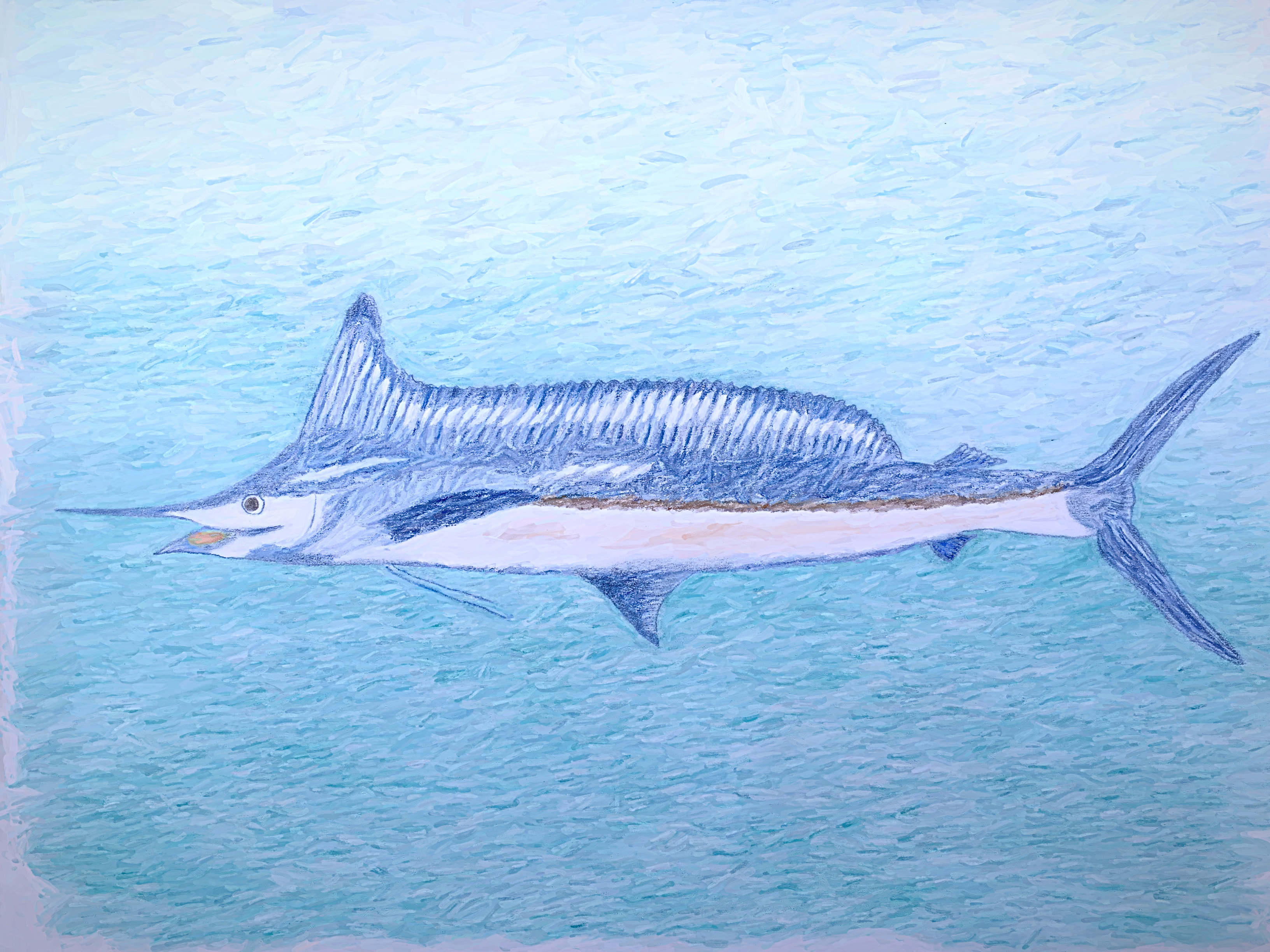
One of the largest and probably best known billfish today is the Atlantic Blue Marlin, “Makaira nigricans” which averages 3 meters (10 feet) long and can weigh up to over 1000 pounds, females are the largest. The Blue Marlin fossil record dates back from about the middle of the Miocene Epoch around 11 million-years-ago and reveals they were discovered along the east coast of the United States. The Blue Marlin could be another possible match to this fossil.

Makaira nigricansBlue Marlin Billfish (Rendering Drawing)

Marlin Facts Continue . . .

Marlins are oceanic species, chiefly found in offshore waters. They are highly migratory and are some of the fastest fish in the sea, reaching 110 km/h (68 mph) in short bursts. A marlin is not a swordfish, but a billfish. Two differences between a marlin and swordfish is that marlins have a more elongated body and a longer, sloping, dorsal fin. Also, marlins have a rounder, spear-shaped bill while swordfish have a flatter, broader “sword” and a shorter dorsal fin. 

  • Marlin’s common name is thought to be derived from its resemblance to a sailor’s marlinspike, an iron hand tool that tapers to a point and is used to separate strands of rope.
  • Marlins are popular sporting fish in tropical seas, consequently, the Atlantic Blue Marlin and the White Marlin are endangered owing to overfishing.
  • Females can live up to 36 years

All rights reserved © Fossillady 2025