Get me outta here!

Fossil Lady

Eager to share my fascination with fossils, rocks and seashells!

Menu

Skip to content
  • Home

Author Archives

Fossilladyhttps://fossillady.wordpress.comThis is where I combine my photography and writing to share my fascination with fossils.
Fossillady's avatar

Clamshell Identification and Facts (From Coquinas, Oysters to Tellins and more)

January 22, 2026 by Fossillady
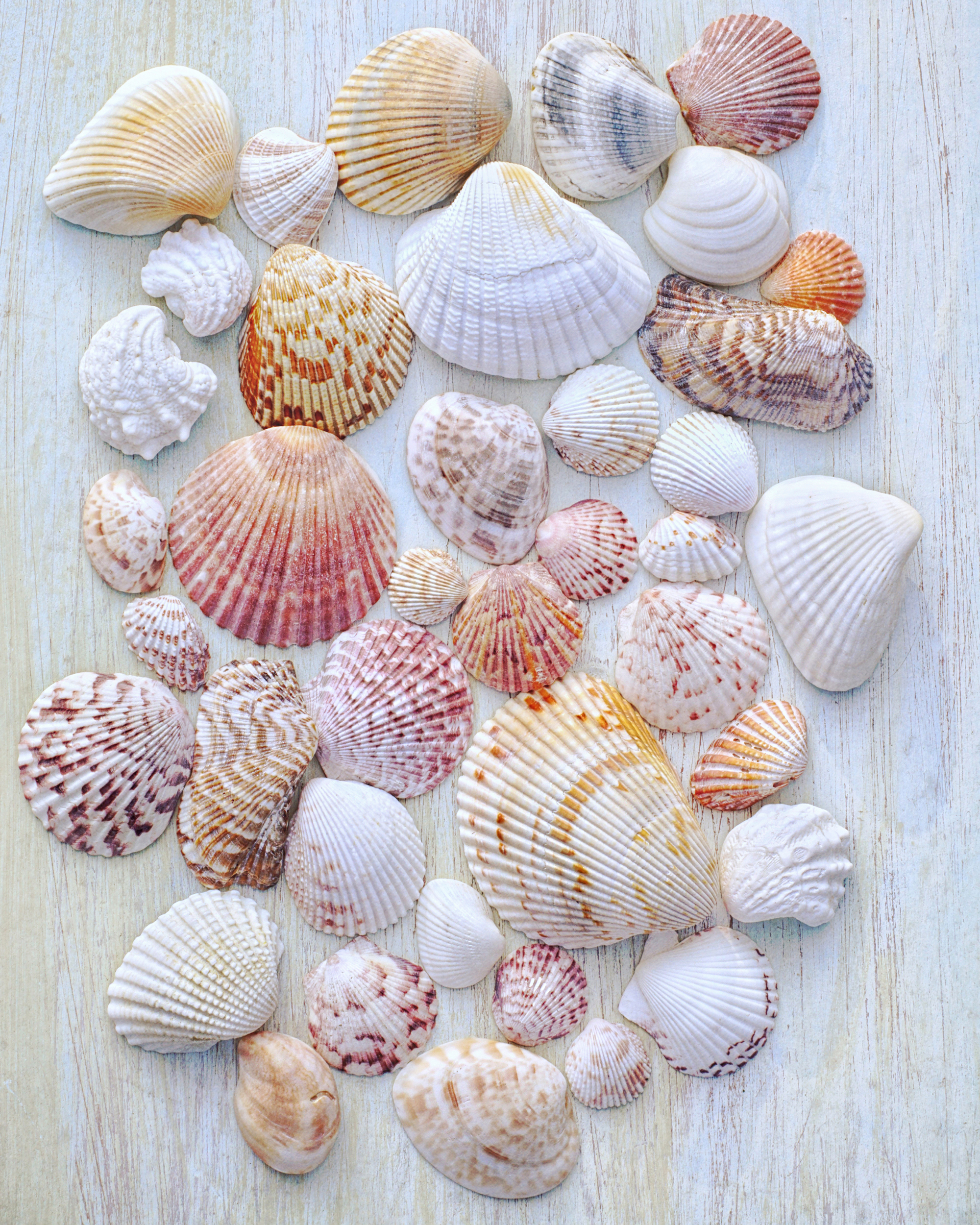
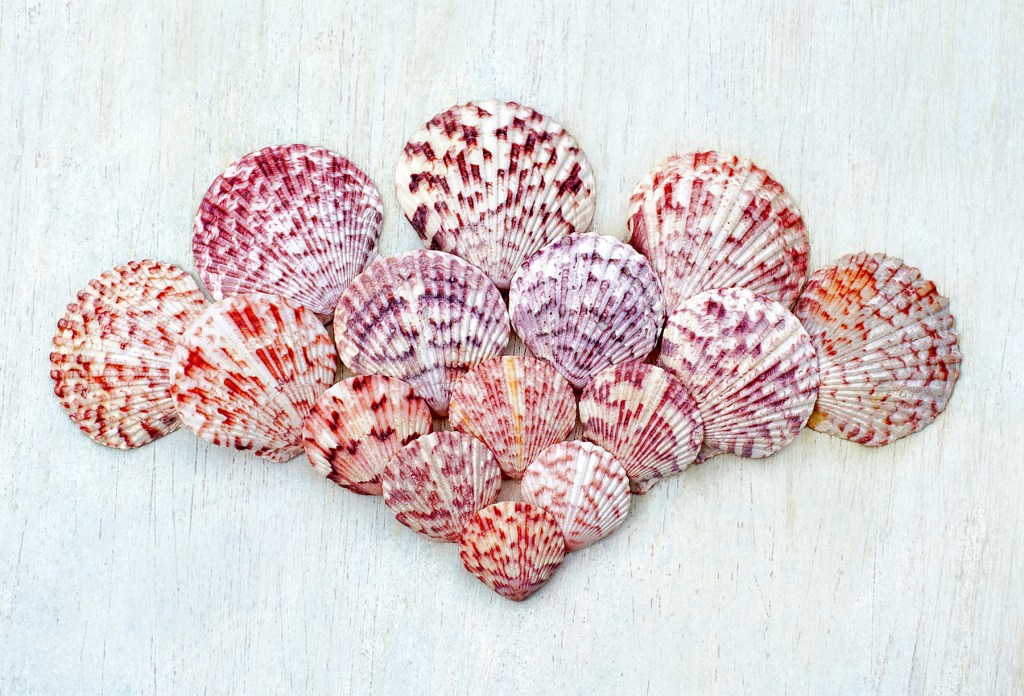
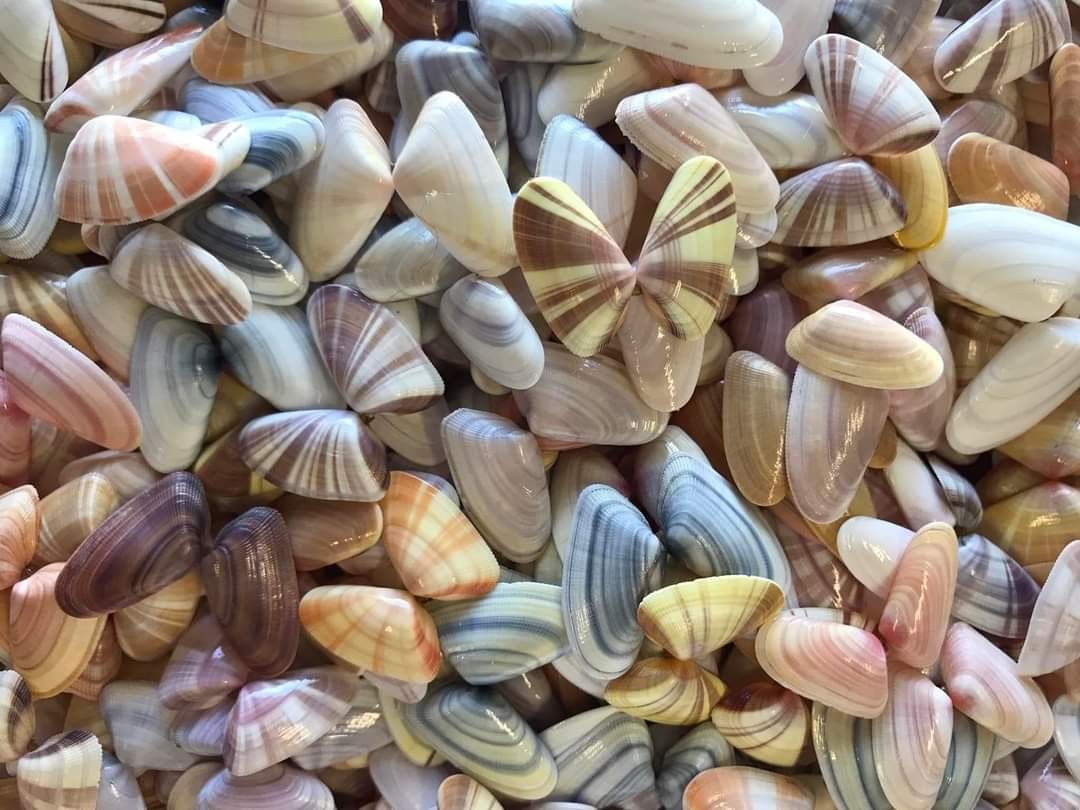
Coquina Clamshell Collage: Source

Brief Intro

The word “clam” can be used to cover all bivalves, including scallops, oysters, arks, and cockles, to name a few. Did you know that there are more than 15,000 species of clams around the globe? Amazing, right? Clams and other bivalves first appeared in the fossil record as tiny creatures as early as the Cambrian Period over 500 million years ago. Beginning around the Devonian Time Period approximately 400 mya through to the Mesazoic Era, they gradually developed into abundant forms. Follow along to learn interesting facts about clams and to help you identify those clamshells you couldn’t resist picking up from the sandy seashore.

Eleven Clamshell Identifications from my Collection in the following order:

  1. Coquinas
  2. Disc Dosinia
  3. Atlantic Surf
  4. Eastern Oyster
  5. Jewel Box Oyster
  6. Atlantic Thorny Oyster
  7. Digitate Thorny Oyster
  8. Jingle Shell Oyster
  9. Atlantic Kitten Paw
  10. Tampa Tellin
  11. Speckled Tellin

For addional Fossillady clam ID including Arks, Angel Wing, Cardita and Lucines click HERE

Coquina Clamshells

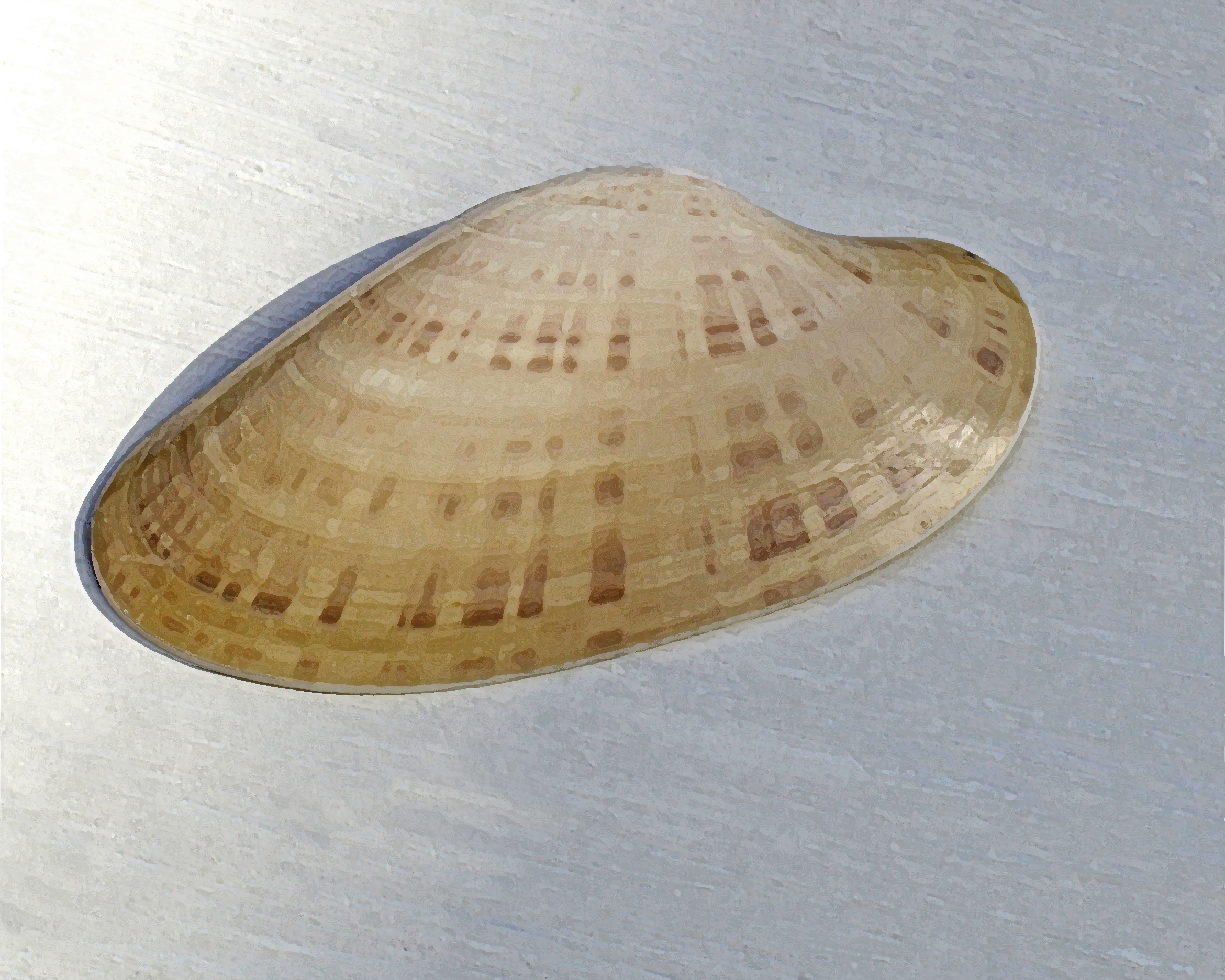
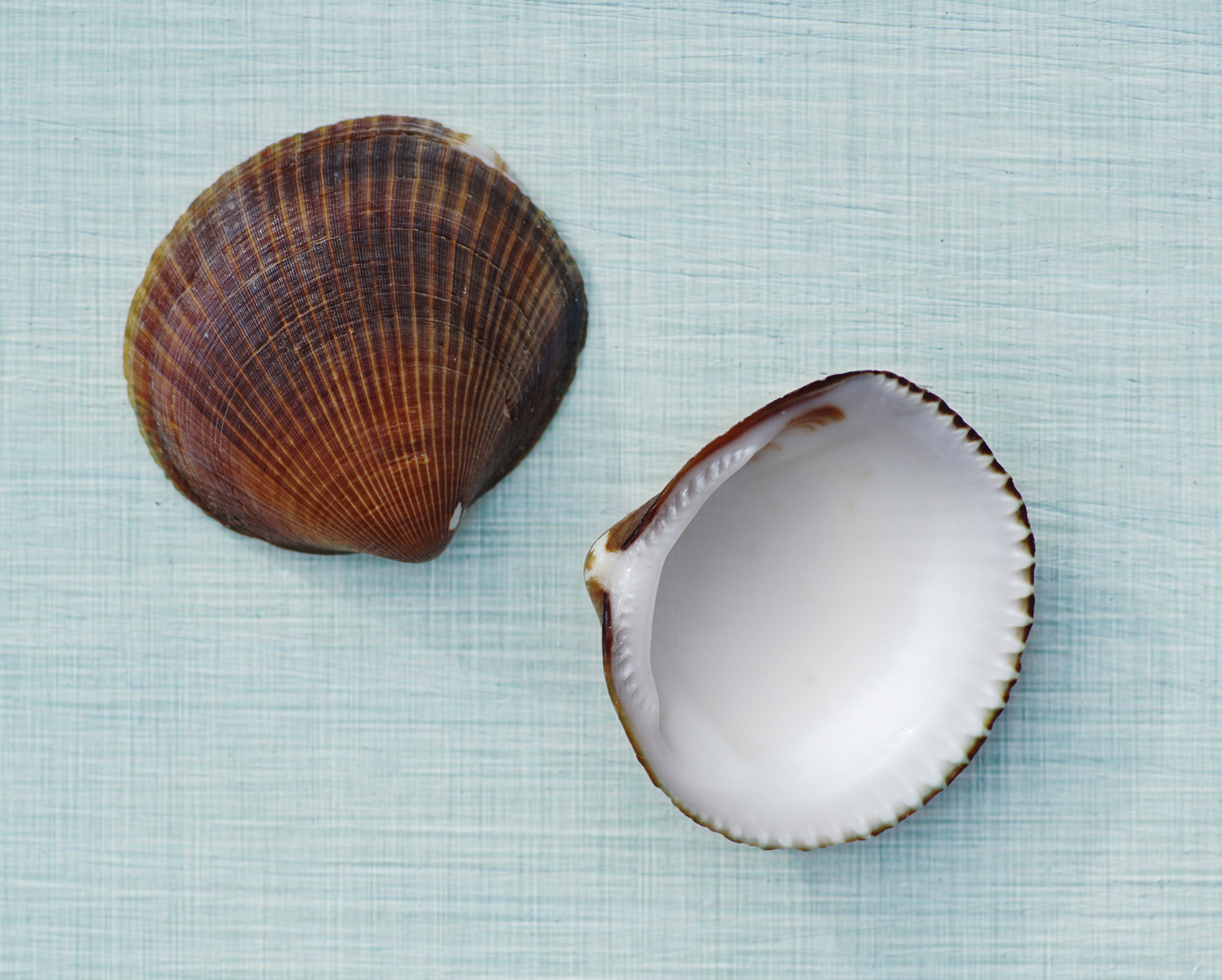
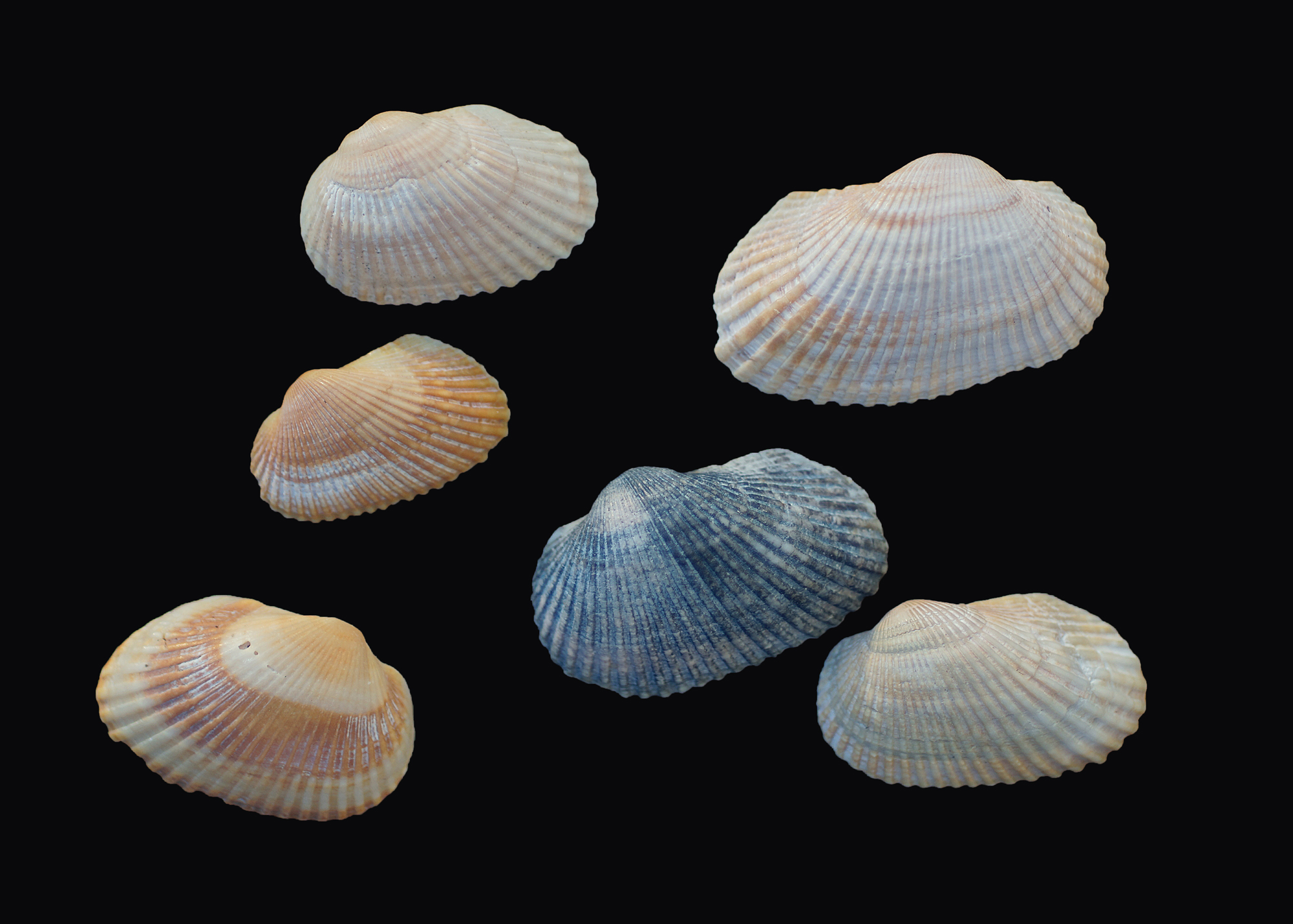
1. Coquina Clam

Coquina Clamshells (Donax variabilis) are inspiring with their display of variable colors of the rainbow. The colors can range from yellowish-brown to blue, lavender to green to pink and typically exhibit a plaid pattern. Their shells are asymmetrical from their pointed beak, slightly elongated and inflated. These are little clams that create the activity you see at the tide line of the surf. With the aid of a fleshy foot, they dart about and can bury under the sand in a twinkling. Apparently, they are sensitive to light and rush to get back into darkness under the sand. They are great in soup, and desired in crafting for their beauty.

  • Size: Up to 3/4 inches
  • Habitat: Sandy shallow subtitle zones
  • Range: Virginia to both coasts of Florida and Texas
Disc Dosinia Clamshell

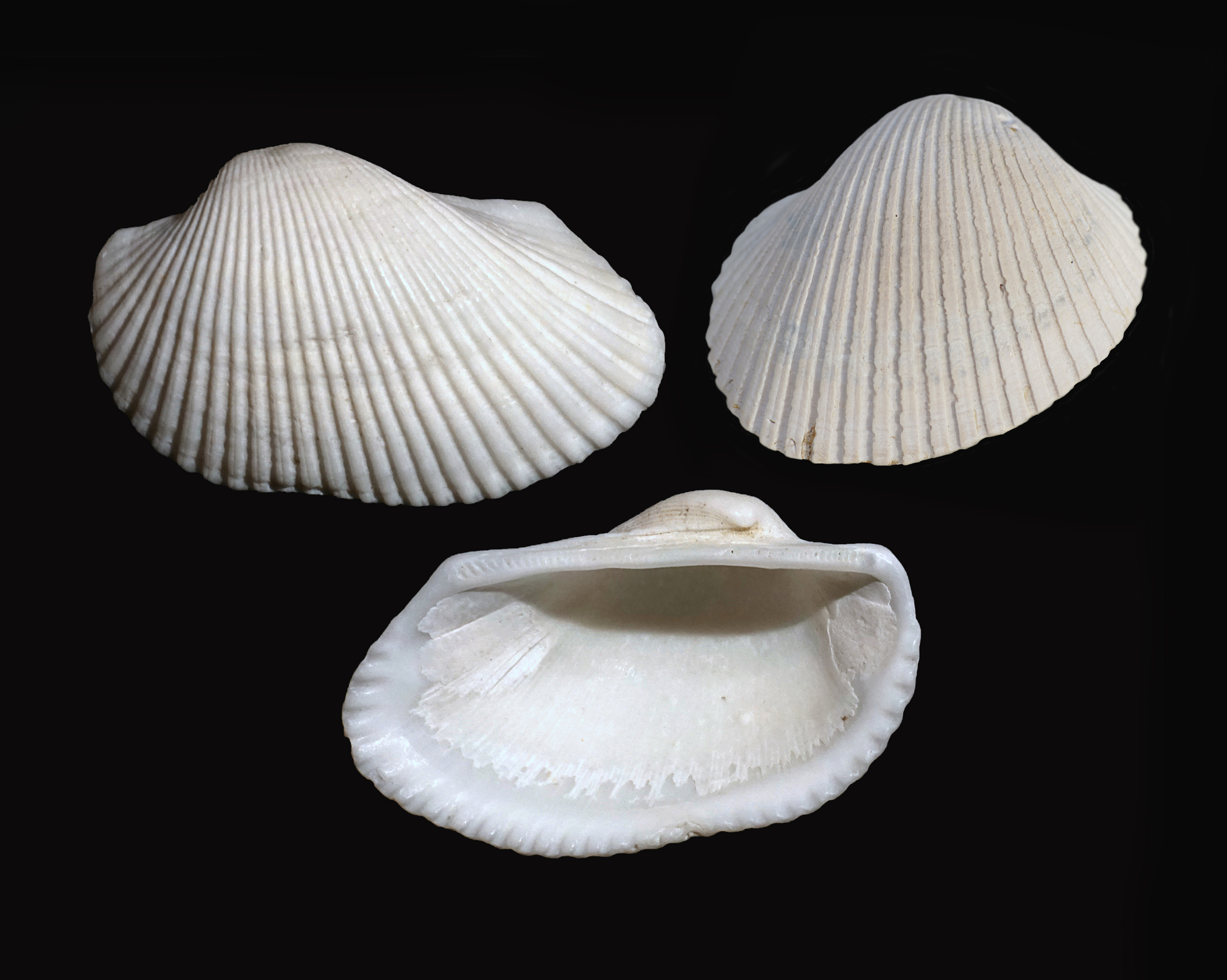
2. Disc Dosinia Clam

The Disc Dosinia clam (Dosinia discus) displays an exterior valve yellowish-white in color with a pure white interior. The valves are moderately thin and quite circular in outline with a small dominant beak. A distinct feature of Disc Dosinia is the fairly even concentric ridges of about 20 to 25 per inch. Another species, Elegant Dosinia, has about 50 ridges to the inch.

  • Size: Average 2 inches, up to 3 inches
  • Habitat: Just offshore in moderately shallow water and paired valves are often commonly found
  • Range: Virginia to Florida, east to the Gulf States and south to the Bahamas
Atlantic Surf Clamshells

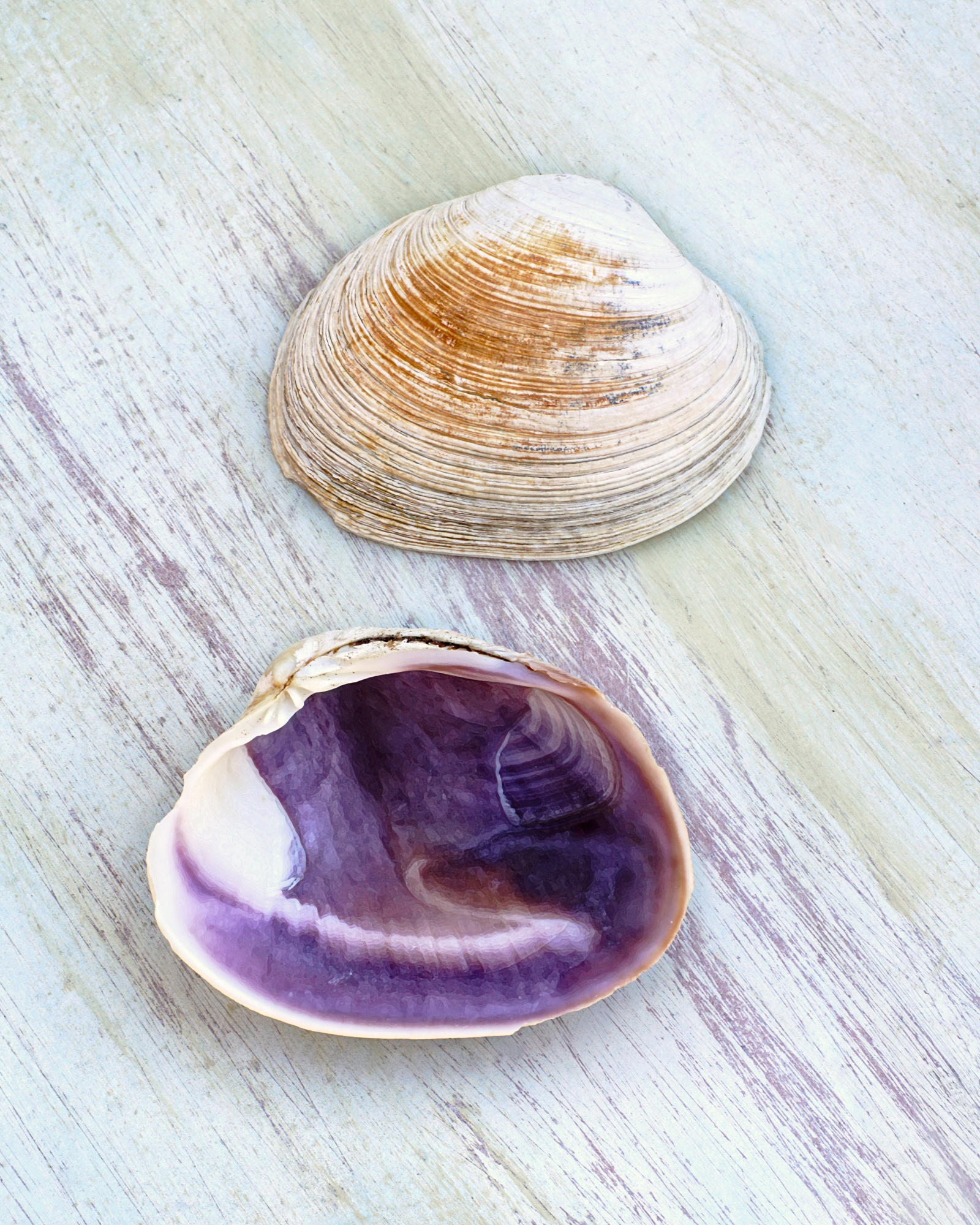
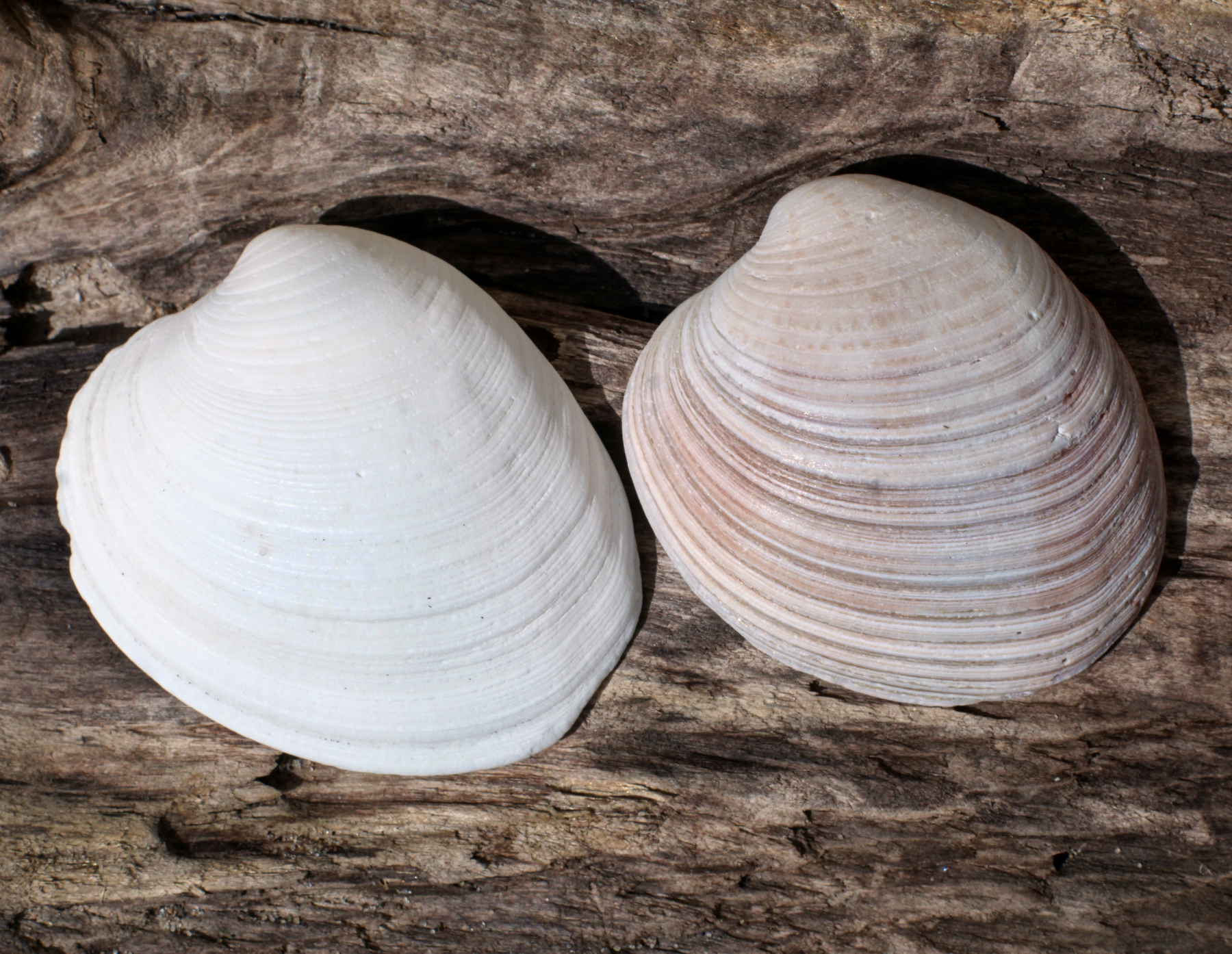
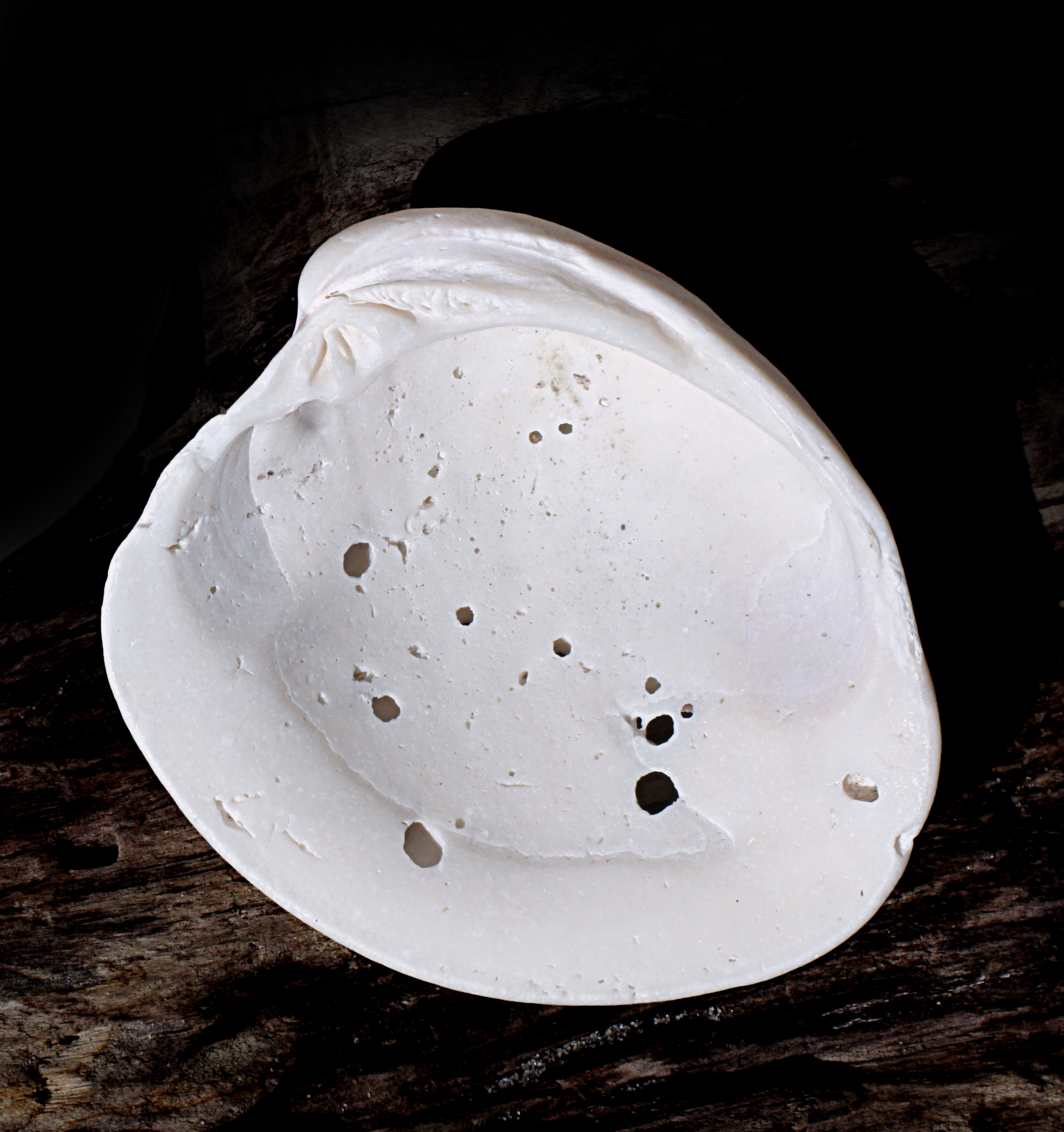
3. Atlantic Surf Clam

The Atlantic Surf Clams (Spisula solidissima), are also known as Hen Clam, Bar Clam, Skimmer Clam, or Sea Clam. They prefer the surf environment on sandy shores feeding on minute plant and animal life that washes back and forth in the waves. After severe storms, beaches are sometimes covered with thousands of these clams! Beachgoers will often pick-up one of their large empty shells to dig with in the sand or take home as a decorative dish. Atlantic Surf Clam valves’ outer surfaces are colored white to yellowish-white, sometimes with added gray. Their interior valves are white with a slight iridescence. The shells are sturdy and triangular-shaped displaying thin concentric growth lines over their exterior shell. They grow fast and large and are prized by humans for their sweet flavor. U.S. wild-caught Atlantic Surf Clam is a smart seafood choice because it is sustainably managed and responsibly harvested under U.S. regulations. They can live up to 35 years.

  • Size: Up to 3 inches
  • Habitat: Warm coastal water near shore, typically in surf waters
  • Range: Predominantly from Nova Scotia, Canada to North Carolina and as far south as Florida to portions of the Gulf States
Eastern Oyster Clamshell Collage

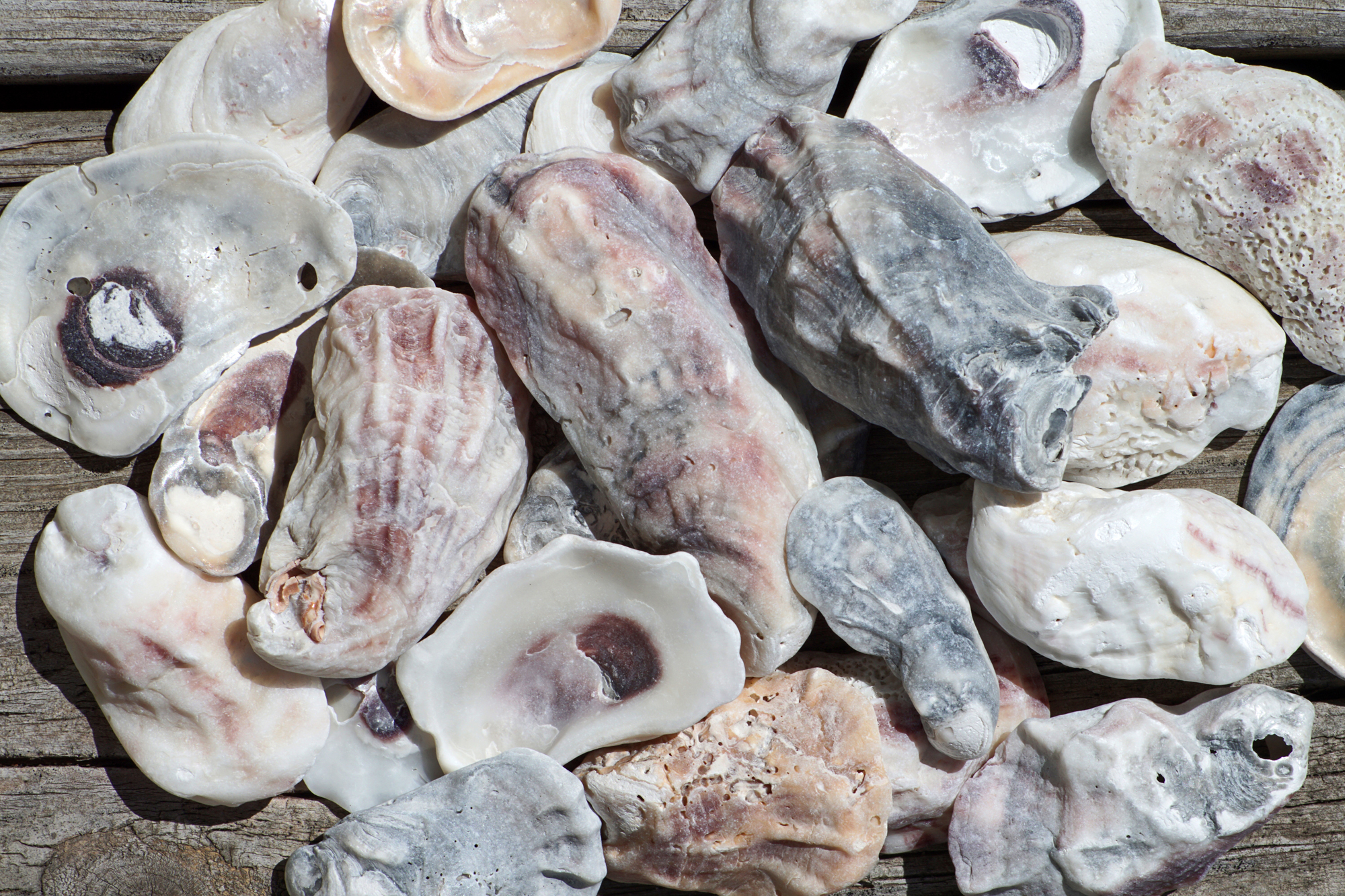
4. Eastern Oyster

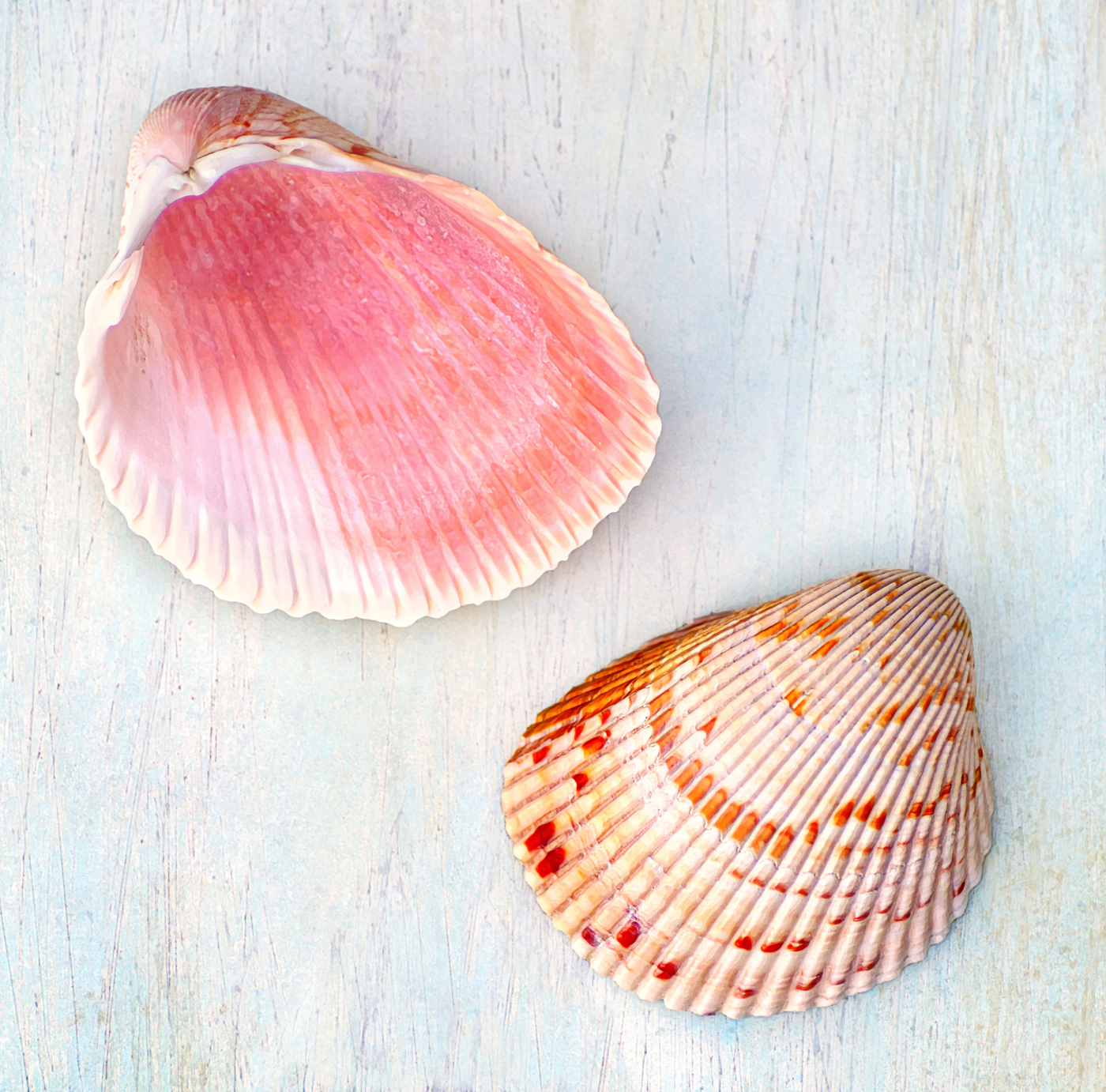
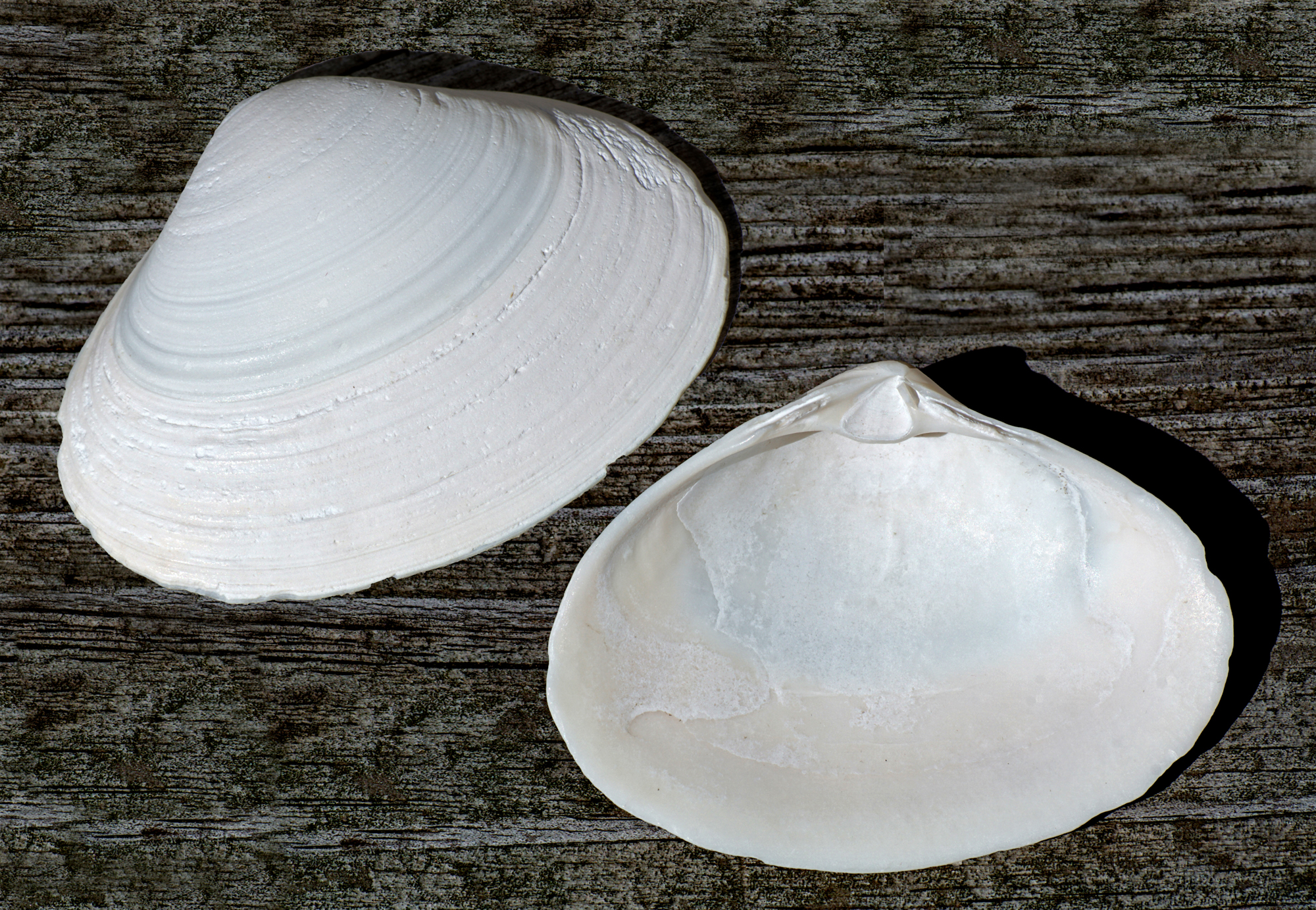
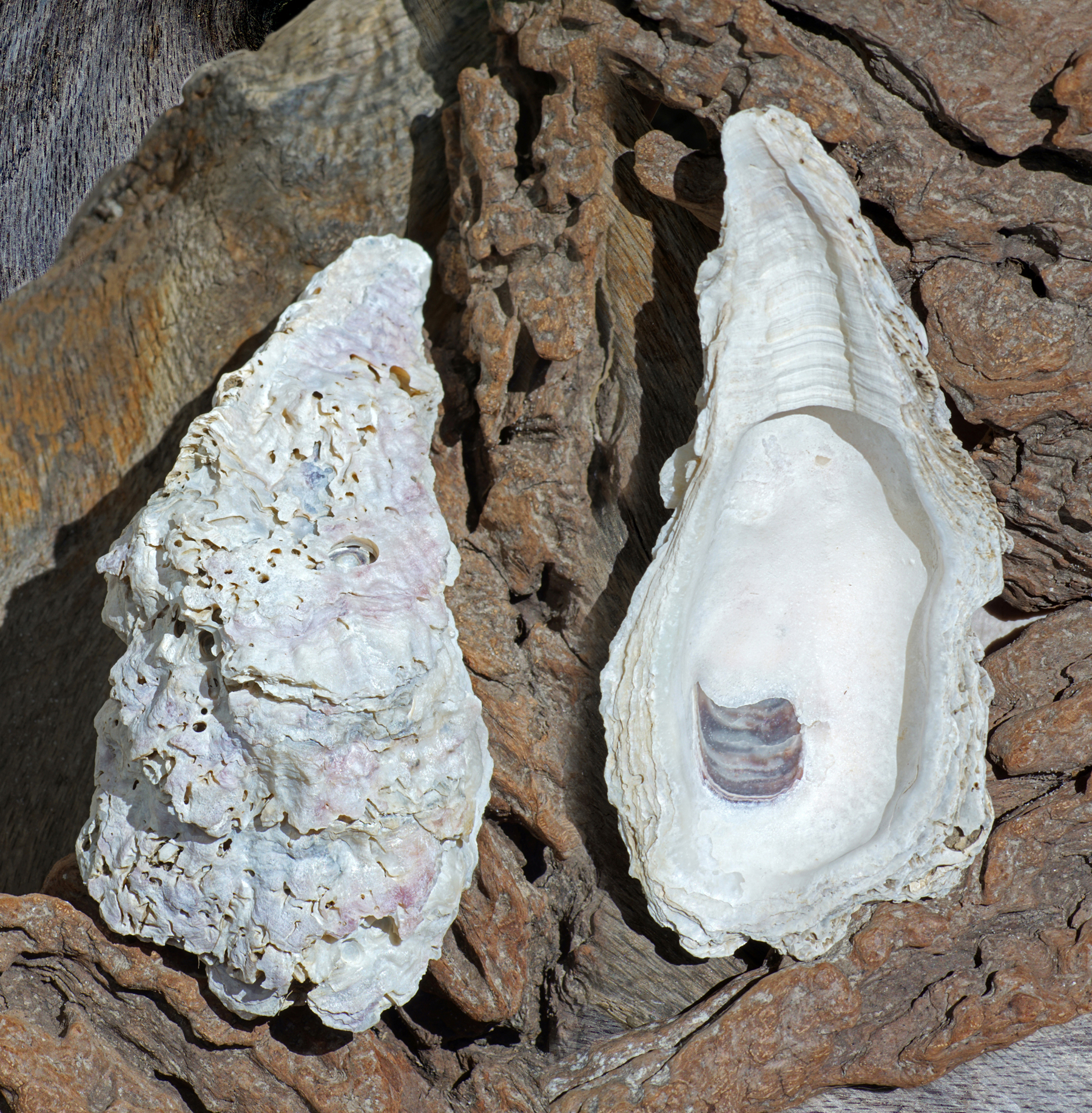
The Eastern Oyster (Crassostrea virginica) can go by several names, including, Wellfleet Oyster, Atlantic Oyster, Virginia Oyster, or American Oyster. Their shell is heavy and possesses a teardrop-oval shape that varies greatly. Sometimes they have scaly concentric layers over their outer surface, and sometimes with irregular concentric rings, and yet sometimes with irregular vertical ribs. It’s interesting to note that they can grow to any shape necessary. The Eastern Oyster shell varies in color from white to gray to tan, or with pinkish markings. The right or top shell is flat with a purple muscle scar on the interior, while the bottom shell is cupped with a dark muscle scar.

Eastern Oyster Shell (Exterior/Interior)

Eastern Oysters are very popular commercially. Today, less than 1% of the original oyster population that lived during 17th-century when the origianl colonists arrived is thought to remain in the Chesapeake Bay and its tributaries. The Eastern Oyster is the state shellfish of Connecticut, and its shell is the state shell of Virginia and Mississippi, and the shell in its cabochon form (polished) is the state gem of Louisana.

  • Eastern Oyster Quick Facts
  • Eastern Oysters exhibit fast growth and reproductive rates.
  • They originally mature as males, then later develop female reproductive capabilities.
  • An adult oyster can filter up to 50 gallons of water in one day.
  • Oysters can live out of the water during cooler months for extended periods.
  • These oysters often attach to one another, forming dense reefs that provide habitat for many fish and invertebrates.
  • They are sought after for their creamy white meat and firm texture with a mild, sweet flavor.
  • Size: Average 3–5 inches, Up to 8 inches
  • Range: Brackish and saltwater from shallow bays 8 to 35 feet deep, often concentrated in oyster beds or rocks
  • Habitat: From Nova Scotia, Canada, south to Florida, east to the Gulf of Mexico and further south as far as Venezuela
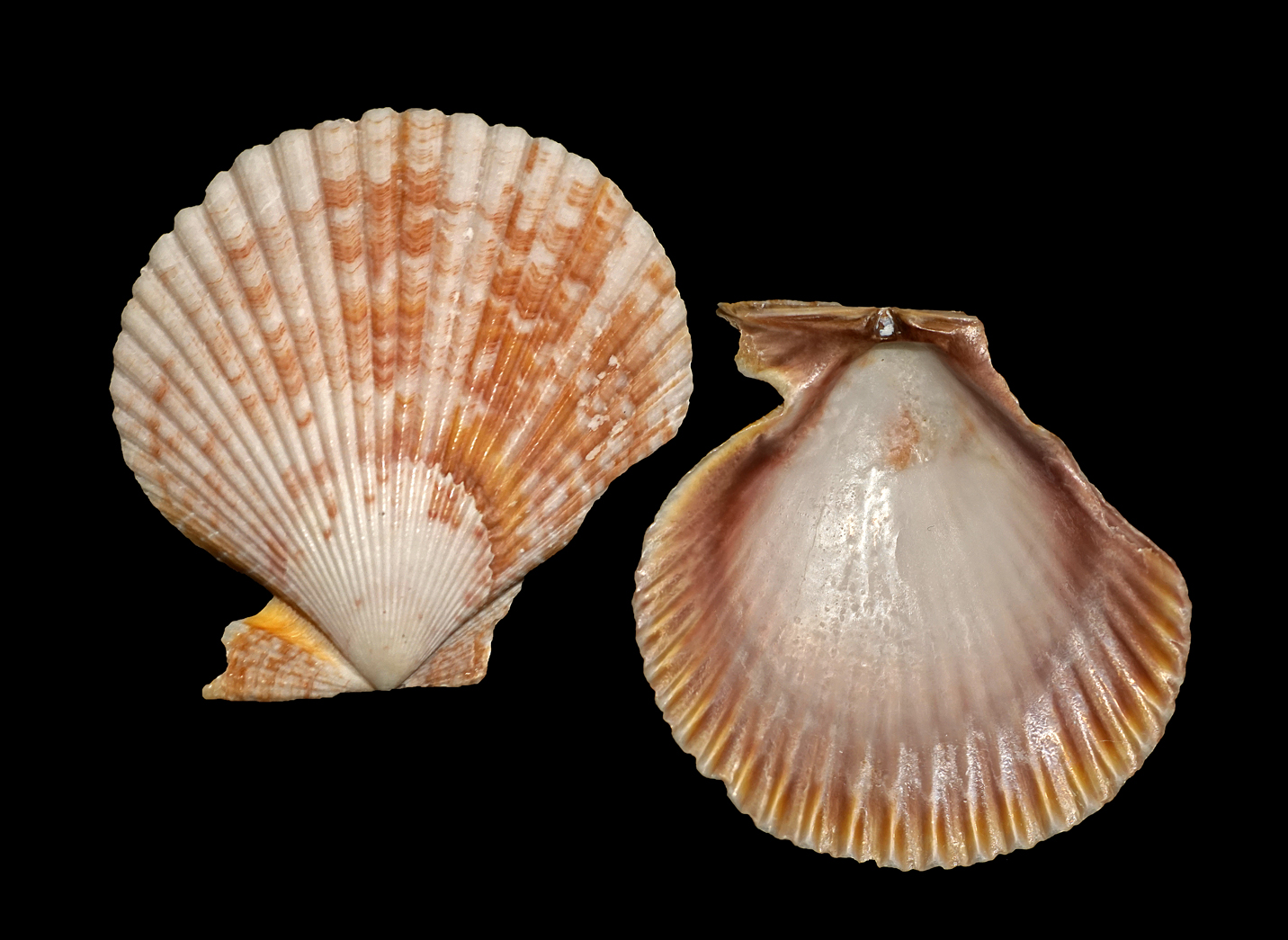
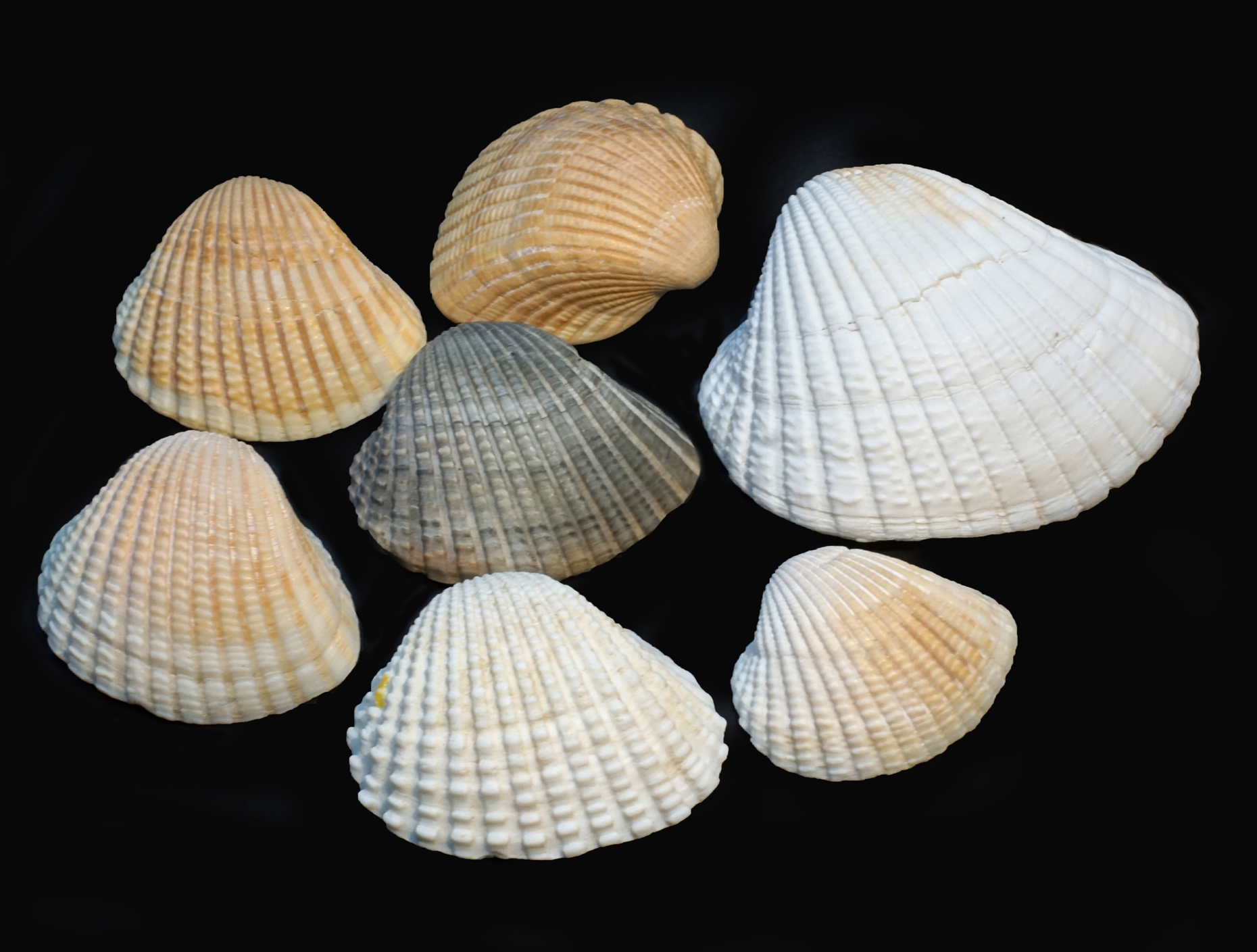
Spiny Jewel Box Oyster Shells Photo

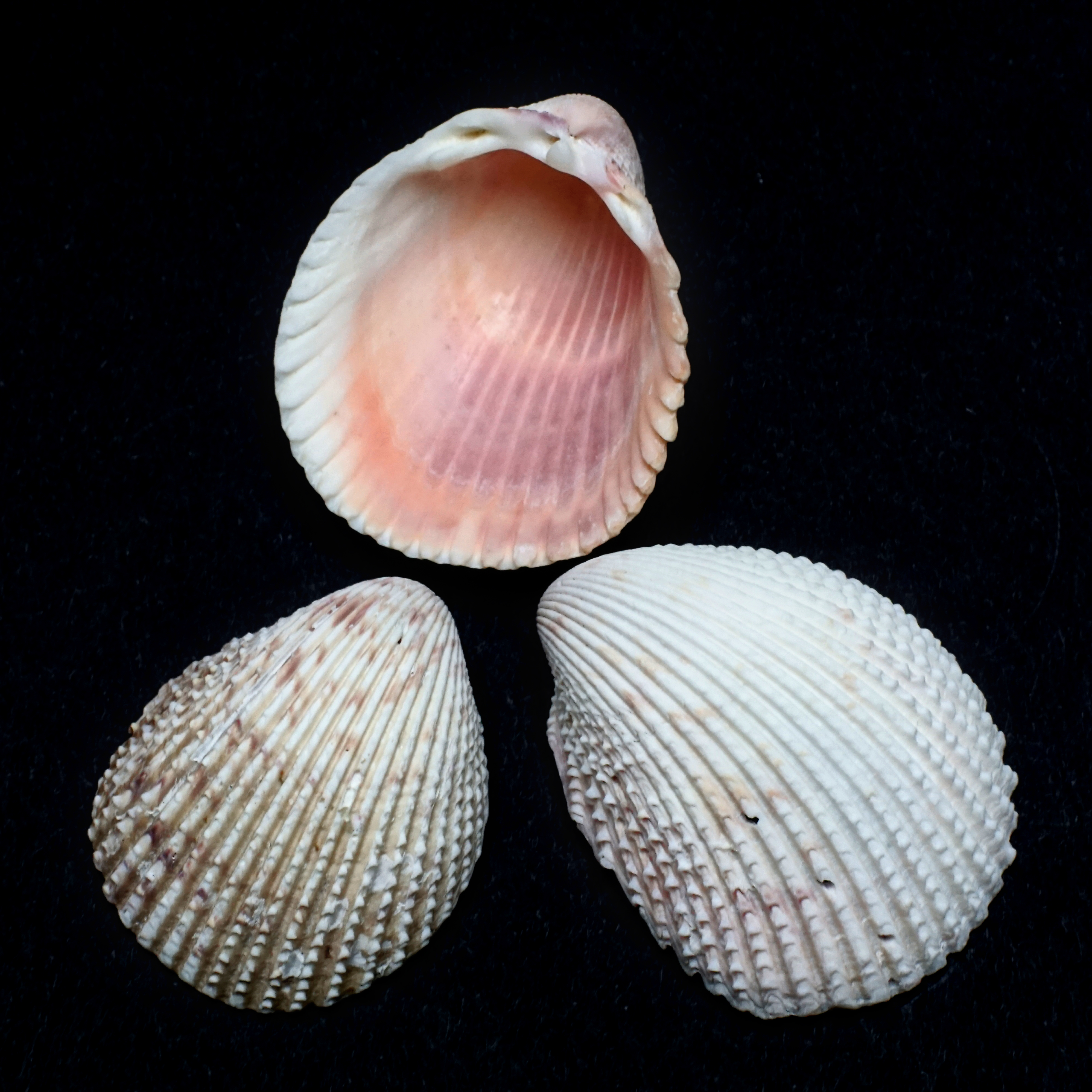
5. Spiny Jewel Box Oyster

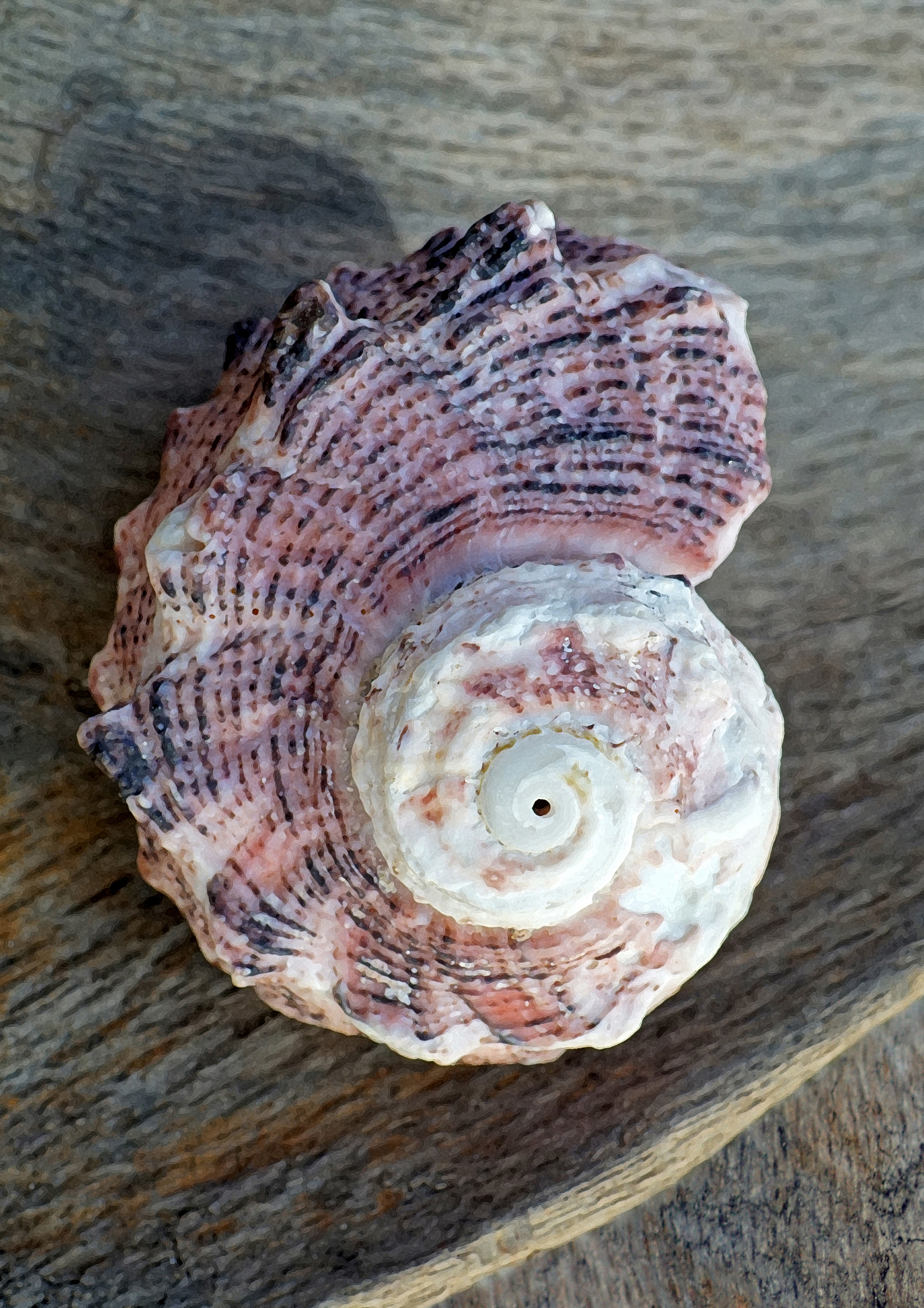
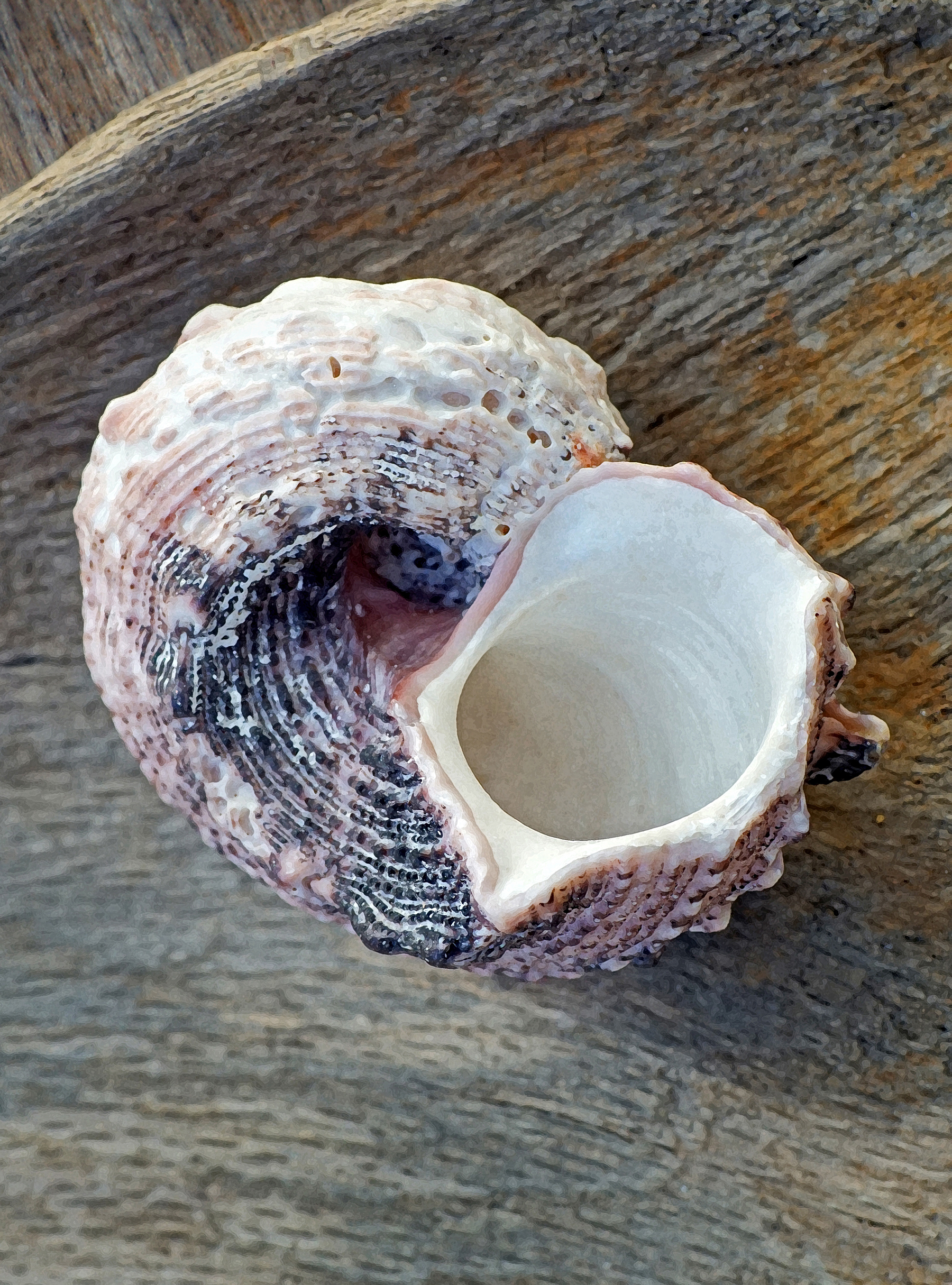
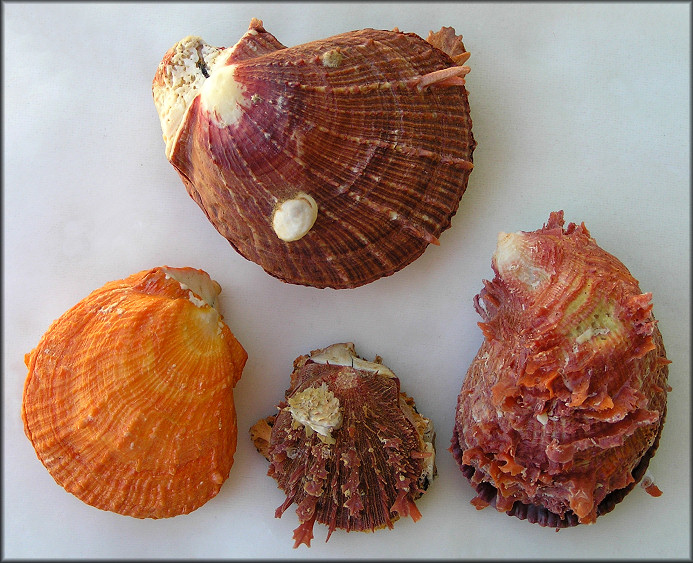
The Spiny Jewel Box Oyster (Arcinell acornuta) possesses a thick, strongly curved shell with knobs or longer spikes along 7–9 rows of spines. Fresh specimens have extended spikes and resemble the thorny oyster described below. The spikes become worn down by the surf and sand like the pair in my example, or the spikes can break off entirely. They can dipsly a variety of colors including white, yellow, pink, purple, orange and even sometimes green, often with combinations of these shades, making them look like colorful jewels on the beach. Their colors vary by species and can include bright hues like magenta and deeper tones, with some even showing iridescent effects, creating diverse and beautiful shells. This bivalve animal attaches itself to an offshore rock or substrate. This answers the question why beachcombers rarely find these beautiful bivalves in their full glory with both valves attached. Also, because they cement themselves to objects, their shells can be irregular and variable in shape.

  • Size: Up to 2 inches
  • Habitat: Attached to rock, coral or shells in warm shallow water (sometimes in deep water) and exposed to air during low tide. Later in life, they become detached
  • Range: North Carolina to Florida and the Gulf of Mexico
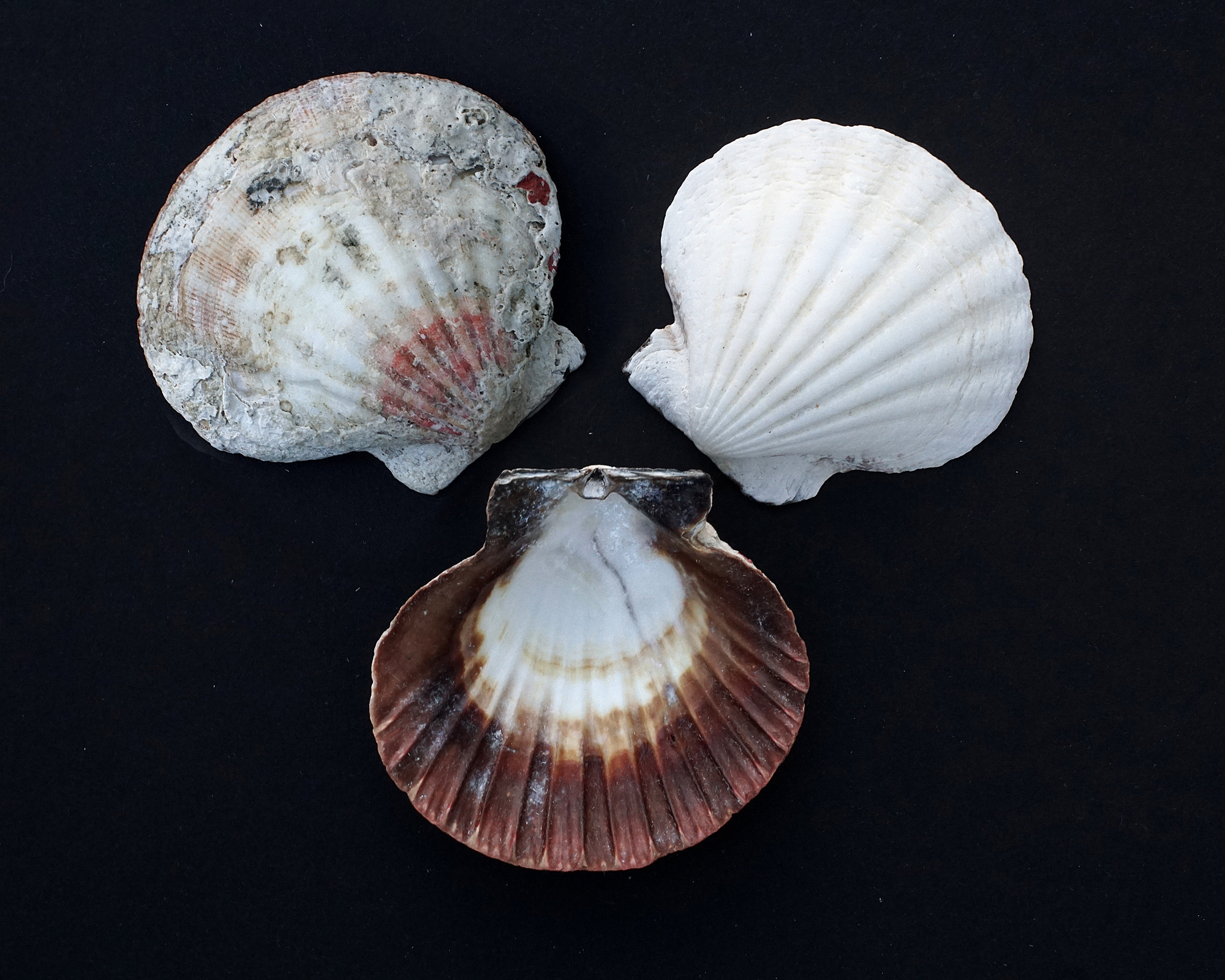
Atlantic Thorny Oyster Shell

6. Atlantic Thorny Oyster

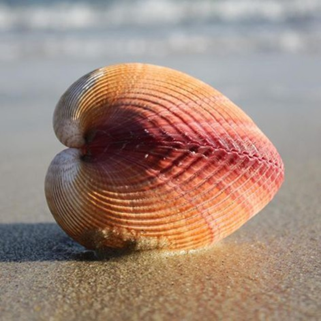
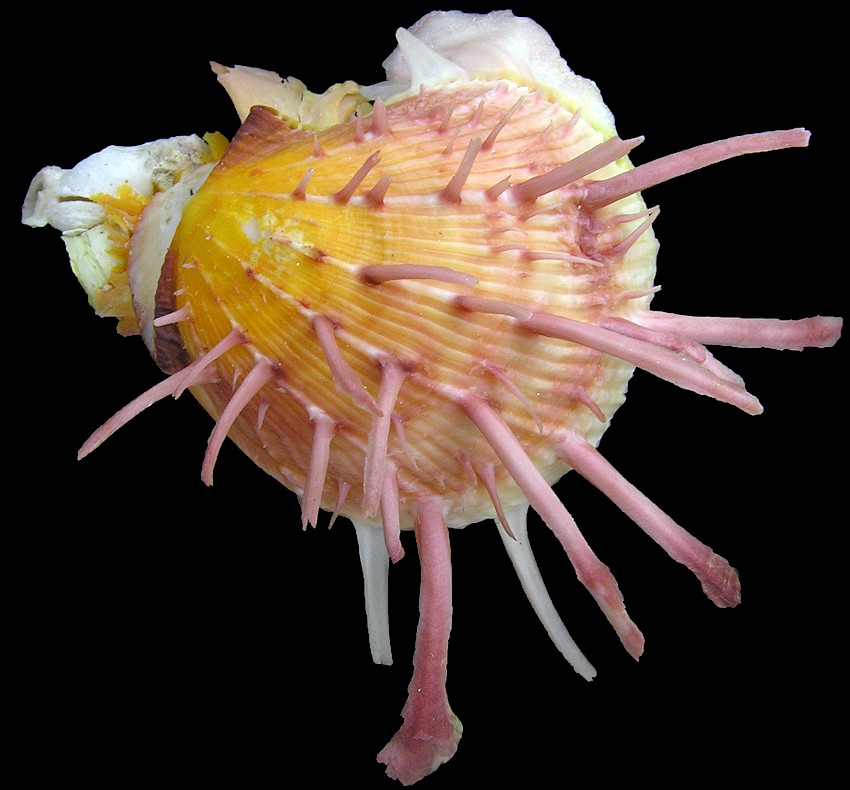
Atlantic Thorny Oyster (Spondylus americanus) shells normally show the telltale protruding thorns or spines, but after the animal dies and washes-up on the beaches, it typically loses its thorns due to wind and surf, which is likely what happened to my sample shown above. Thorny oysters possess a thick shell with a vibrant spectrum of colors, including bright orange, deep red, rich purple, yellow, pink, cream, and white, often with combinations or banding. They can be circular, oval, or irregular in shape. While they often have a generally round outline, their shape is highly adaptable, allowing them to conform to the crevices or surfaces whereever they attach.

Atlantic Thorny Oyster with Spines: Source
  • Size: Up to 5 inches  
  • Habitat: Deepwater reefs, especially in areas with high sedimentation. It is often lodged in a crevice or concealed under an overhang
  • Range: North Carolina and Texas southwards to Venezuela and Brazil

Digitate Thorny Oyster Shell with Tubeworm Casing Burrow

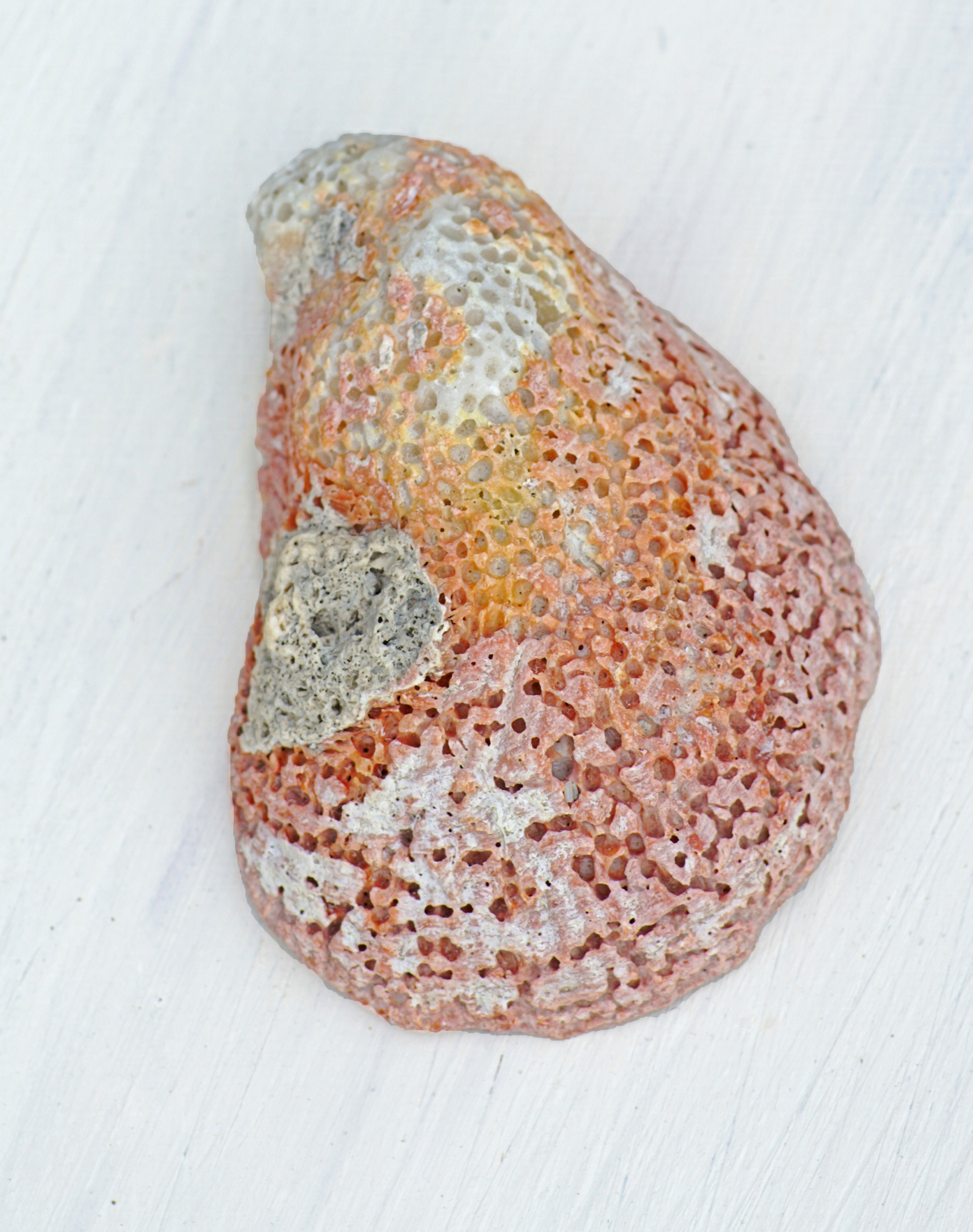
7. Digitate Thorny Oyster

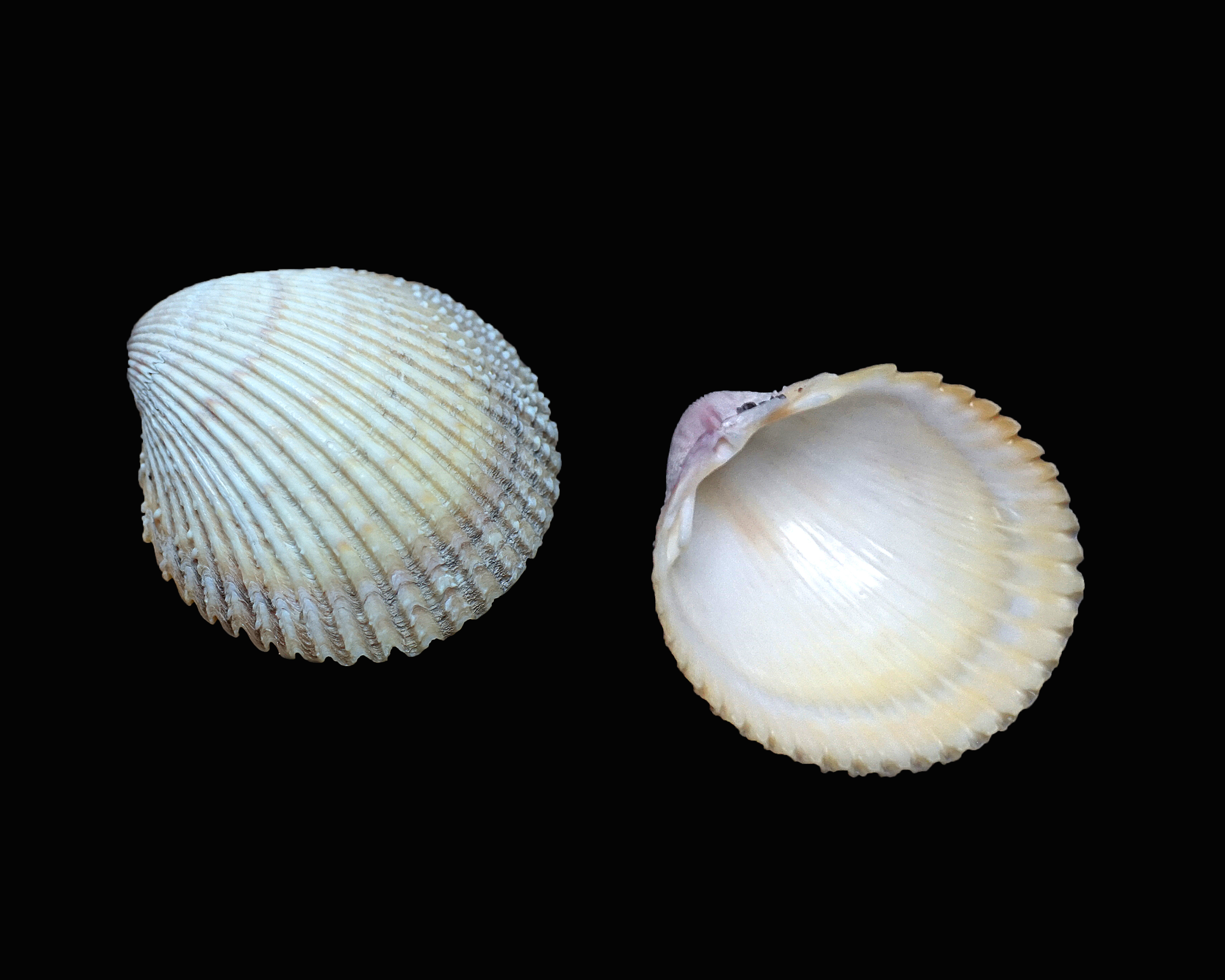
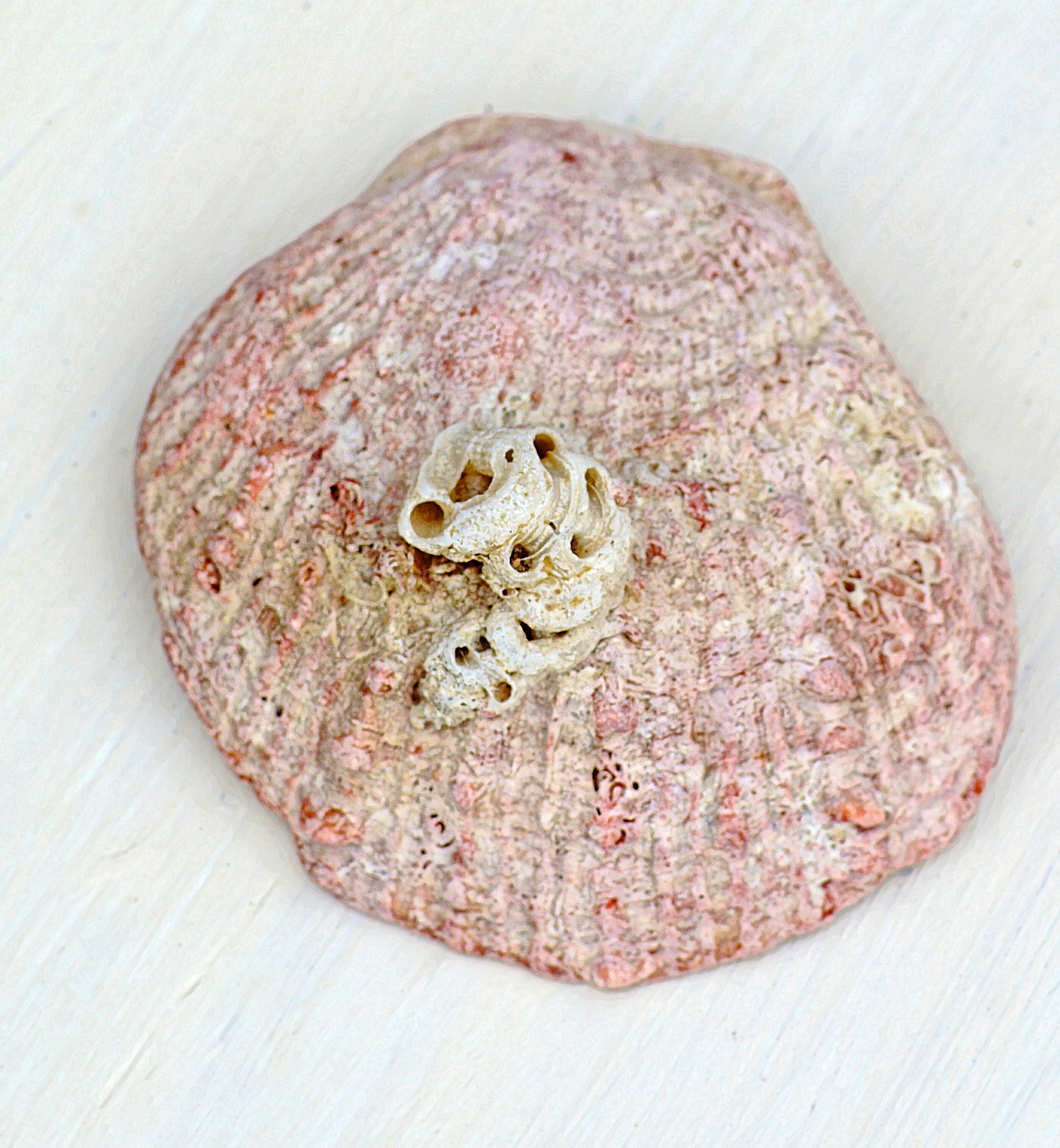
Digitate Thorny Oyster (Spondylu stenuis) is often mistaken for the Atlantic Thorny Oyster (Spondylus americanus). There are many species of Thorny Oysters from the genus “Spondylus” that vary considerably in appearance and range. They are also known as Spiny Oysters. However, they are not true oysters, yet they share some habits such as cementing themselves to rocks or other hard surfaces almost always with their lower valve. They are actually more closely related to scallops. Also, the two halves of their shells are joined with a ball-and-socket hinge rather than with a toothed hinge, which is more common in other bivalves.

Digitate Thorny Oyster: Source

The Digitate Thorny Oyster displays a thick lumpy shell most often with thorns, although they have fewer than most spiny oysters and are generally thicker, shorter and flatter rather than pointy. Their spines often break off or are lost after the animal dies, frequently appearing as “naked” or smooth shells on beaches. Some varieties are whitish, pink, reddish or orange. Interior is whitish with a wide darker band around the perimeter. Note: The example above of the Digitate Thorny Oyster has a tubeworm casing attached to it.

….

  • Size: Average 3 inches, up to 5 inches
  • Habitat: Attach to coral reefs or rocky reefs depending on species in shallows or in deeper waters
  • Range: North Carolina around Florida to Texas, southwards to Venezuela and Brazil
Jingle Shell Oyster Shells

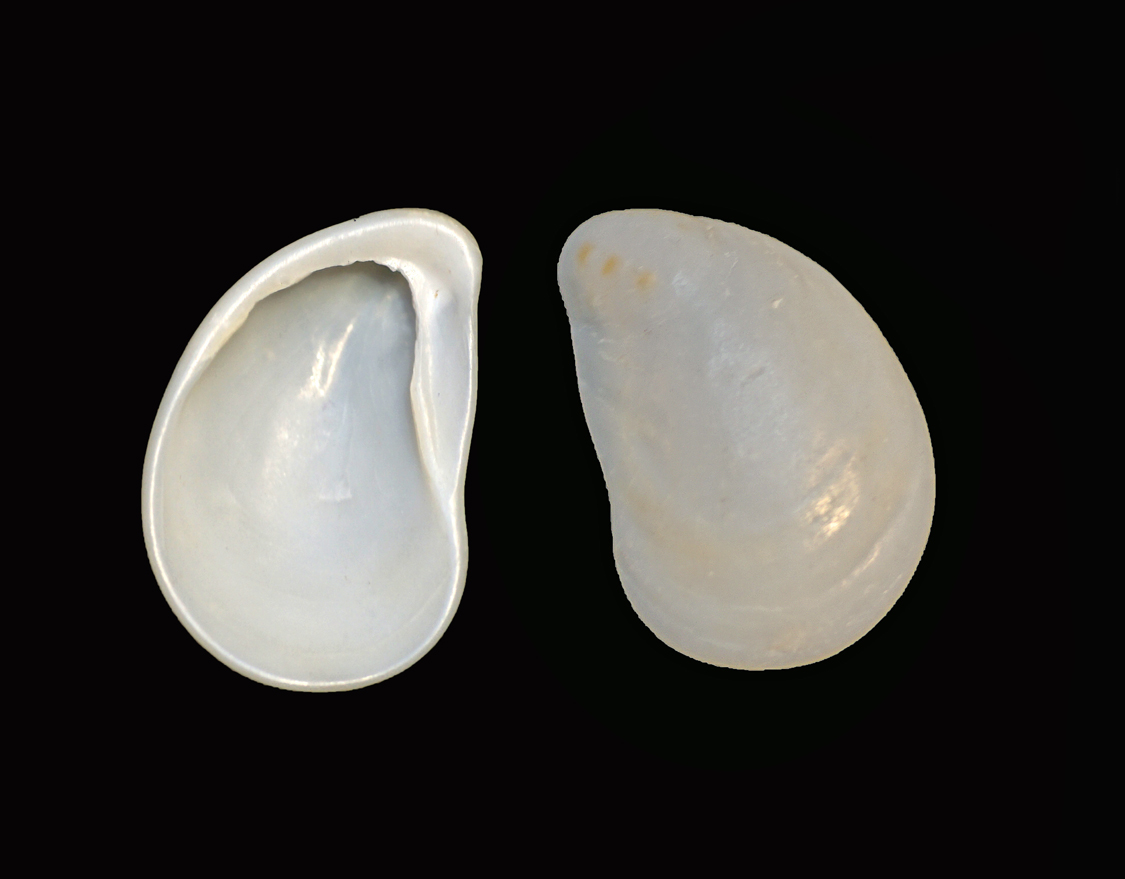
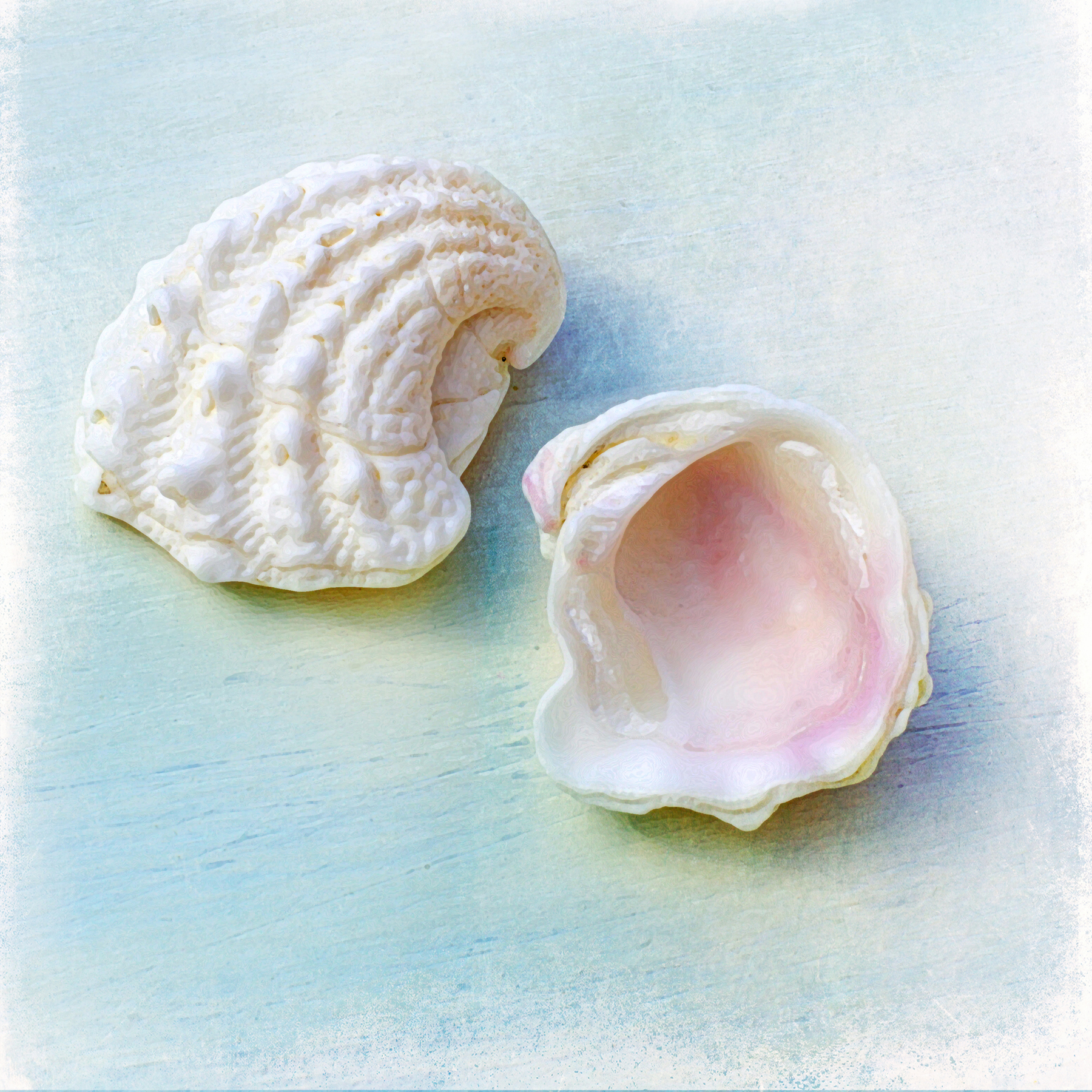
8. Jingle Shell Oyster

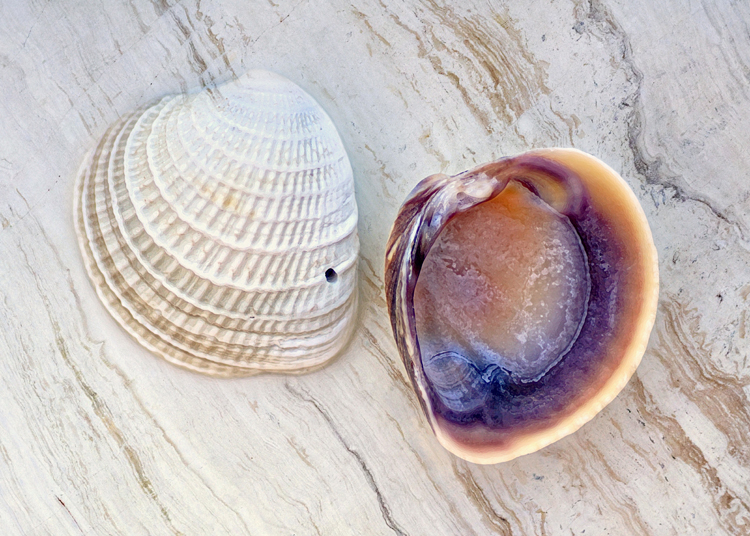
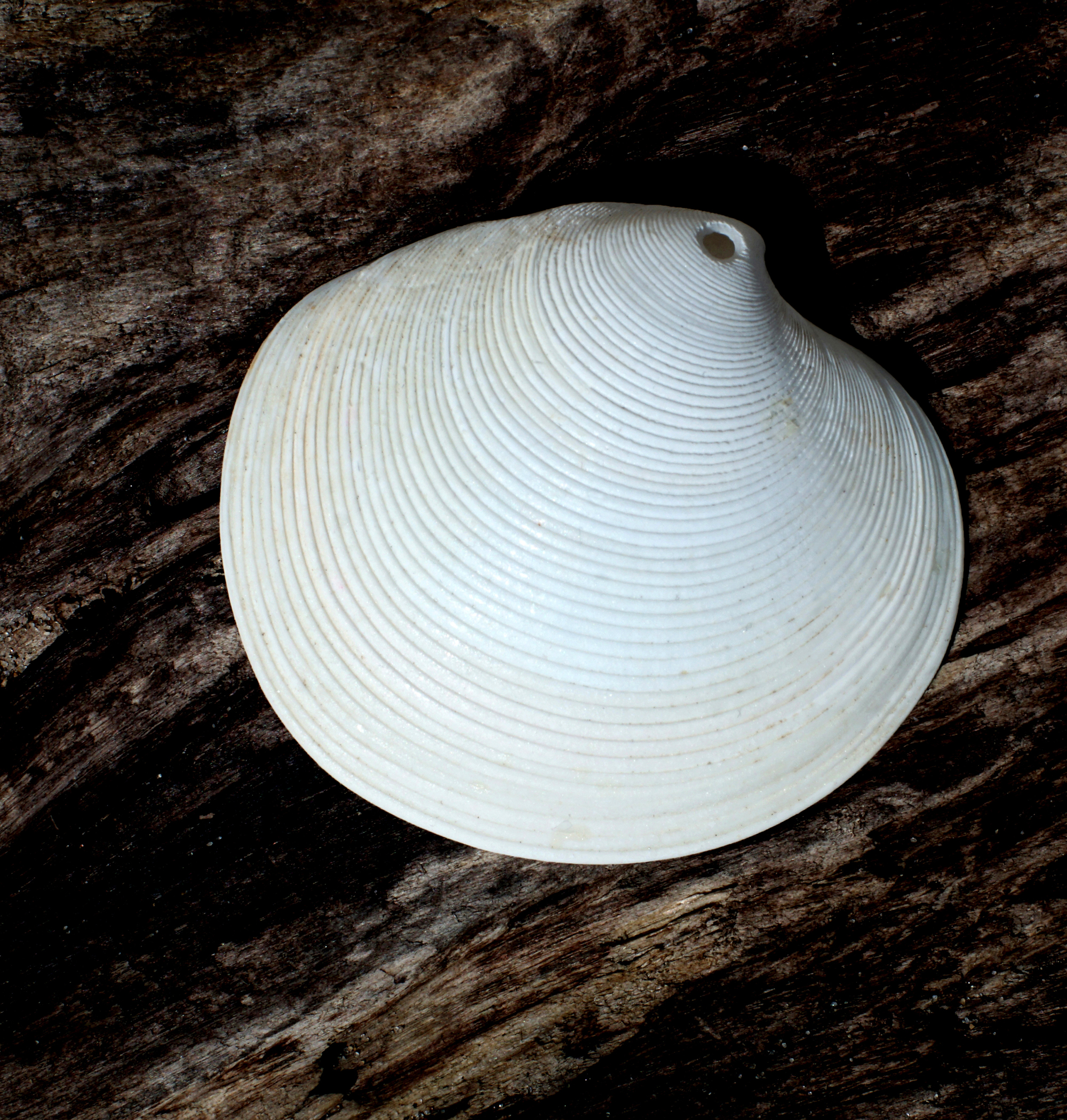
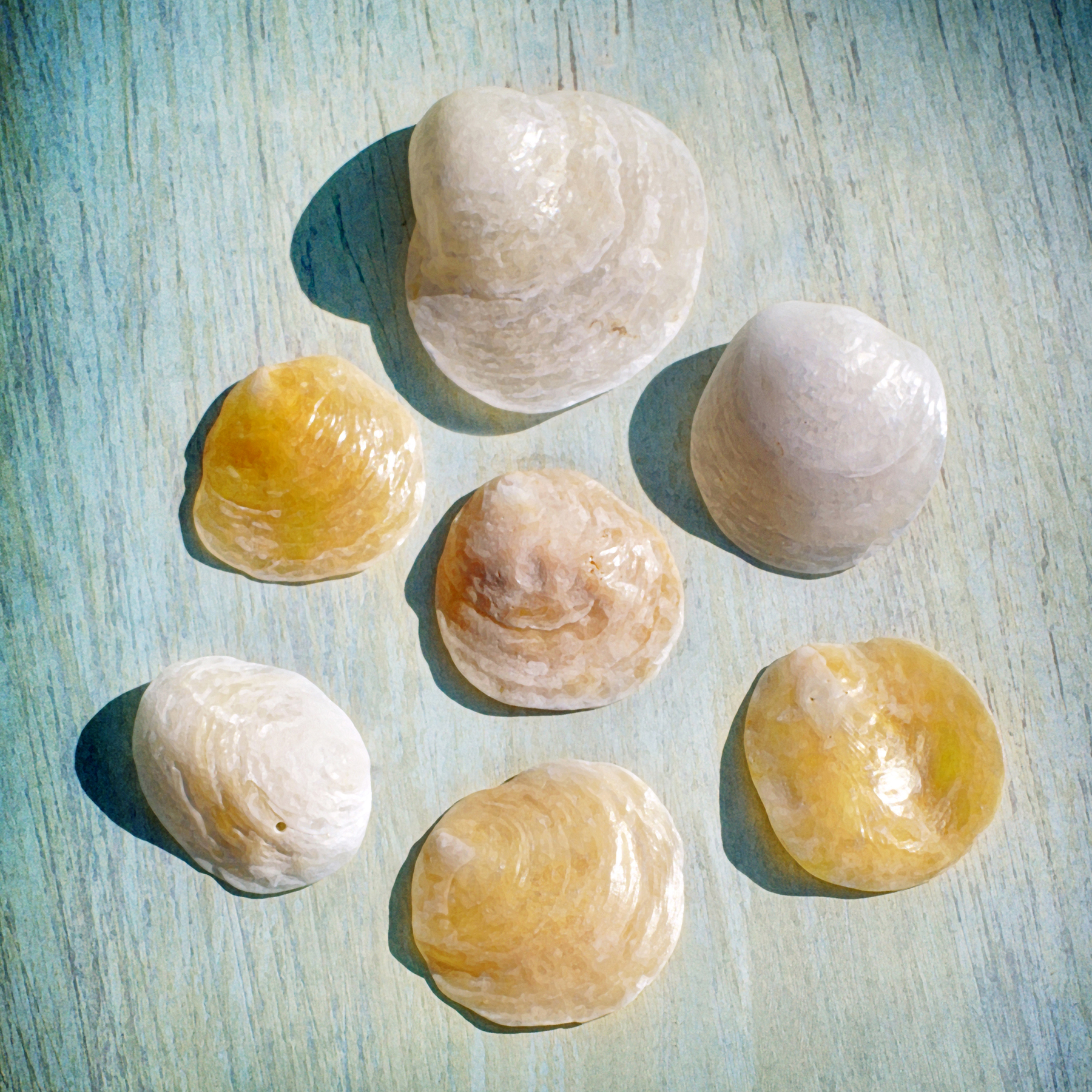
The Jingle Shell Oyster (Anomia simplex) also known as Mermaid’s Toenail and Saddle Oyster, is a bivalve with thin, translucent, irregular shaped, pearly valves. The exterior valve is curved, usually yellow, silver, whitish or orange, and the interior valve is flat and whitish with a hole at the apex. It has a fleshy appendage (byssus) which passes through the hole to anchor itself upon rocks, seaweeds, or old shells. Consequently, usually only the upper valve washes ashore. Jingle Shells are often attached to submerged objects so thickly that one grows on top of another. Consequently, oyster dredges will bring them up in quantity. People use them for crafting and they make lovely wind chimes that create a sweet sound.

  • Size: Up to 2 inches
  • Habitat: Shallow waters, beaches, oyster beds, and mollusk shells.
  • Range: Nova Scotia, Canada to Florida, Texas and the West Indies
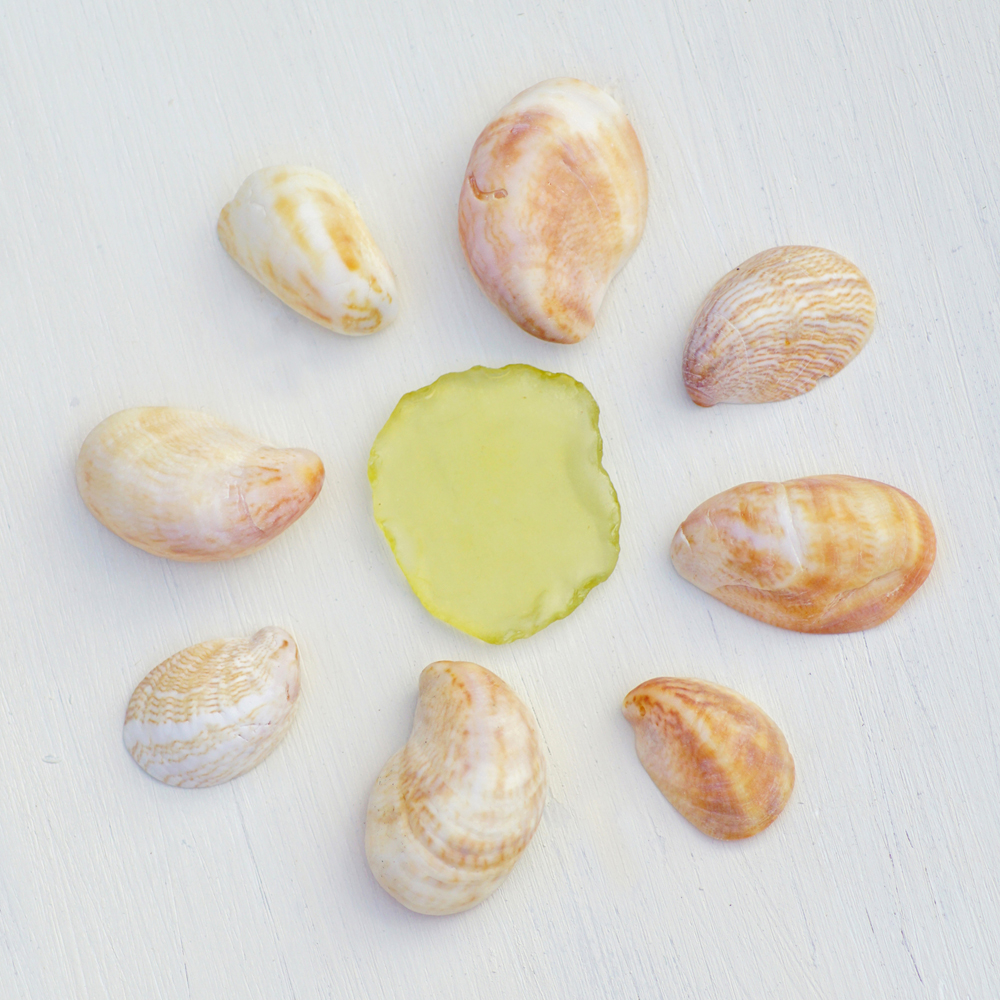
Atlantic Kitten Paw Clamshells

9. Atlantic Kitten Paw Clam

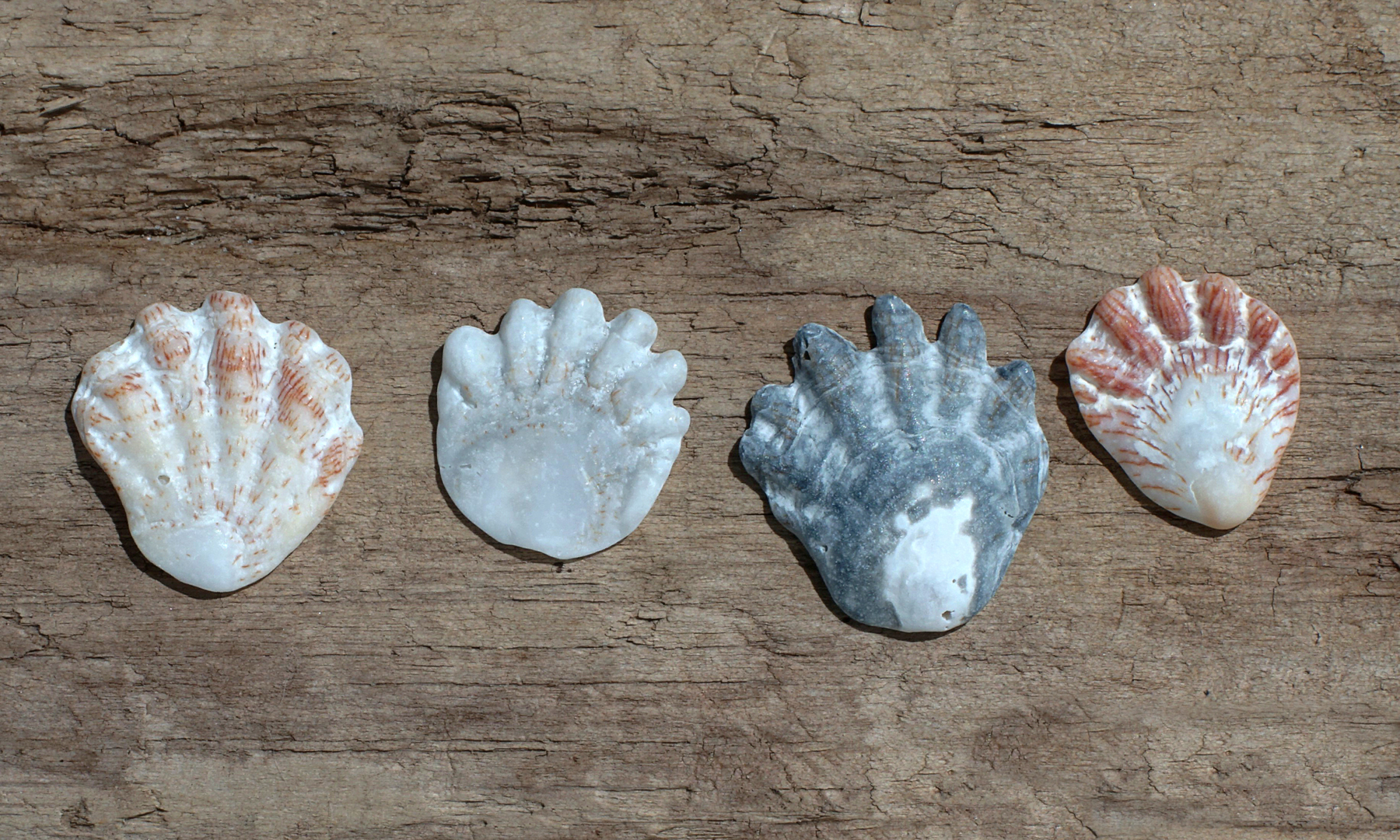
Atlantic Kitten Paws (Plicatula gibbosa) are related to oysters and sometimes are called Cat’s Paw. Still, I prefer the former as they are tiny little seashells no bigger than a penny and too cute to be associated with the mighty hunter. Their valves vary in color and are almost flat, but tough, with a bumpy texture and show an irregular triangular shape resembling their name. They typically attach themselves to rocks using the left valve, so it’s more common for seashell hunters to find the right valve onshore.

  • Size: Up to 1 inch
  • Habitat: Offshore in sandy substrate up to 300 ft (91m) depth
  • Range: From North Carolina to Florida, east to Louisiana and as far south as the West Indies
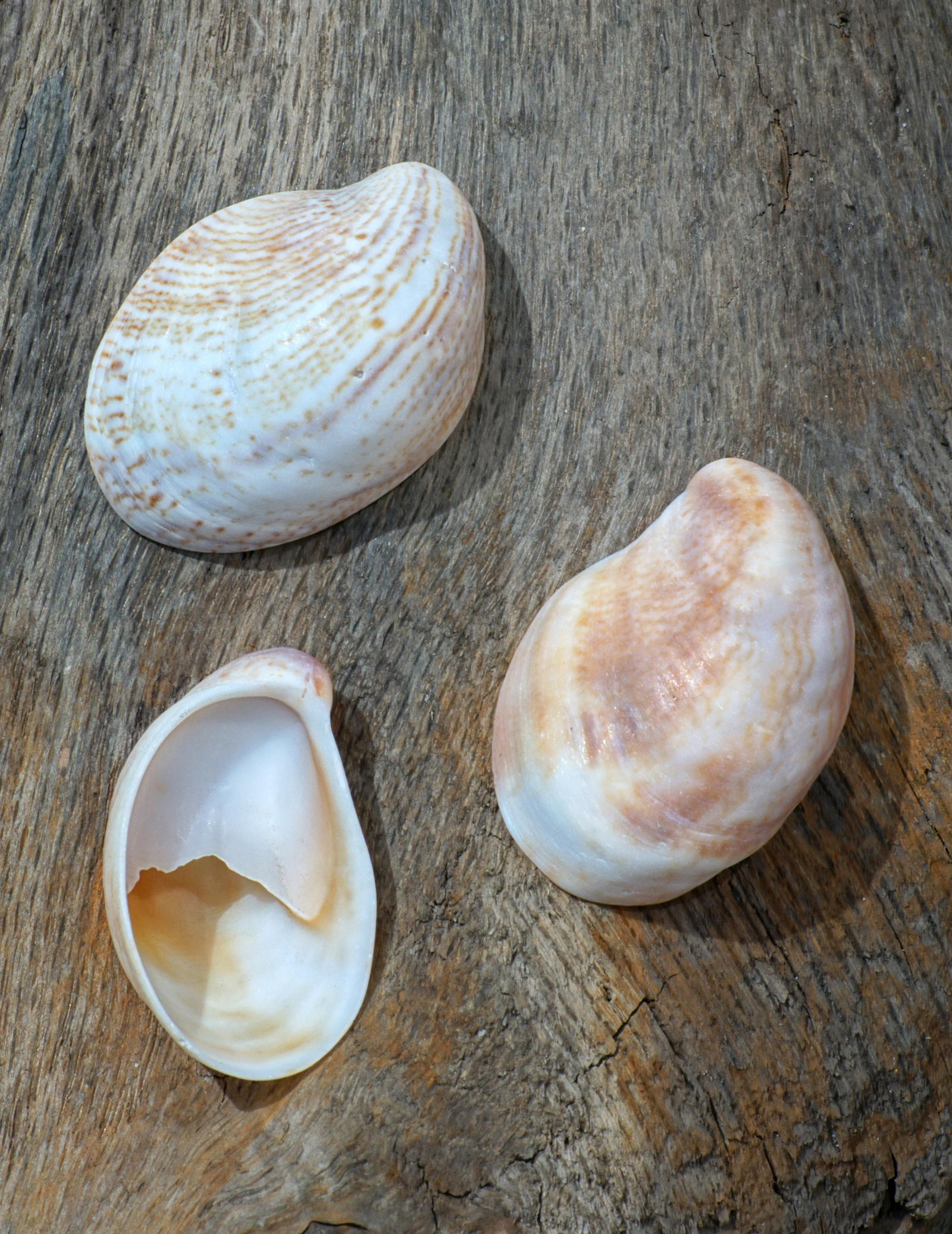
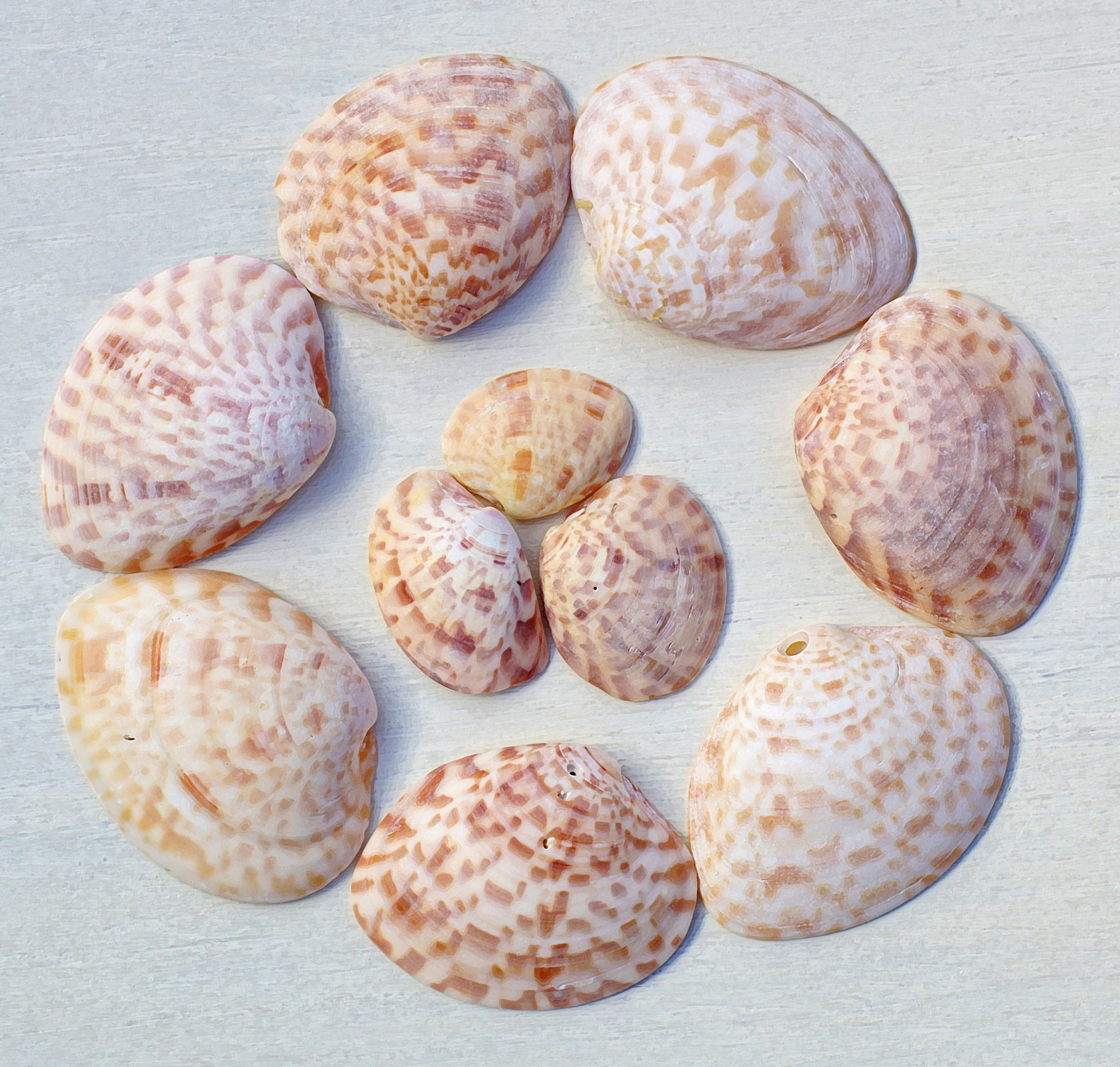
Tampa Tellin Clamshells

10. Tampa Tellin Clam

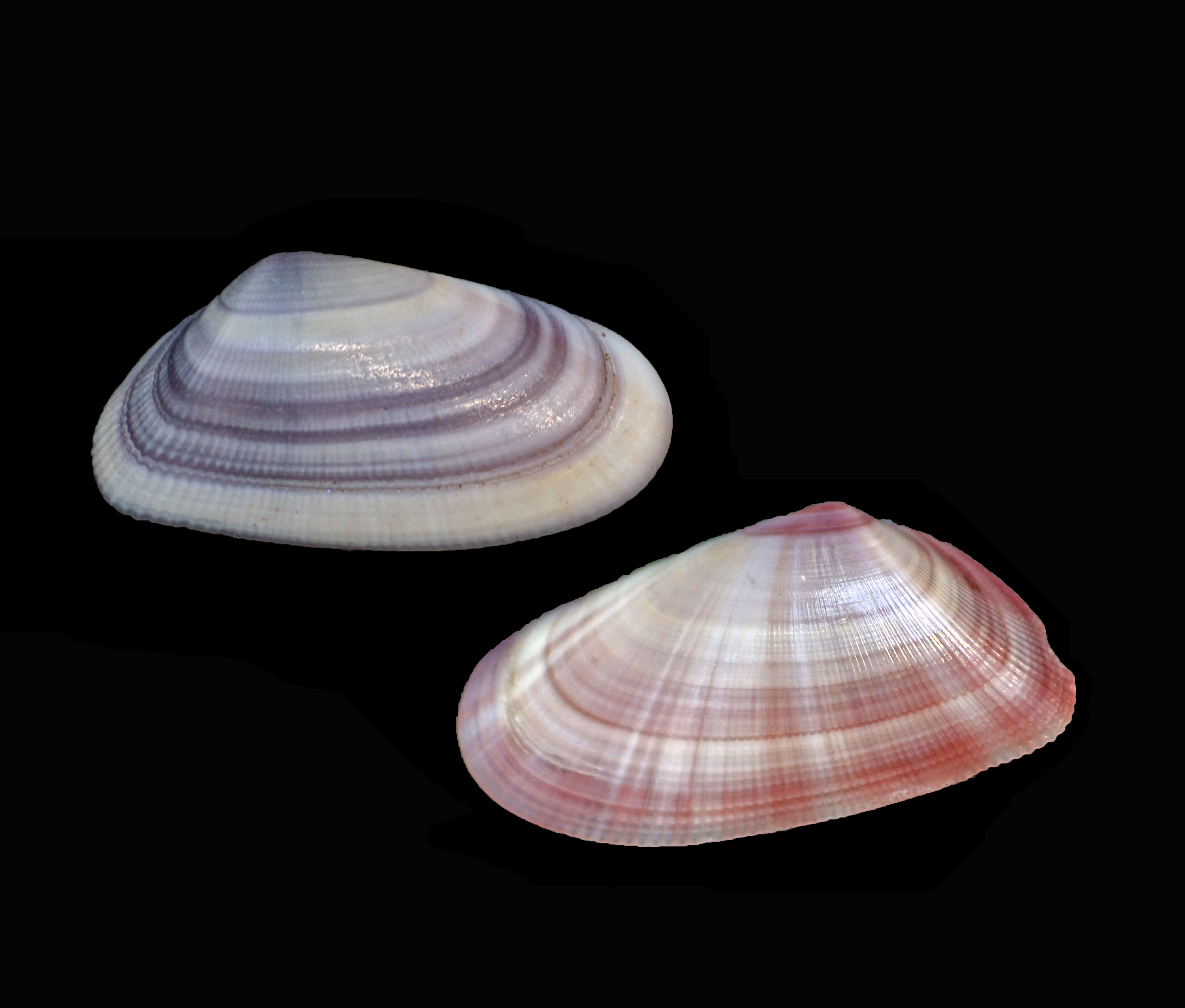
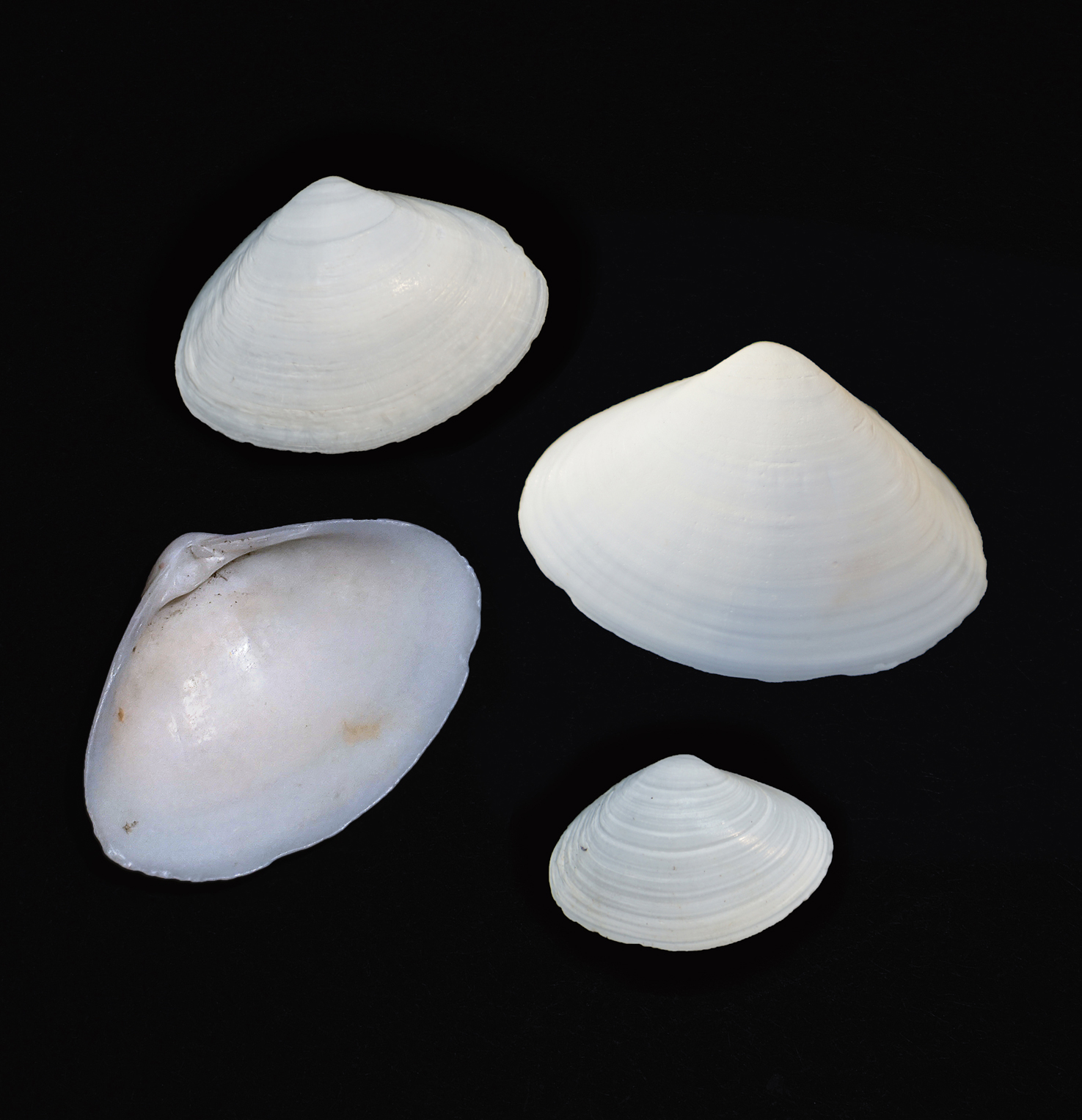
Tampa Tellin (Tampaella tampaensis) clamshells are colored opaque white (sometimes tinged pinkish-orange) with a shiny white interior. They display slightly inflated, oblong-shaped valves with very thin concentric ridges on the exterior. The valve is fairly symmetrical from its somewhat pointed beak. The valves are relatively thin and compressed. The hinge is not strong, and shells washed up on the beach are often broken. In general, Tellin clamshells belong to a family which is often considered the aristocracy of bivalves. Of several hundred species, scores are found along both U.S. coasts, especially in the warmer waters of the Atlantic and Gulf coasts. Some Tellins are rose-colored and attractive with banded patterns, very desirable to collectors, but most are white to creamy colored.

  • Size: Average 1/2 inch up to 4 inches
  • Habitat: Shallow sand and grassy inland bays and lagoons
  • Range: Florida to Panama and Texas
Speckled Tellin Clamshell

11. Speckled Tellin Clam

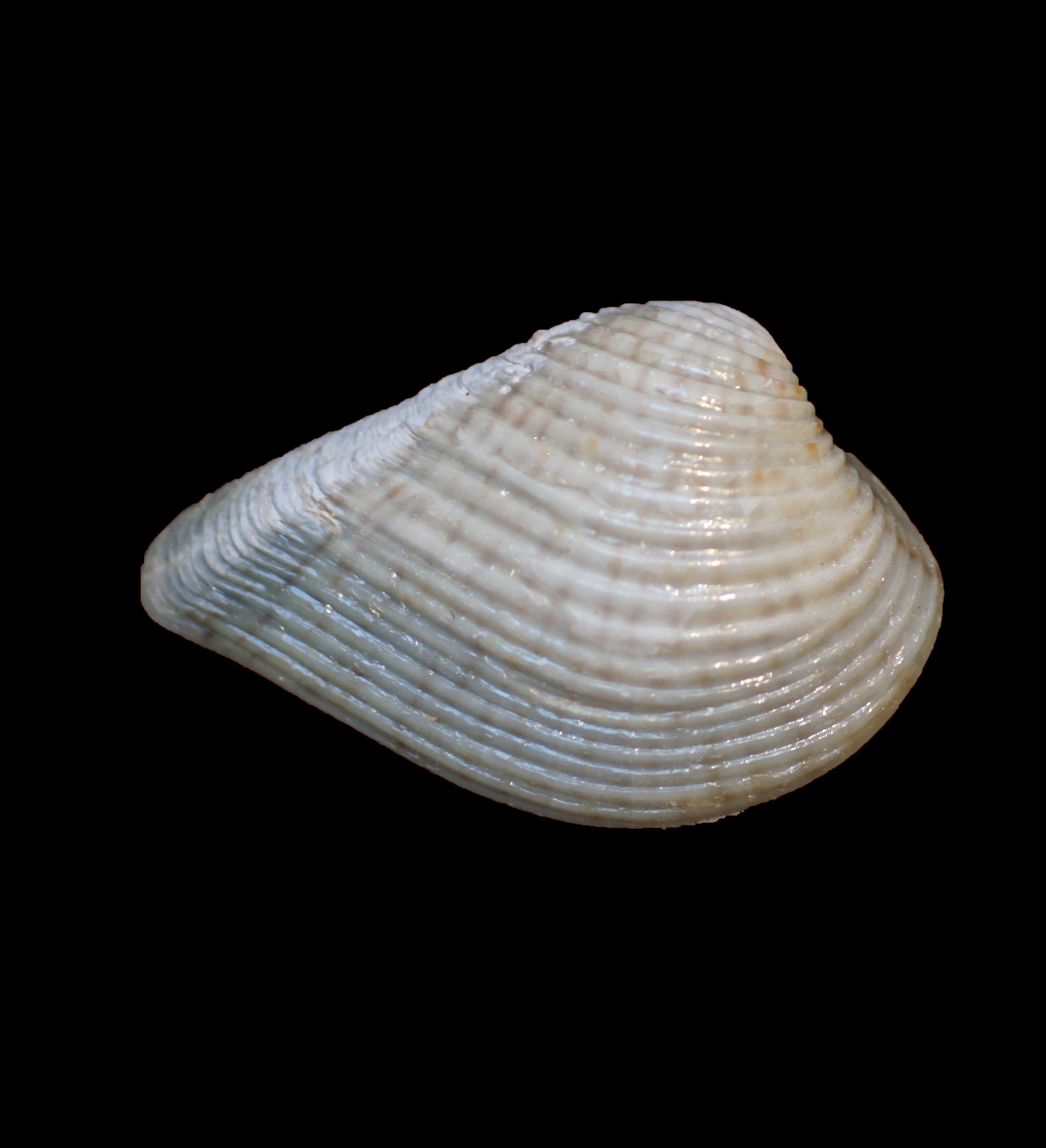
Speckled Tellin (Tellina listeri) also known as Interrupted Tellin, has an exterior valve that is shiny, creamy-white with purplish-brown rays or speckling. The interior is white with the colors showing through. The shell is moderately thin, long and oval. The valve has strong concentric lines and a crease extending from the beak to the edge. It is not edible.

  • Size: Up to 2 inches
  • Habitat: Moderately shallow water, but buries itself deeper in the mud and sand than most bivalves
  • Range: North Carolina to Florida and Brazil

Share this:

  • Share on Pinterest (Opens in new window) Pinterest
  • Share on Facebook (Opens in new window) Facebook
  • Print (Opens in new window) Print
  • Email a link to a friend (Opens in new window) Email
  • Share on LinkedIn (Opens in new window) LinkedIn
  • Share on Reddit (Opens in new window) Reddit
  • Share on X (Opens in new window) X
Like Loading...
Clam Seashells General Comment clamshell identificationclamshell photo IDCoquina clamshellsoyster identificationsSeashell IDseashell photosTellin clam identificationthorny oyster photos

Clamshell ID and Interesting Facts (From Arks, Angel Wings, Cardita, to Lucine Clams)

January 22, 2026 by Fossillady
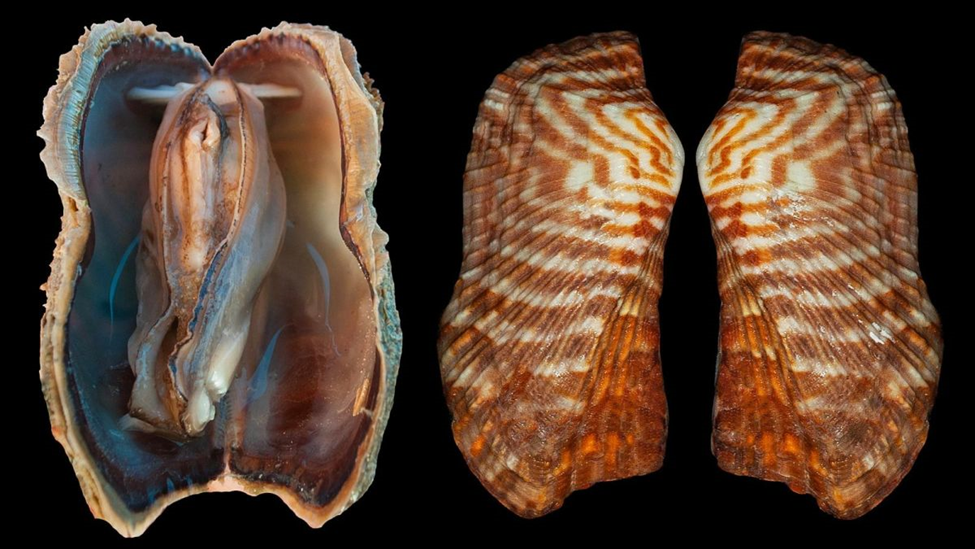
Zebra Ark Outer Shell and Interior: Source

Brief Intro

The word “clam” can be used to cover all bivalves, including scallops, oysters, arks, and cockles, to name a few. Did you know that there are more than 15,000 species of clams around the globe? Amazing, right? Clams and other bivalves first appeared in the fossil record as tiny creatures as early as the Cambrian Period over 500 million years ago. By the Devonian Period around 400 mya and through the Mesazoic Era, they gradually developed into the abundant forms. Follow along to learn interesting facts and help identify those clamshells you couldn’t resist picking up from the beach.

Twelve Atlantic Clamshell Identifications and Interesting Facts from my Collection in the following order:

  1. Ponderous Ark
  2. Blood Ark
  3. Transverse Ark
  4. Incongruous Ark
  5. Cut-Ribbed Ark
  6. Zebra Ark
  7. Broad-Ribbed Cardita
  8. Angel Wings
  9. Buttercup Lucine
  10. Chalky Buttercup Lucine
  11. Florida Lucine
  12. Pennsylvania Lucine

For additional Fossillady clam ID including Coquina, Various Oysters Tellins and more, click HERE.

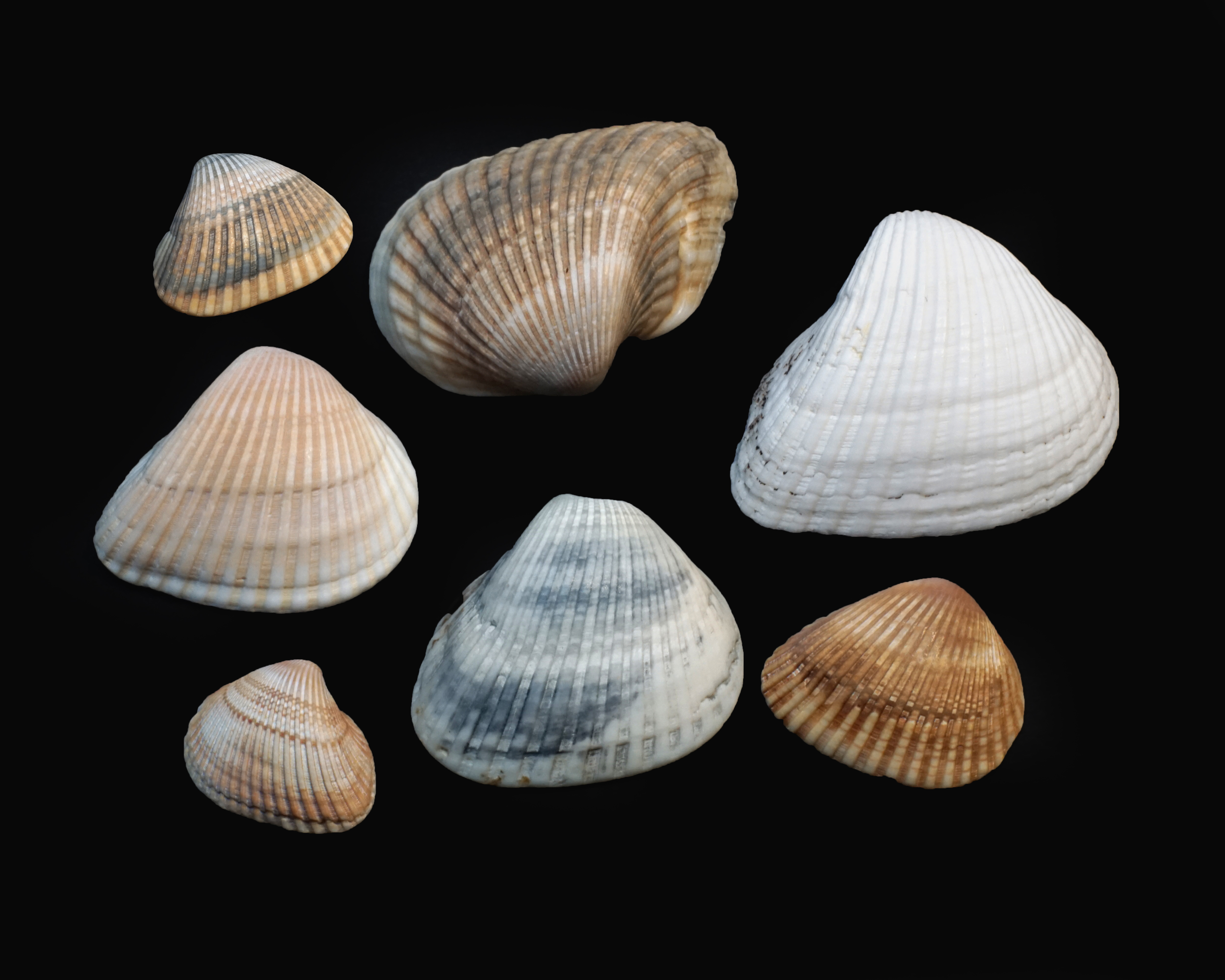
Ponderous Ark Clamshell Collection

1. Ponderous Ark Clam

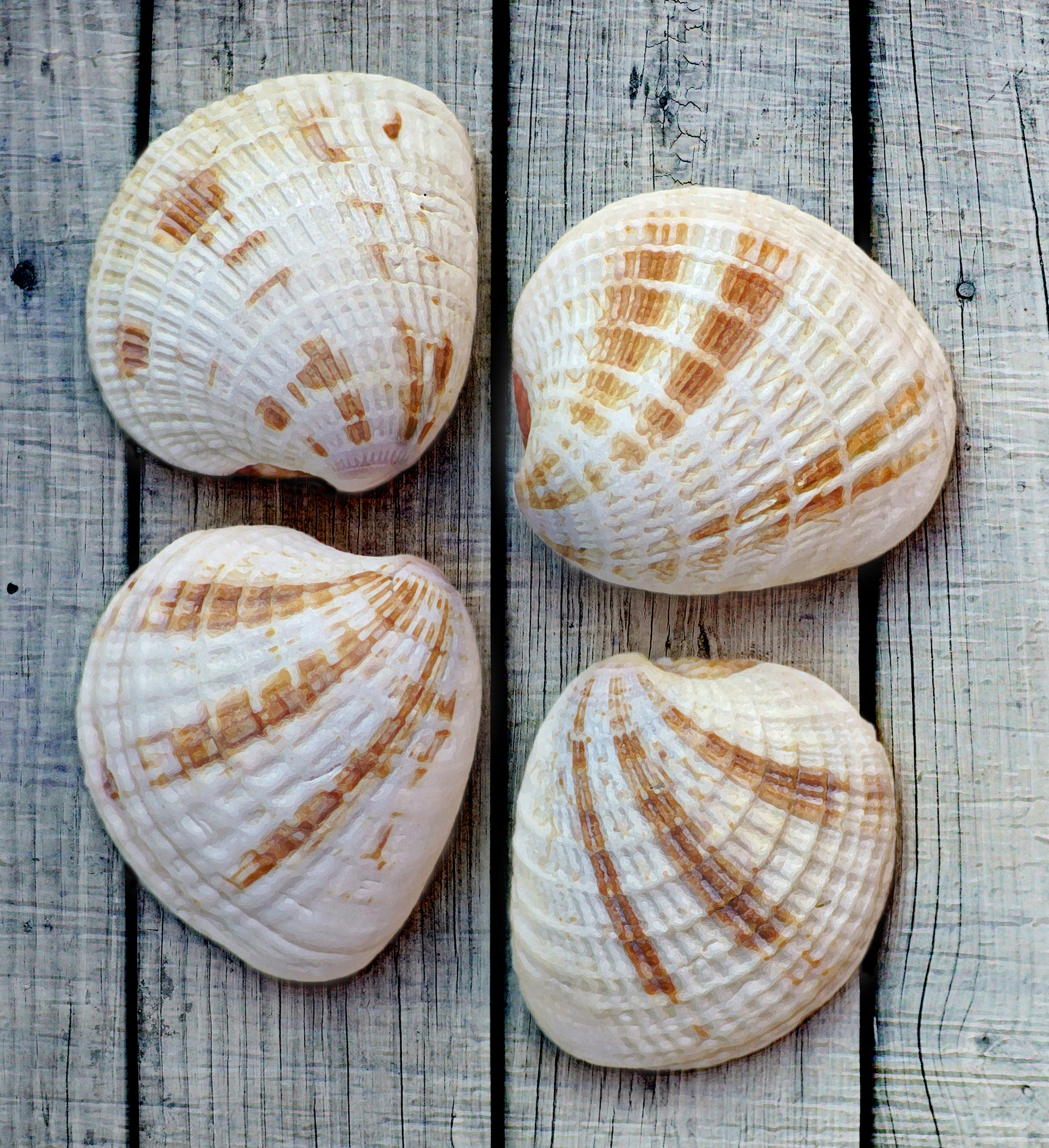
Ponderous Ark (Eontia ponderosa) clam displays a very thick triangular shell with 27 to 31 strong, flat radiating ribs and a large beak that turns back to the rear of the shell. These arks have a dark, velvety skin worn to white after beaching, and the calcareous shell can later stain to rust or gray. Their robust shells make them and their relatives, such as the Blood Arks, among the most common beach finds where other bivalve shells are otherwise pulverized in high-energy wave zones. Ponderous Ark and its relatives are a family of small to large-sized edible saltwater clams.

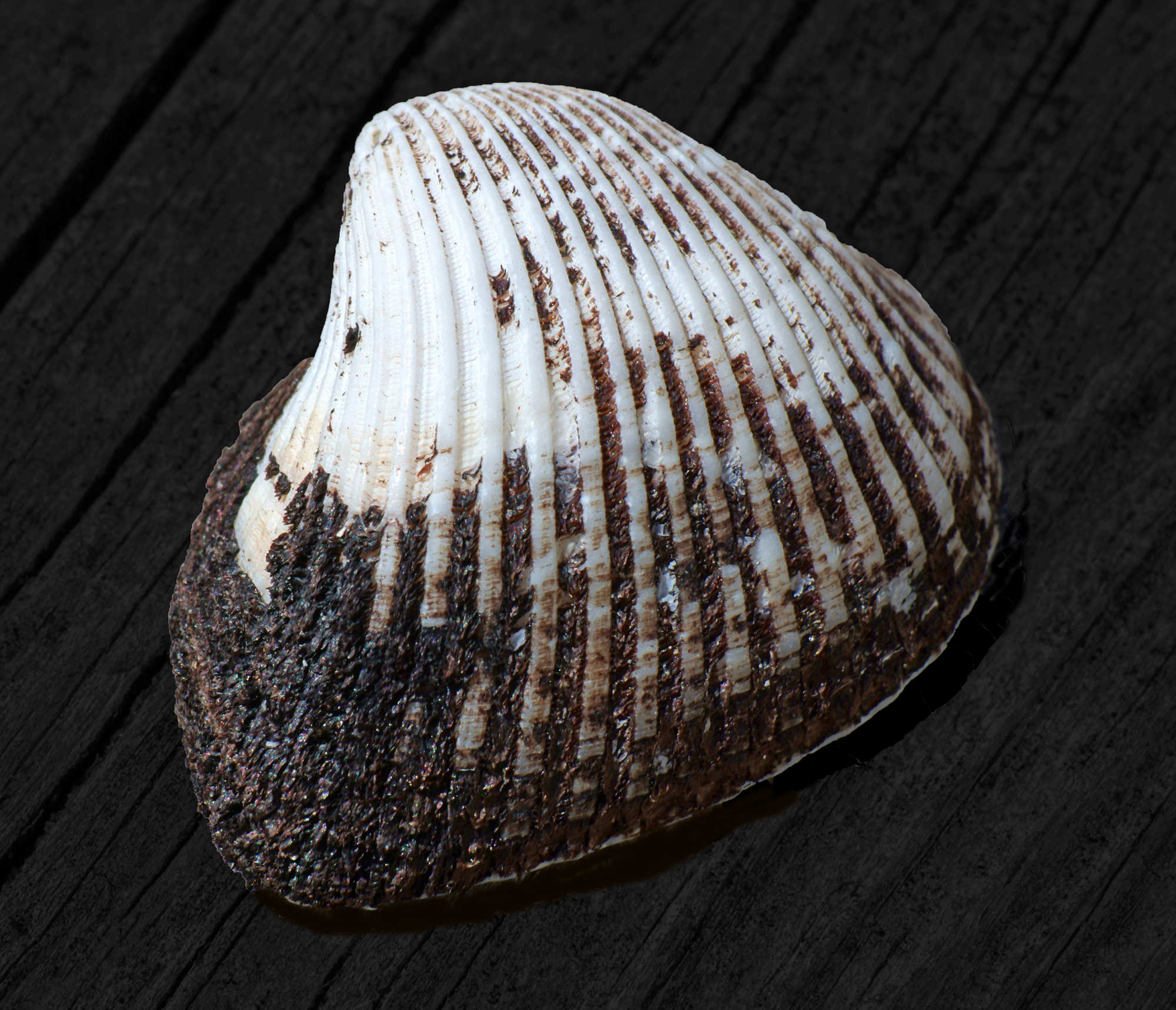
Ponderous Ark Clamshell with Periostracum Covering
  • Camouflaging Layer over Arks: The Periostracum The shells of many ark species have a thick layer of a dark brown velvety covering called the “periostracum”. The photo shows the covering layered over the shell which has partly been worn away. It serves as a protective camouflage. After beaching, the periostracum begins to wear off and, in time, can completely disappear.
  • Size: Up to 3 inches
  • Habitat: A sand dweller in shallow shores
  • Range: Virginia to Key West and the Gulf of Mexico
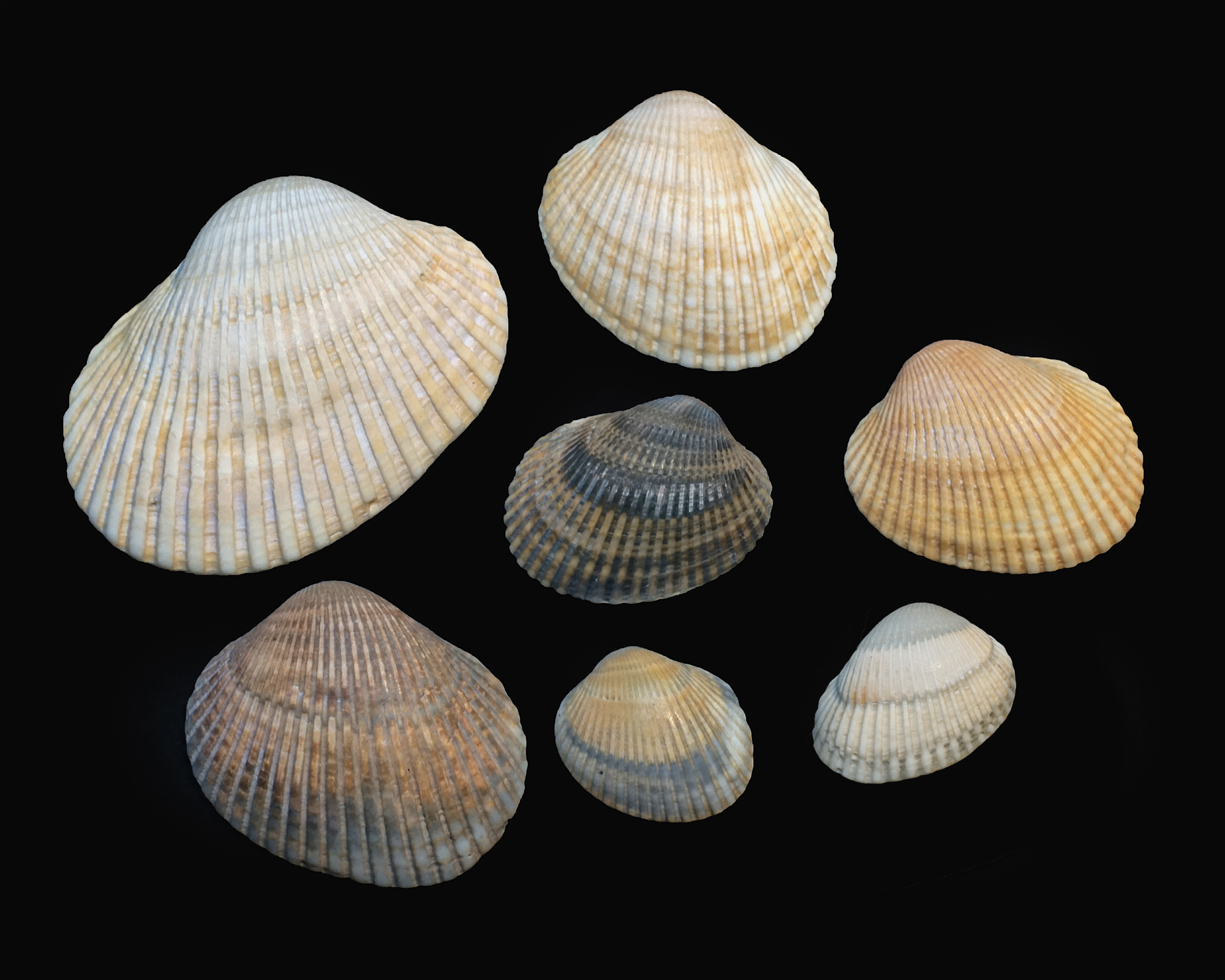
Blood Ark Clamshell Collection

2. Blood Ark Clam

Blood Ark (Anadara ovalis) derives its name from its uncommon red blood; most mollusks have clear blood. Like their close relative, the Ponderous Arks, Blood Arks have very thick shells, only to a slightly lesser degree. After the outer layer “periostracum” wears off, the shells may appear white, gray, or rust-colored. The interior is typically creamy white. Each valve typically has approximately 35 deep, flat radiating ribs.

  • Size: 2 1/2 inches
  • Habitat: Sandy shallows
  • Range: Cape Cod, Massachusetts, to Florida and east to Texas
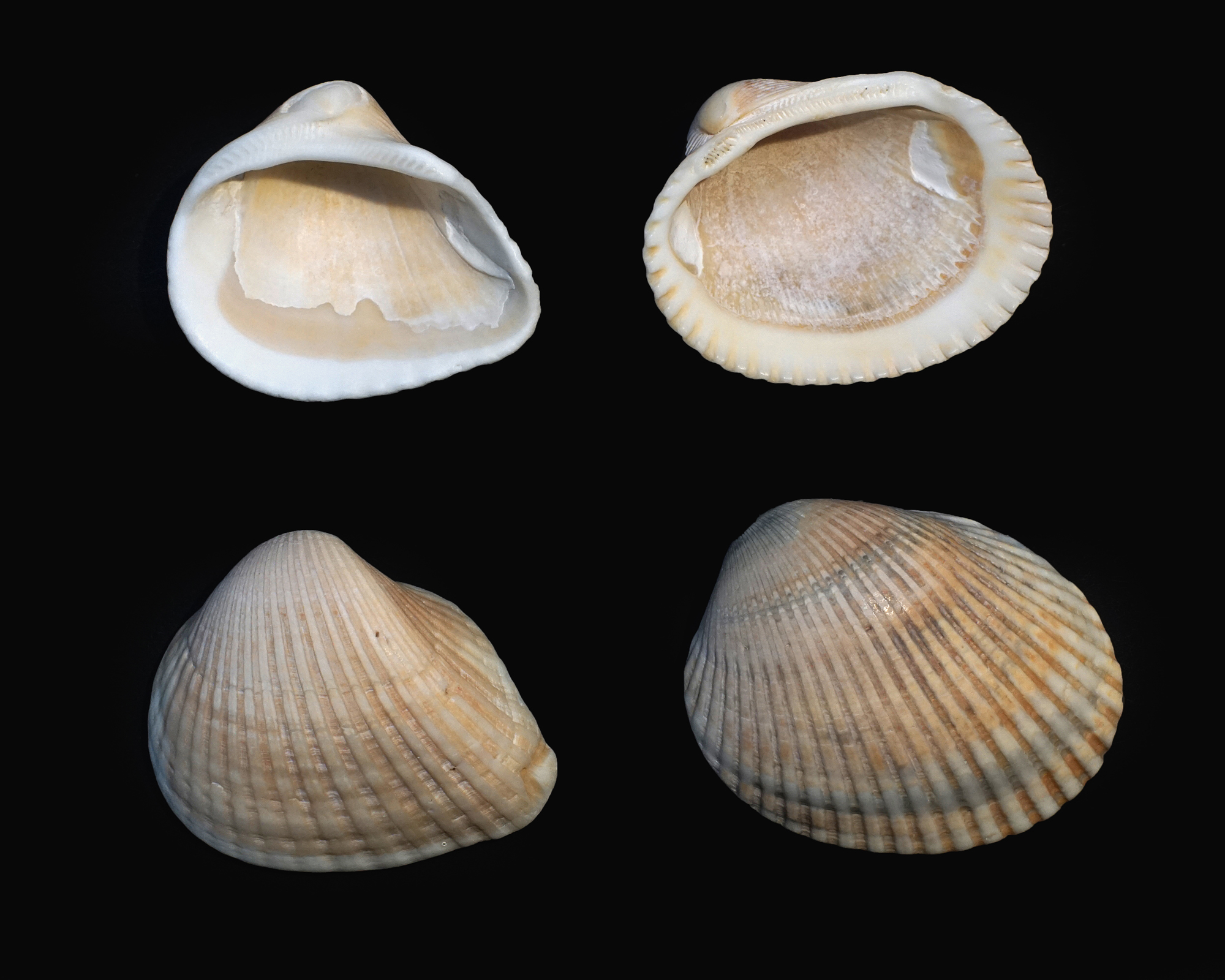
Comparison: Ponderous Ark Shells (left) and Blood Ark Shells (Right)

Comparison: At first glance, it’s hard to tell apart the Blood Ark from the Ponderous Ark. The Ponderous Ark (left) has a more triangular-shaped shell with an inflated high crease from the beak, whereas the Blood Ark (right) has a more elongated oval shape (observe the comparison photo). Also, the hinge line of the Blood Ark is slightly longer and straighter.

Transverse Ark Clamshells

3. Transverse Ark Clam

Transverse Arks (Anadara transversa) are fairly sturdy, elongated oval and small bivalves. Their valves are somewhat inflated, bearing a relatively long straight hinge line. They display squarish ribs and are usually colored white once the periostracum covering wears off after beaching. Like many seashells, they can stain rust or gray after prolonged exposure to the sun and air. They are commonly found on Florida shores.

  • Size: Up to 1 1/4 inches
  • Habitat: Gulf and bay sandy bottoms or hard substrates
  • Range: Massachusetts to Florida, east to parts of the Gulf of Mexico and south to the West Indies
Incongruous Ark Clamshell Collection

4. Incongruous Ark Clam

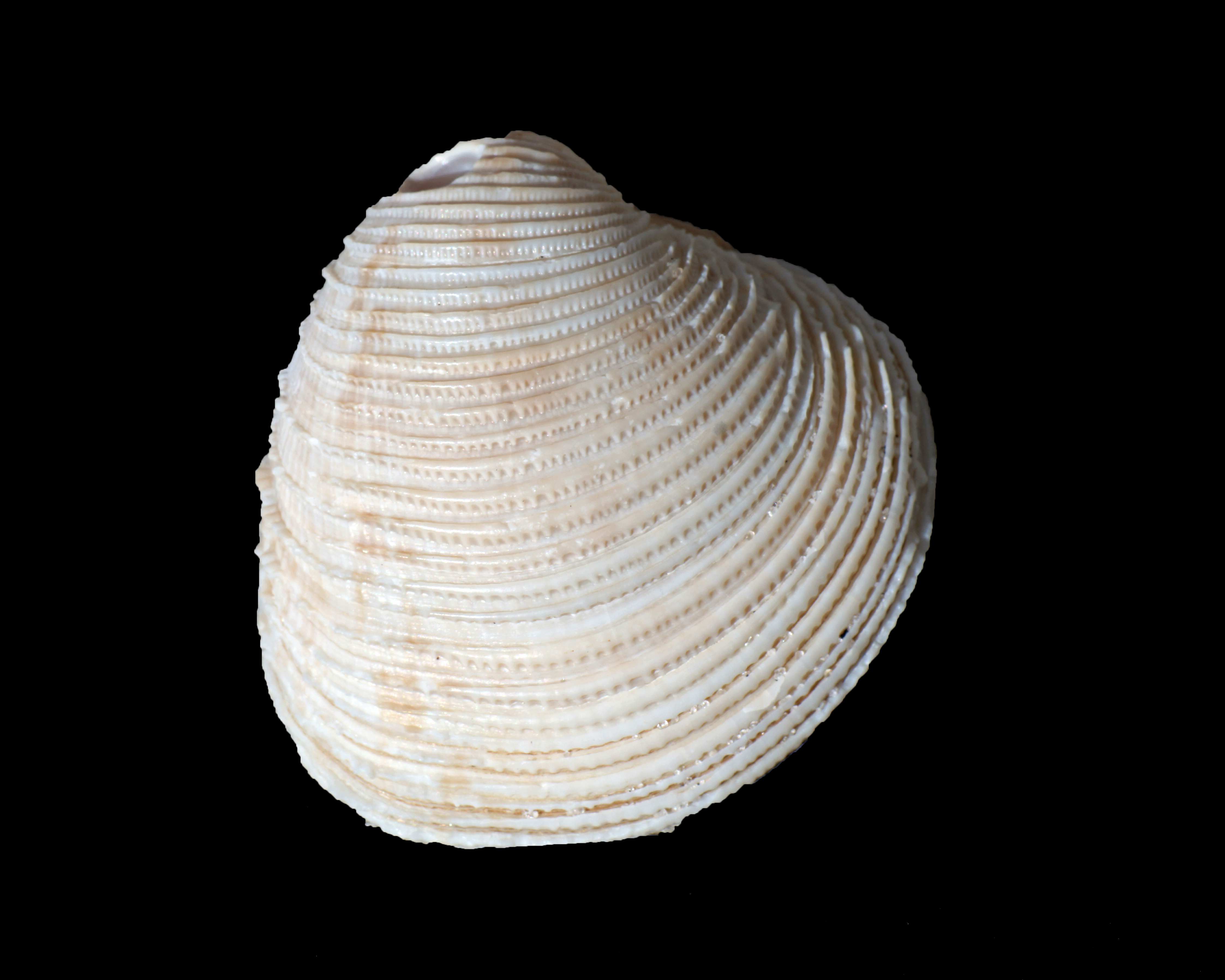
The desirable Incongruous Ark (Scapharca brasiliana), formerly (Anadara brasiliana) possesses a sturdy shell distinguished by obvious beading on its strong radial ribs. The shells grow in a triangular shape with well-inflated valves and a strong beak turned back. The color is white with the brown, furry covering (periostracum) while alive and may discolor after being beached by the sun.

  • Size: Up to 3 inches
  • Habitat: Gulf and bay sandy bottoms
  • Range: North Carolina to Brazil
Cut-Ribbed Ark Clamshells

5. Cut-Ribbed Ark Clam

Cut-Ribbed Ark (Anadara floridana), otherwise known as (Anadara secticostata) possess fairly inflated shells with an elongated, slightly uneven oval shape. Their hinge is long and quite straight. Usually the shell is colored white, but like other arks, they are susceptible to staining rust after beaching. The valve consists of 30–38 radial ribs flattened on top with a groove down the center of each rib and concentric ridges between the ribs.

  • Size: Up to 4 1/2 inches
  • Habitat: Offshore sands, but closer to shore in Southern Florida
  • Range: North Carolina, Florida and the Gulf of Mexico to Texas and Westward
Zebra Ark Clamshells

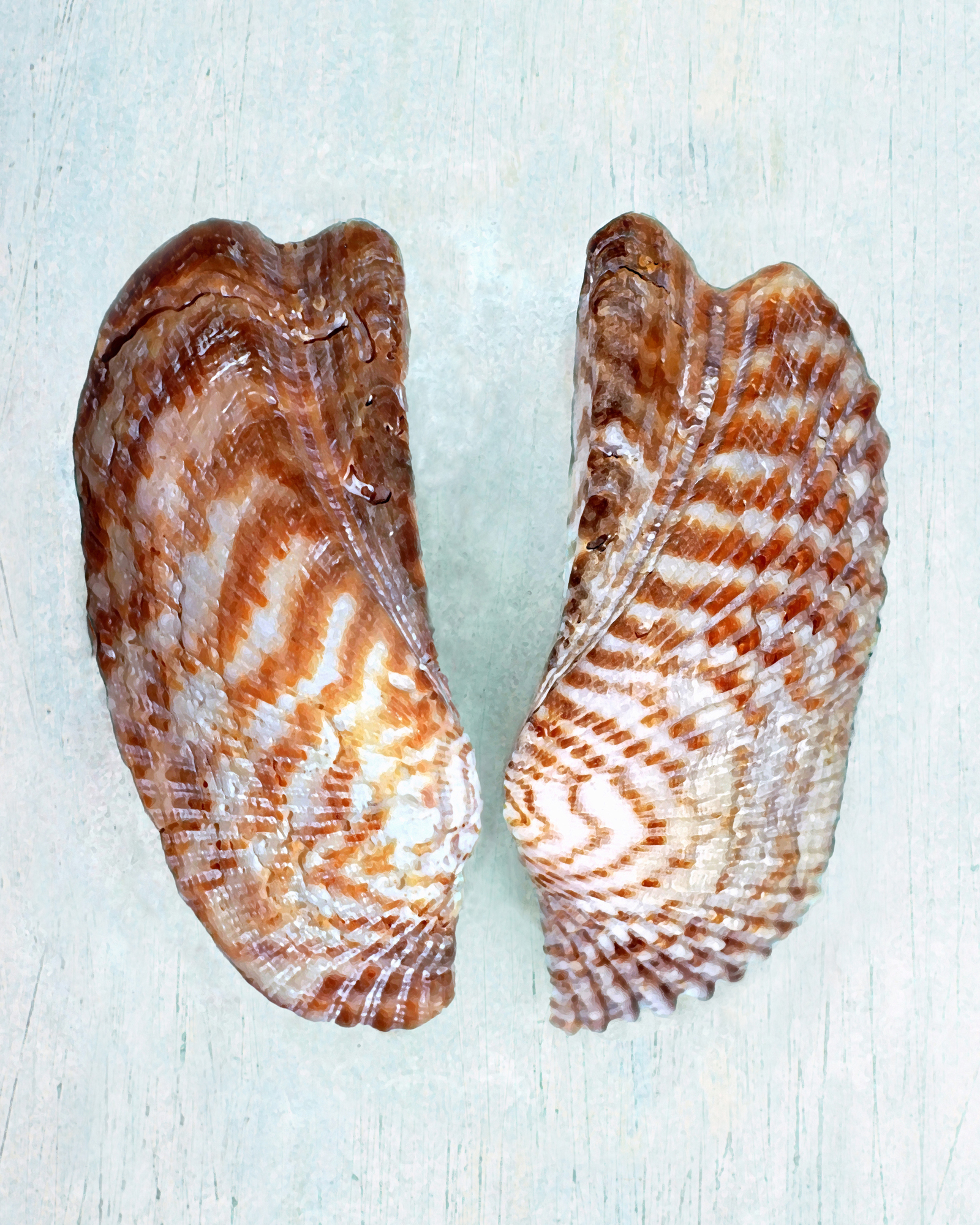
6. Zebra Ark Clam (Turkey Wing Ark)

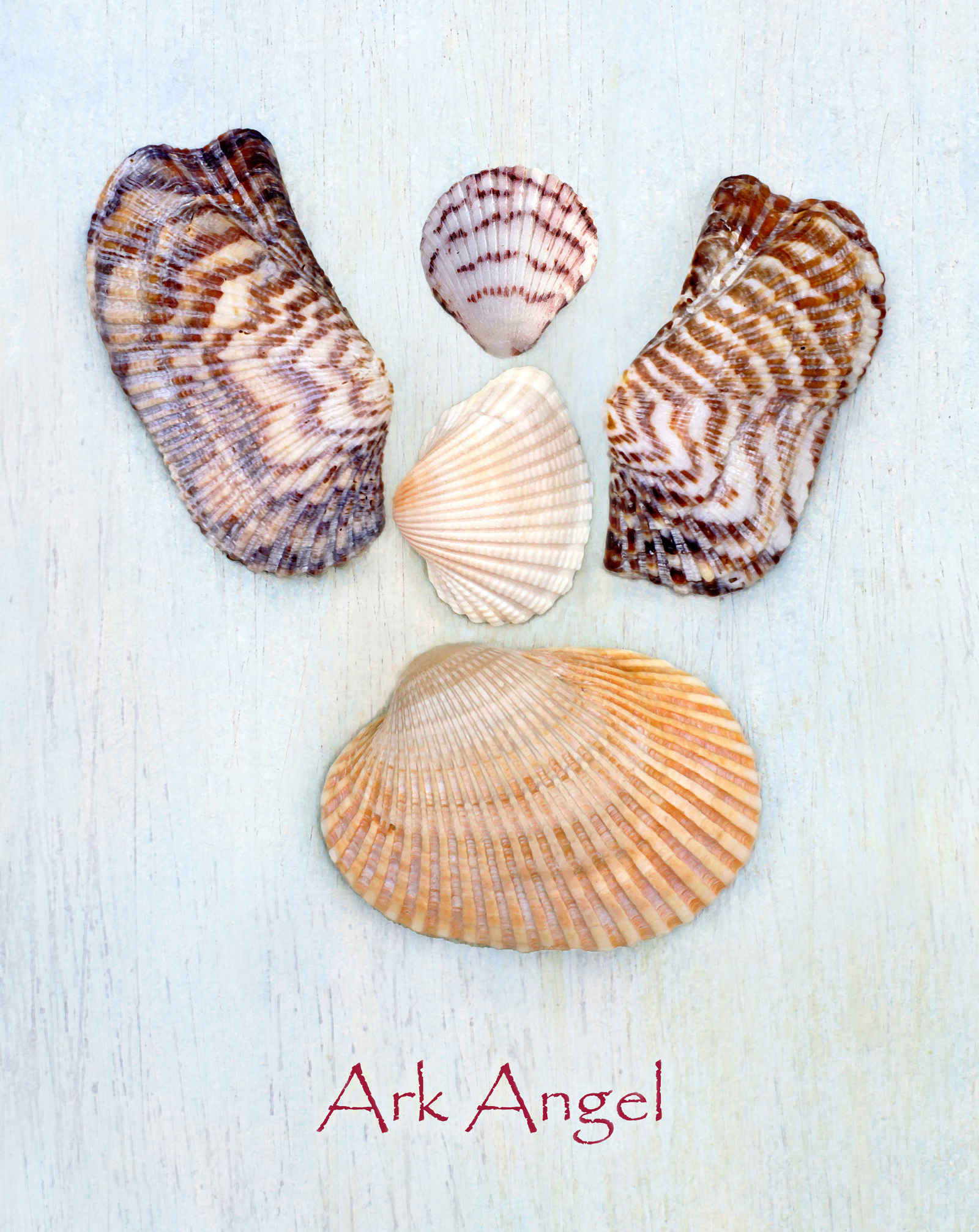
Zebra Arks or Turkey Wing Arks (Arca zebra) possess an unusually elongated oval shape with a long straight hinge. The surface of the valve is uneven with rough-textured ribs. Still, their most distinguishing mark is the attractive zigzag alternating brown and white stripes resembling a zebra or, noticeably, a turkey wing.

Just for Fun – Various Ark Shells (Ark Angel) My Photosite Image

This ark shell has also been called “Noah’s Ark” because of its shape when the valves are connected. Like many ark shells in general, living examples are covered with a thick and bristly “carpet” or periostracum that wears away after the animal has died and after bleaching by the sun.

  • Size: Up to 3 1/2 inches
  • Habitat: The mollusk attaches itself by its byssus (threadlike filaments) to rocks and other solid objects in shallow water
  • Range: North Carolina to the West Indies, and also on Bermuda’s shores, as well as in the Mediterranean
Broad-Ribbed Cardita Clamshell Collage

7. Broad-Ribbed Cardita Clam

Broad-Ribbed Cardita (Carditamera floridana) is also known as the Bird Wing clam. The exterior shell is covered with white and purple or chestnut blotches with a white interior. The shell is oval, small and thick, with 20 strong raised and beaded radial ribs. Jewelry makers and crafters love this little shell which washes ashore commonly on Florida beaches.

  • Size: Up to 1 1/2 inches
  • Habitat: Attaches itself to the substrate by means of its byssus (threadlike filaments) in sand or mud 3 to 25 feet deep
  • Range: Florida east to Texas and Mexico
Angel Wing Clamshells

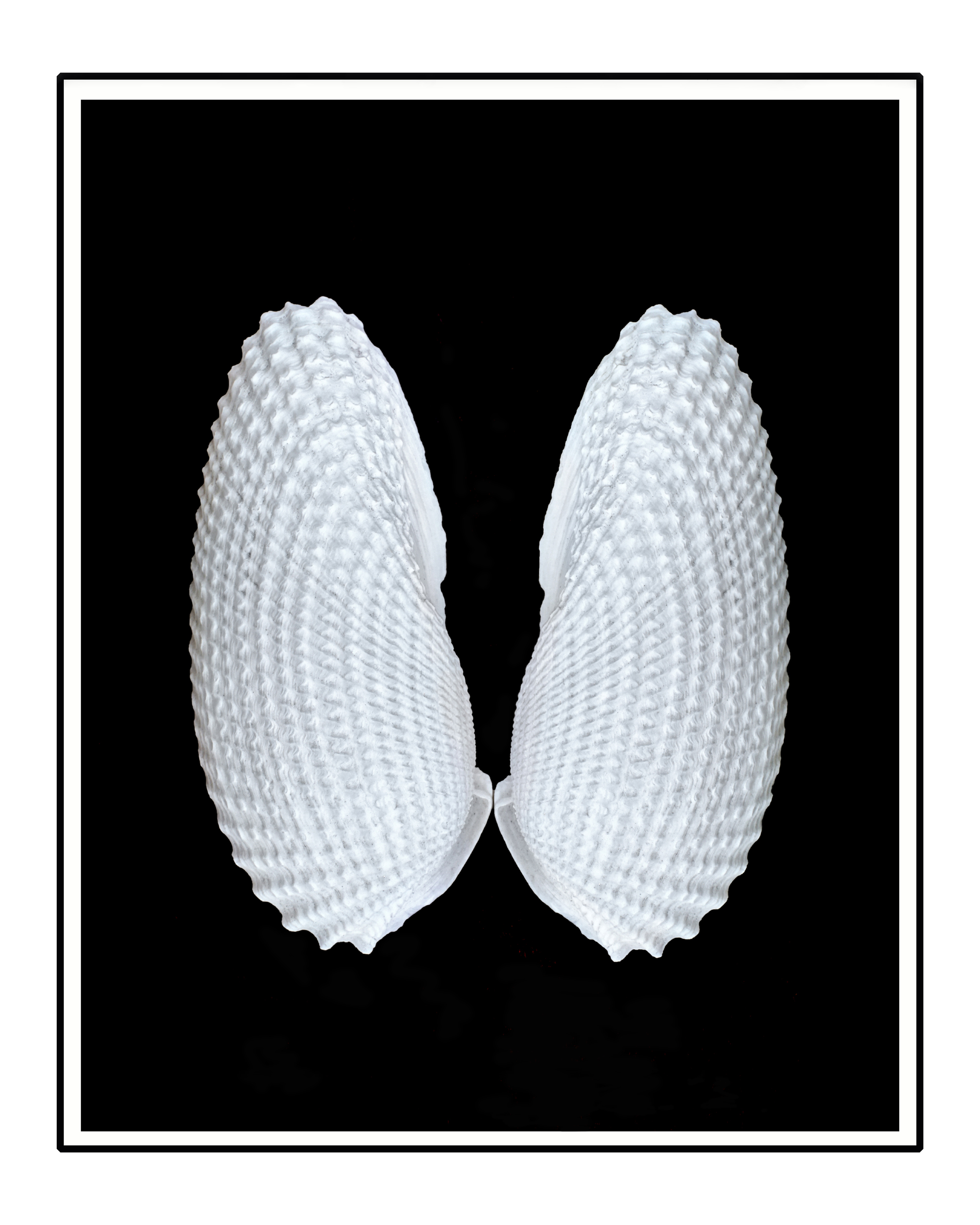
8. Angel Wings Clam

Angel Wing clams (Cyrtopleura costata) display lovely elongated, wing-like valves with 26 radiating ribs finely sculptured, intercepted with a series of concentric growth rings parallel with the margin. Angel Wings are typically white and sometimes tinged pinkish. The muscles on their hinges are relatively weak, so it’s uncommon to find the left and right valves connected. Also, their valves are rather thin and brittle, so they’re often found damaged from rough seas. Interestingly, Angel Wing shells will glow if exposed to ultraviolet light. They living animal can extend a long siphon that protrudes from the burrow used to circulate water and draw in food particles with enough strength to bore into clay, wood and even shale.

  • Size: Up to 7 inches
  • Habitat: Shallow water burrowing up to three feet deep in mud, clay or peat
  • Range: Cape Cod to Florida and the Gulf of Mexico, east to Central America and as far south as Brazil
Buttercup Lucine Clamshells

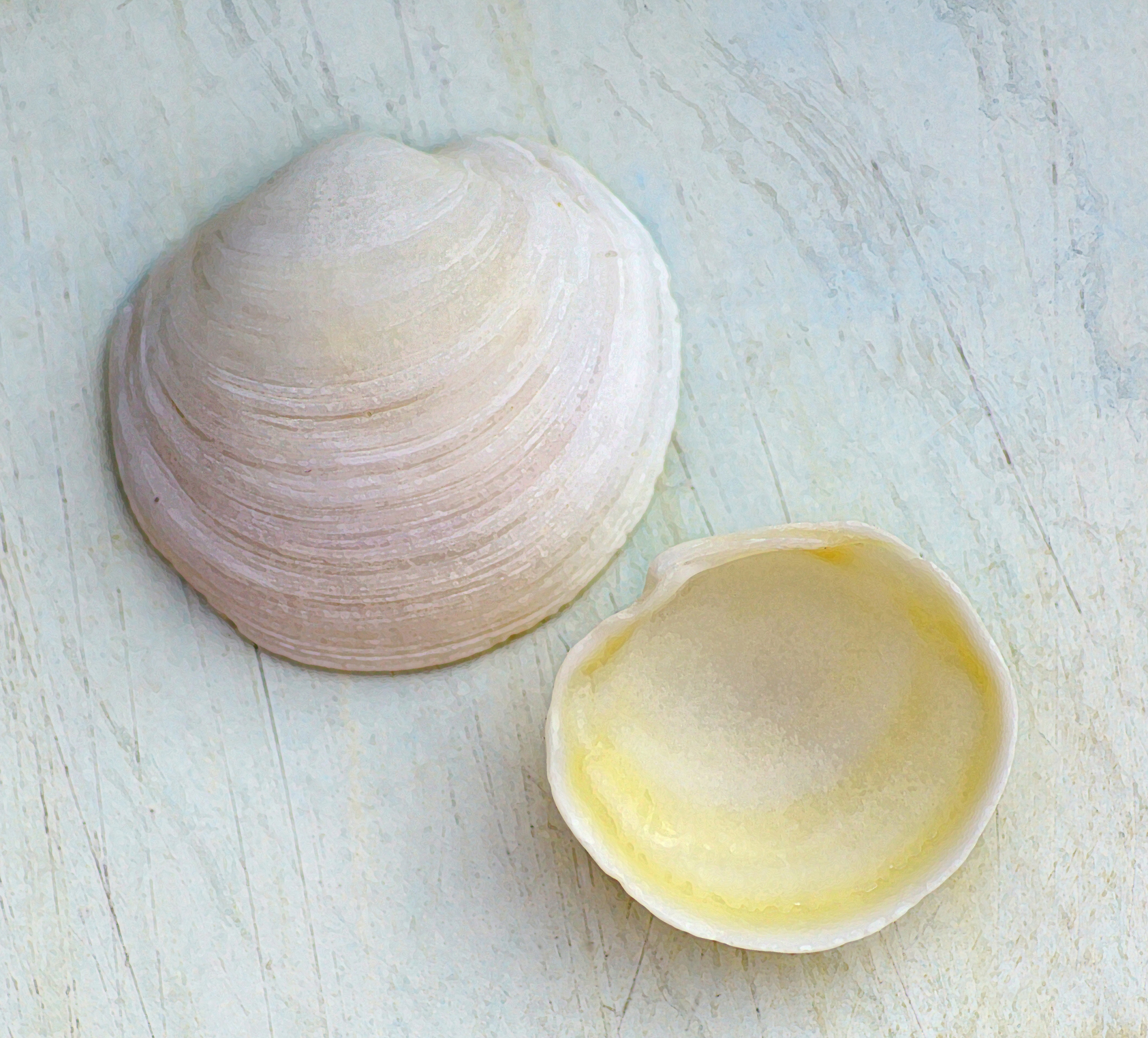
9. Buttercup Lucine Clam

The Buttercup Lucine or Lucina (Anodontia alba) is a circular, bowl-shaped, small bivalve with a fairly sturdy white outer shell and creamy to butter yellow interior. The exterior has numerous fine concentric lines and a somewhat wide hinge plate. Lucines are common in warm waters on both the Atlantic and Pacific Coasts of North America. They are not edible. Did you know the Lucines are named for Lucina, an aspect of the Roman Goddess, Juno, who represented light and childbirth?

  • Size: Up to 2 inches
  • Habitat: Deep to shallow water
  • Range: North Carolina to Florida and the West Indies, as well as the U.S. Pacific Coast
Chalky Buttercup Lucine Clamshells

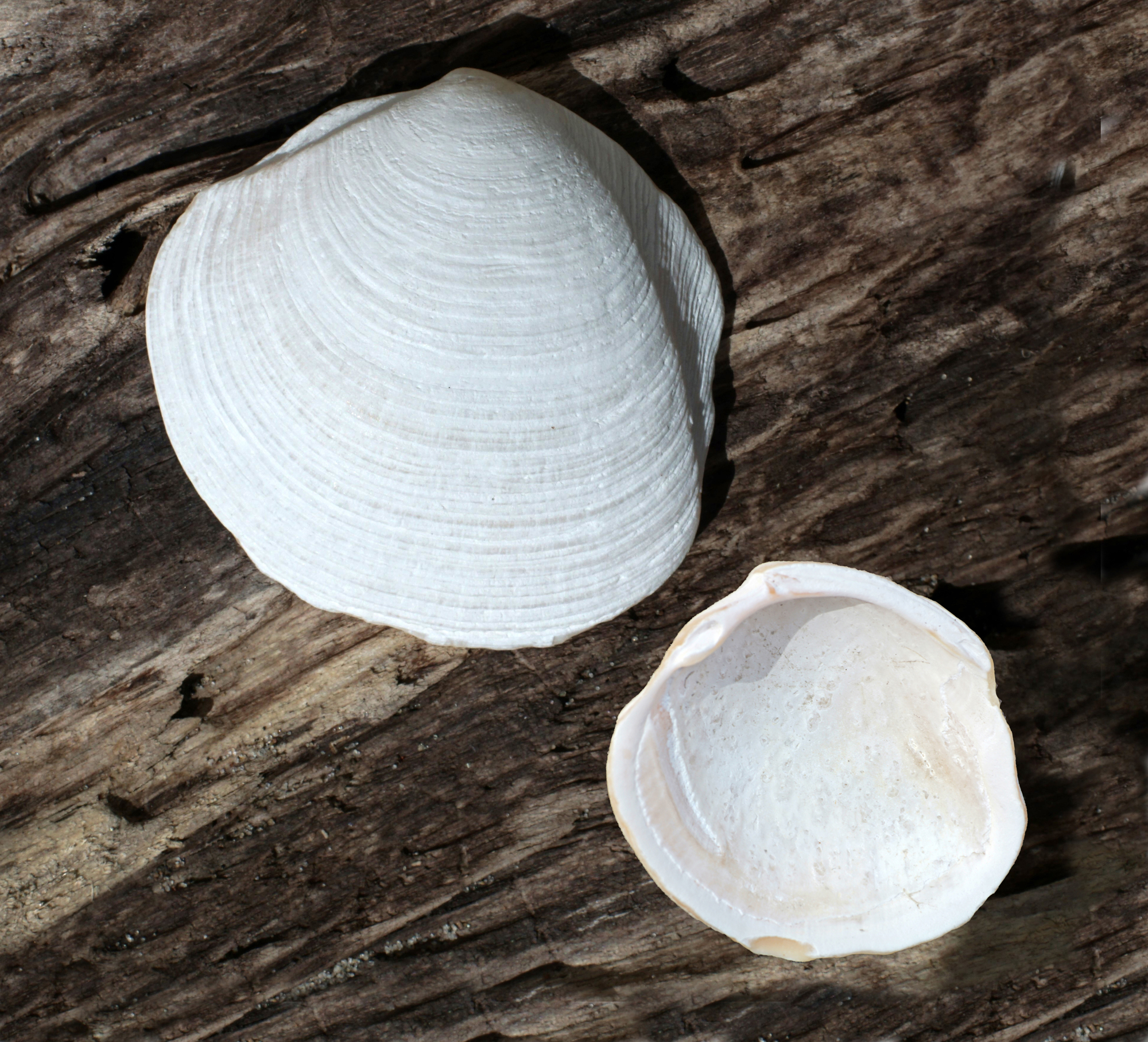
10. Chalky Buttercup Lucine Clam

The Chalky Buttercup Lucine (Anodonitia philipiana) clamshell is slightly thicker and also larger than the Buttercup Lucine (Anodontia alba). The valve color is white with white to pale yellow interior and possesses numerous concentric lines with a dominant furrow.

  • Size: Up to 2 1/2 inches
  • Habitat: Deep water, but can reach the beach when tidal flow washes it up
  • Range: North Carolina to Florida and the Gulf states, as well as south to the West Indies
Florida Lucine Clamshells

11. Florida Lucine Clam

The Florida Lucine or Lucina (Pseudomiltha floridana) displays weak growth lines but has a sturdy shell. Both its exterior and interior valve colors are white. The shell is fairly inflated and very round with a beak that turns forward which is small, but prominent. They have been called the Face Shell because they are used for the faces of shell dolls. They are not edible.

  • Size: Up to 1 1/2 inches
  • Habitat: Moderate shallow water
  • Range: Florida to Texas and the U.S. Pacific Coast
Pennsylvania Lucine Clamshell

12. Pennsylvania Lucine Clam

The Pennsylvania Lucine or Lucina (Linga pennsylvanica) shell is off-white with distinct concentric ridges and a distinct diagonal furrow about the posterior region. The interior is the same color as the exterior. The shell is sturdy, heart-shaped and inflated with a beak inclined forward. Beach-worn specimens are smooth and shiny. They are not edible.

  • Size: Up to 2 inches
  • Habitat: Shallow water
  • Range: North Carolina to Florida and the West Indies, as well as the U.S. Pacific Coast

Share this:

  • Share on Pinterest (Opens in new window) Pinterest
  • Share on Facebook (Opens in new window) Facebook
  • Print (Opens in new window) Print
  • Email a link to a friend (Opens in new window) Email
  • Share on LinkedIn (Opens in new window) LinkedIn
  • Share on Reddit (Opens in new window) Reddit
  • Share on X (Opens in new window) X
Like Loading...
Clam Seashells General Comment angel wings clamsark clamsAtlantic seashell identificationbivalve factsclam factsclamshell identificationclamshell imagesLucine clams

Identifying Fossils (Crinoids, Bryozoans, Corals and More) Discovered on Lake Michigan Beaches

January 18, 2026 by Fossillady
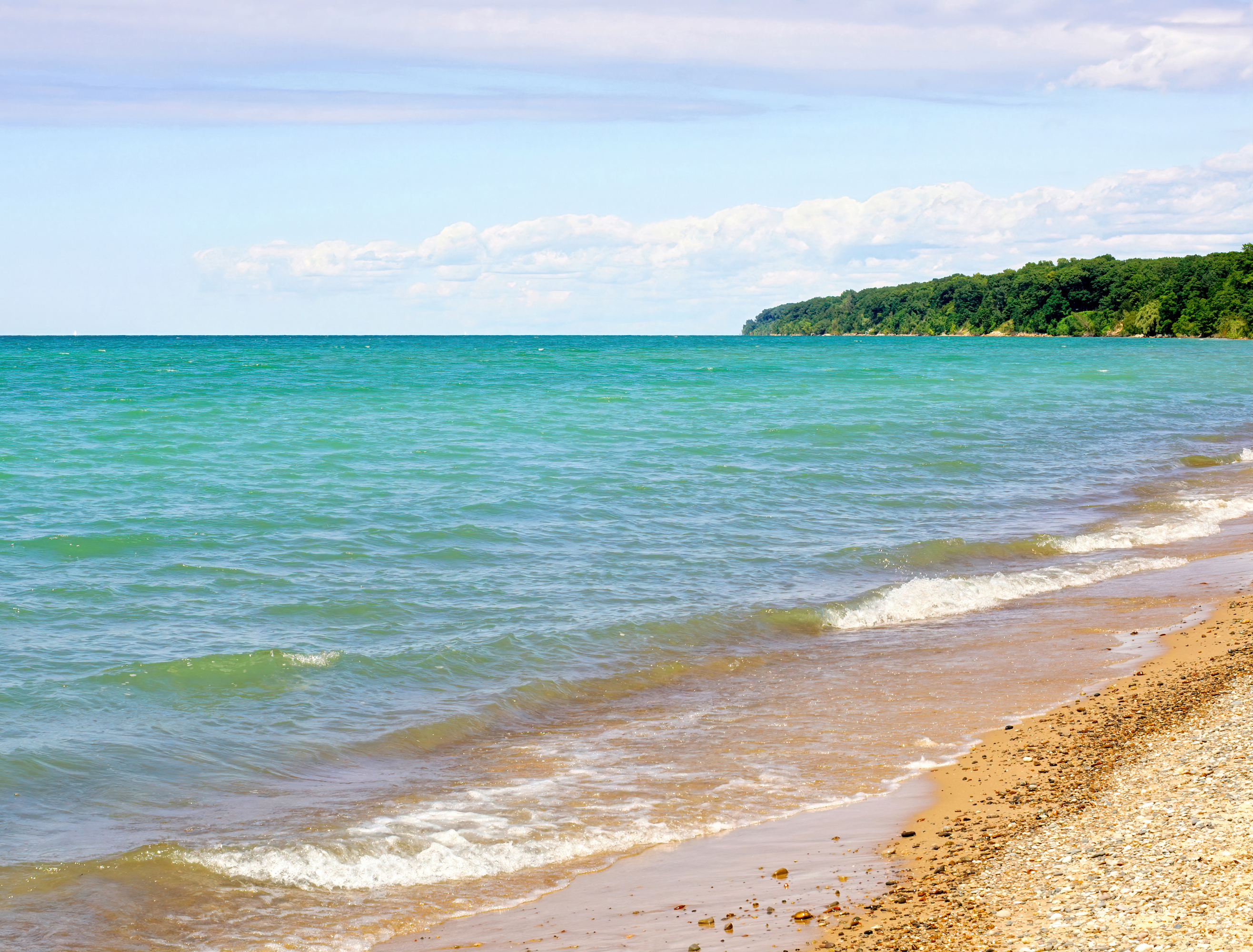
Lake Michigan Beach Fossil Hunting

I Found a Fossil on the Beach and Wondered

You’re enjoying a walk on the beach and something catches your eye lying in the sand. It’s not driftwood or beach glass or even a pretty rock. You suspect you have found something that was once a living creature and you can’t let it go. Has that ever happened to you? A deep sense of wonder and childlike imagination may drive you to find out what you picked up from our freshwater or saltwater sandy-shores. My own sense of wonder led to learn about the fossilized creatures I have found on the beaches of Lake Michigan, including what they looked like when they were alive and how and when they lived. I was also curious to know how they showed up so prevalent along our freshwater beaches. Taking things a step further, I drew illustrations of their living beings included in my article.

  • Fossil Facts in the following order:
  • Crinoids
  • Bryozans
  • Brachiopods
  • Clams
  • Petoskey Stones
  • Favosites Honeycomb Corals
  • Horn Corals
  • Chain Coral Halysites
  • Stromatolites

    NOTE: The following fossil descriptions are individually included articles in my fossillady site under “Categories” with additional info, illustrations or photos. I decided it would be expedient for Lake Michigan beach fossil-hunters to present them here together in a single article.

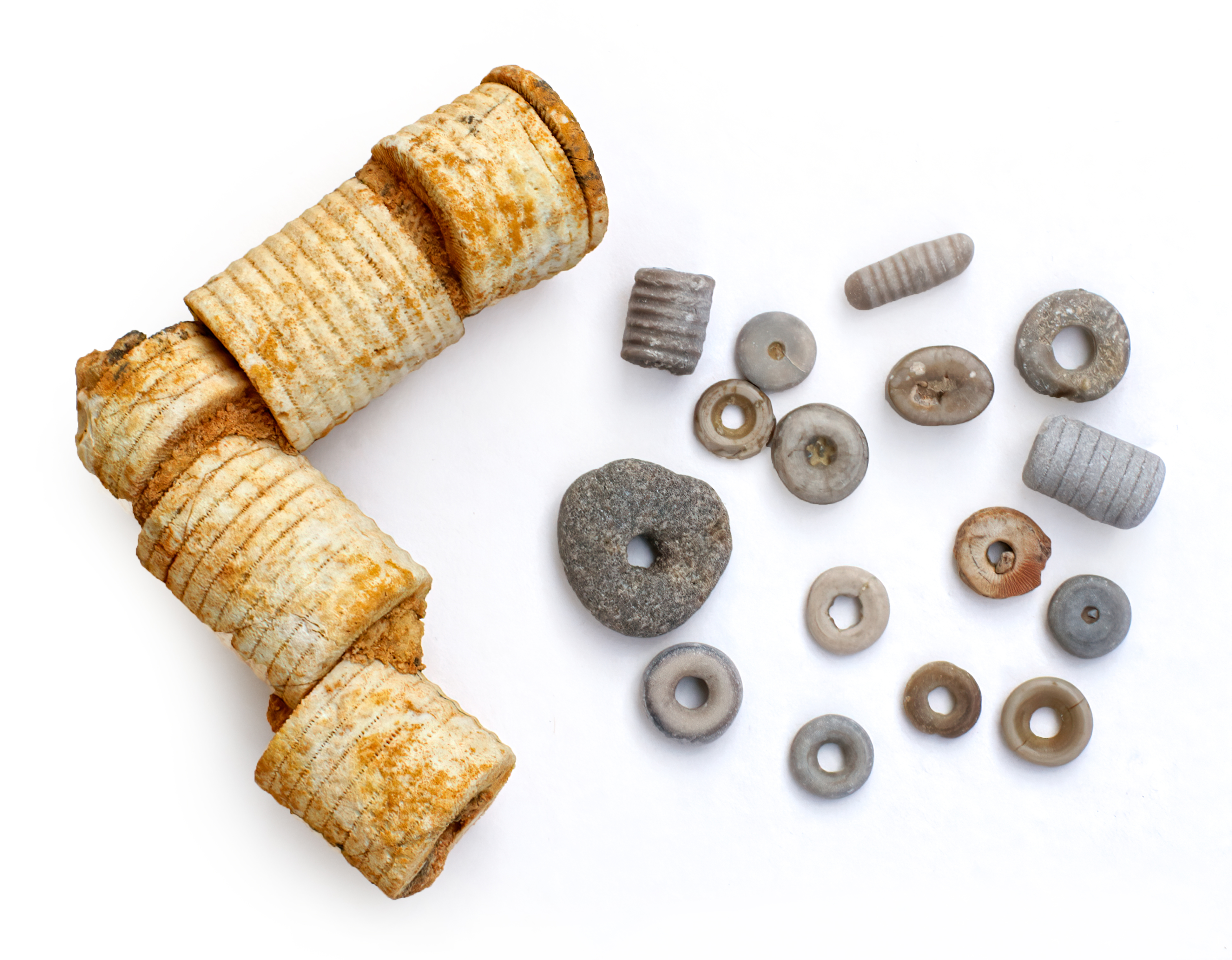
    Crinoid Fossil Stems and Tiny Crioid Fossil Pieces

    Crinoid Fossils

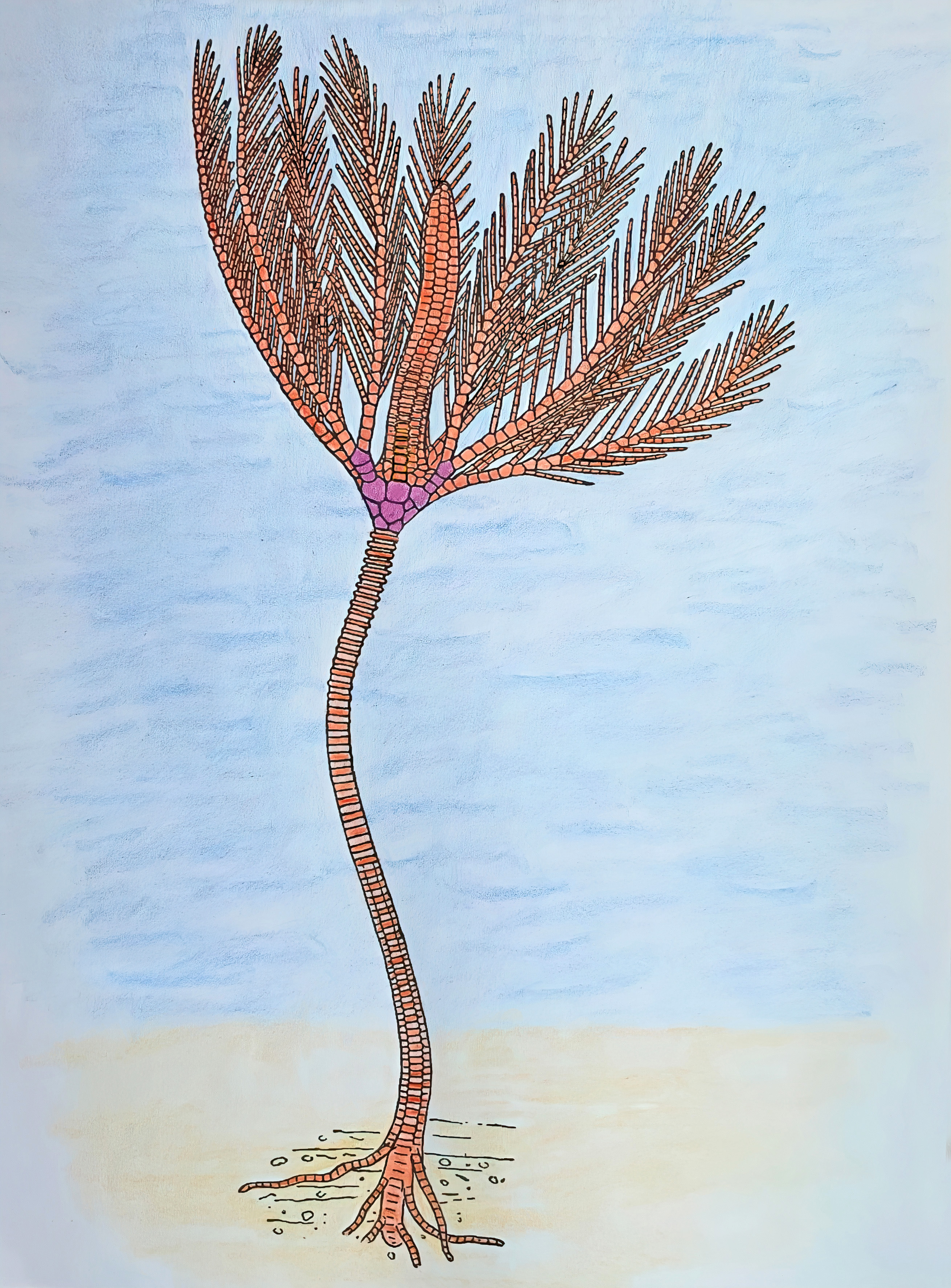
    Crinoid fossils are some of the most common fossils found along Lake Michigan beaches. They’re often referred to as “Indian Beads” because Native Americans are known to have strung together their broken off cheerio-shaped pieces in order to make necklaces. They’ve also been referred to as Lucky Stones because spotting one of the tiny pieces requires a bit of luck! Crinoid animals were sessile creatures—in other words, they remained attached to the sea floor by means of a long single stem. Attached atop of their stem was an intricate cup-like structure from where numerous branching arms grew outwards, much like a plant or tree. The frame works of crinoids were constructed from each individual circular section (shown above) which were stacked one on top of another. The hole in the center of each section contained soft tissue supplying nutrients throughout the animal. Some varieties were known to have towered several meters high off the seafloor. Their entire structure resulted in the living organisms’ beautifully colored and flower-like appearance, which granted them another common name “sea lilies”.

    Crinoid “Sea Lily” Illustration Drawing

    Sea lily crinoids captured tiny food particles passing by in ocean currents with their feathery network of fingers that functioned like traps. Crinoids invertebrate animals fit into the phylum of Echinoderm, meaning spiny skin. They are cousins to starfish, sea urchins, and feather stars.

    “Sea lily” crinoids lengthy history dates far back to the Ordovician Period around 500 million years ago, although the fossil record reveals their heyday occurred during the Mississippian Period around 345 mya. Today, there are far few species, but they lack the long meandering stems common in Paleozoic varieties and live in colder, deep ocean depths. For more photos and drawing of crinoids go to another fossillady article specifically about theme HERE.

    …

    How Are Saltwater Ocean Fossils Found as Far North as Michigan? During their Paleozoic lifetimes, much more of the world’s continents were covered under warm, shallow, saltwater seas, including the Great Lakes regions. When thousands of Paleozoic ocean species died, including crinoids, they became buried in sediment and under certain conditions, fossilized.

    Millions of years later, around ten thousand years ago, the giant glaciers sculpted deep basins, forming the Great Lakes. In the process, they also dug into the deep layers of sediment where crinoid remains and their counterparts lay buried and were thusly released. Since then, the perpetual wave action of the big lakes has continued to deposit them on our beaches where we have the privilege of finding them!

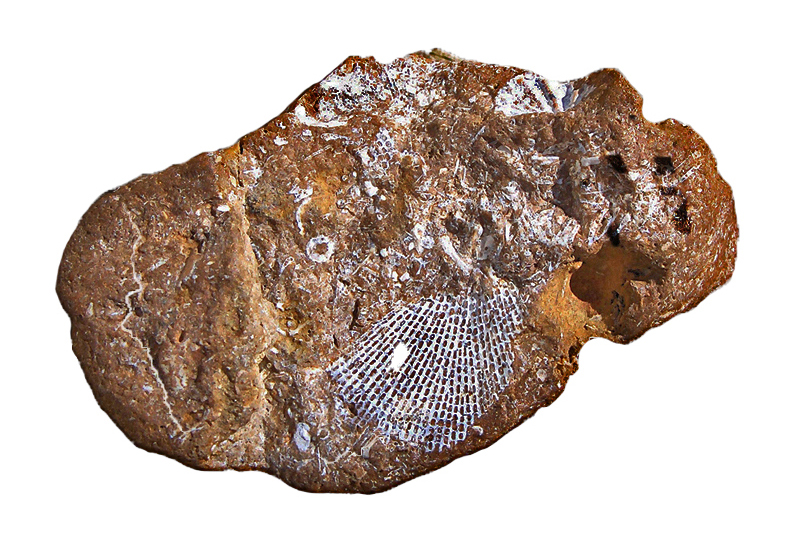
    Extinct Bryozoan Fossil “Fenestella” Found on Lake Michigan Beach

    Bryozoan Fossils

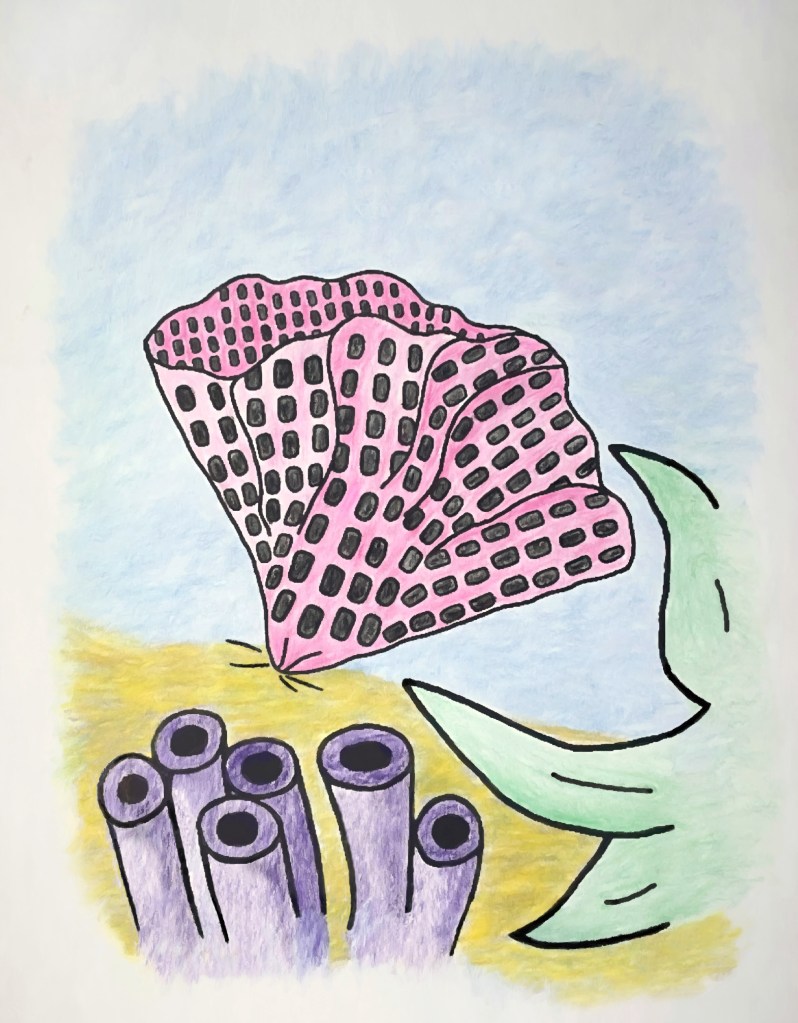
    Bryozoans earn the common name, lace corals, due to their delicately threaded appearance, but they were not true corals. Instead, they were moss-like invertebrate animals. My sample belongs to the family of extinct “Fenestellida” known for their fan-shaped, mesh-like constructs and the genus “Fenestella”. They lived in tight colonies sculpted by hard, limy, branching structures. The colony consisted of thousands of individual animals called “zooids”. Each individual zooid lived inside its own limy tube called a zooecium. The zooecium were the size of sewing needles. A single zooid began the colony. A modern day bryozoan colony has been observed growing from a single zooid to 38,000 in just five months. Each additional zooid is a clone of the very first.

    Bryozoan “Fenestella” Extinct Fossil Drawing

    Interesting how bryozoans feed. Each zooid has an opening through which the animal can extend its “lophophore” a ring of tentacles that captured microscopic plankton passing by in the oceanic currents. If one zooid receives food, it nourishes the neighboring zooids joined by strands of protoplasm. If only we humans could be more like them, ensuring everyone on the planet is fed!

    Their incredible fossil record dates back 500 million years ago (mya), with 15,000 known species. Today there are approximately 3,500 living species. For more information and photos about bryozoans you can go to the fossillady article specifically about them HERE.

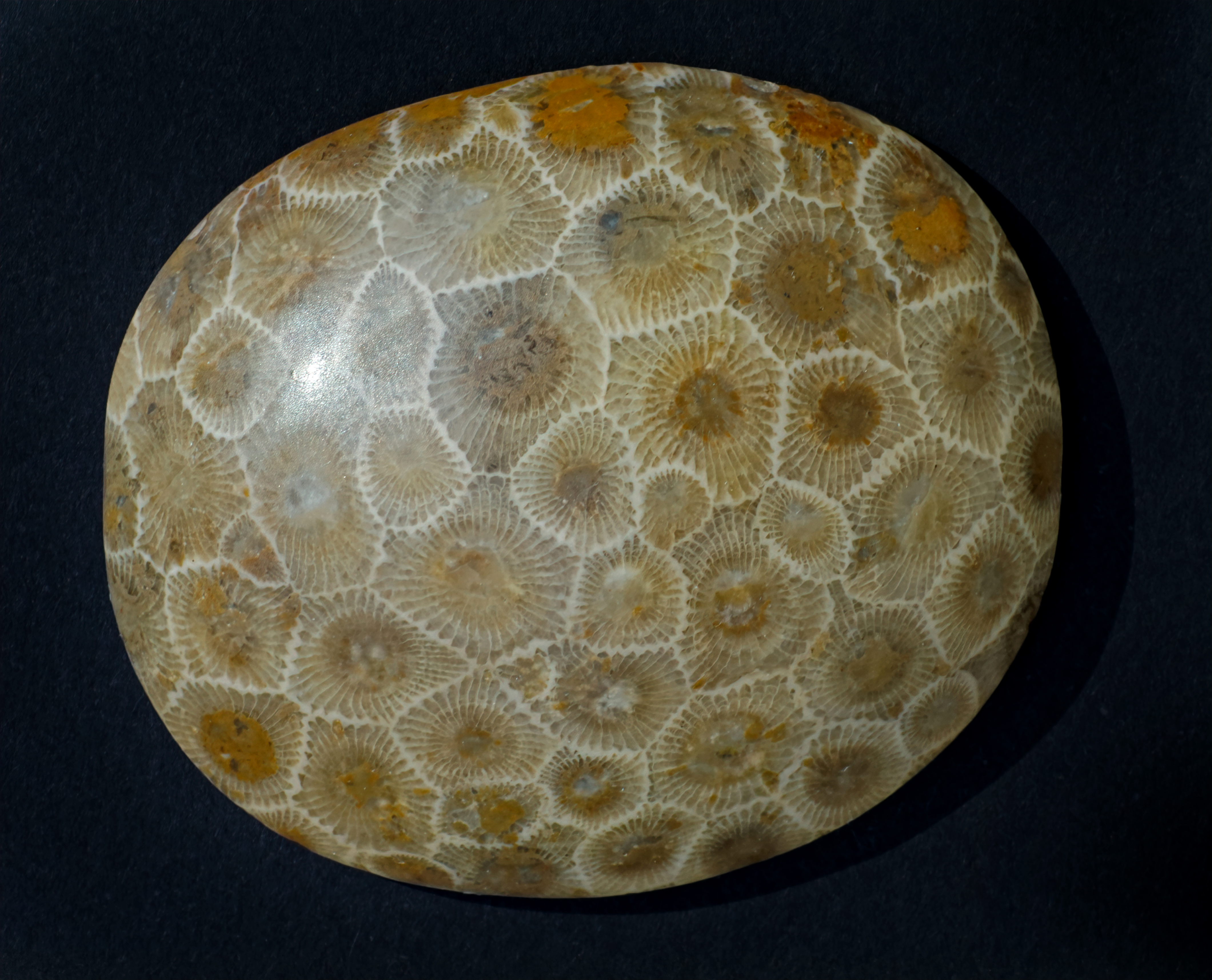
    Polished Petoskey Stone (Hexagonaria, percarinata) Coral Fossil, Michigan

    Petoskey Stone Coral Fossils

    Petoskey Stones “Hexagonaria, percarinata” flourished in mass colonies during the Paleozoic time slot when Michigan and all of the Americas were covered under shallow, saltwater seas. The ancient seascape must have been lit up with a quiltwork of colors created by their vast colonies. Sadly, they became extinct at the end of the Permian Period mass extinction approximately 250 million years ago.

    The name “Petoskey” originated from an Ottawa fur-trader chief named, Petosegay. A northern Michigan city was named after him, later, the name was modified to Petoskey. Because the coral fossils are so abundant near the city of Petoskey and surrounding region, Governor George Romney signed a bill in 1965 making the Petoskey Stone the official state stone and fossil.

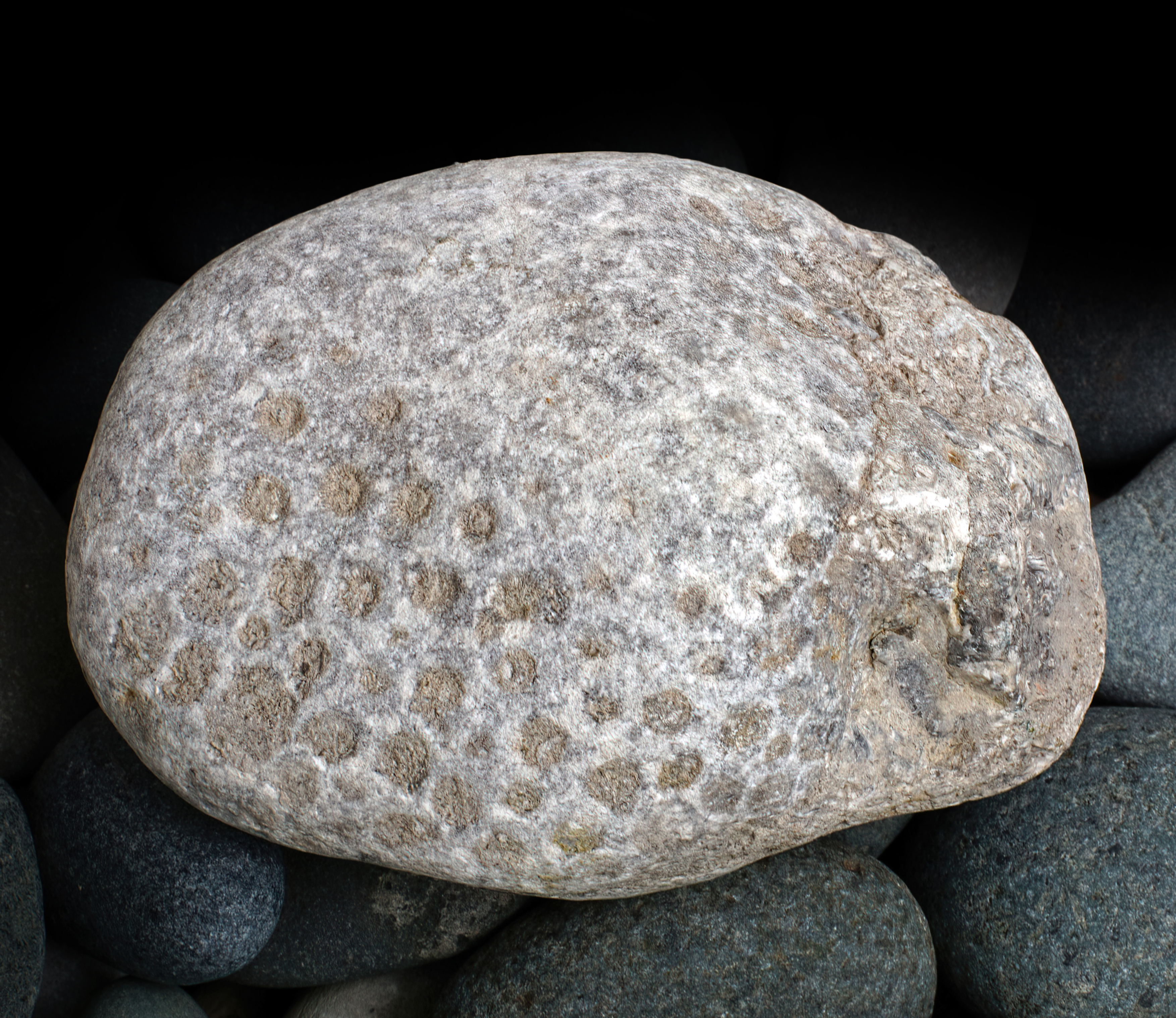
    Petoskey Stone found on Southwestern Lake Michigan Beach
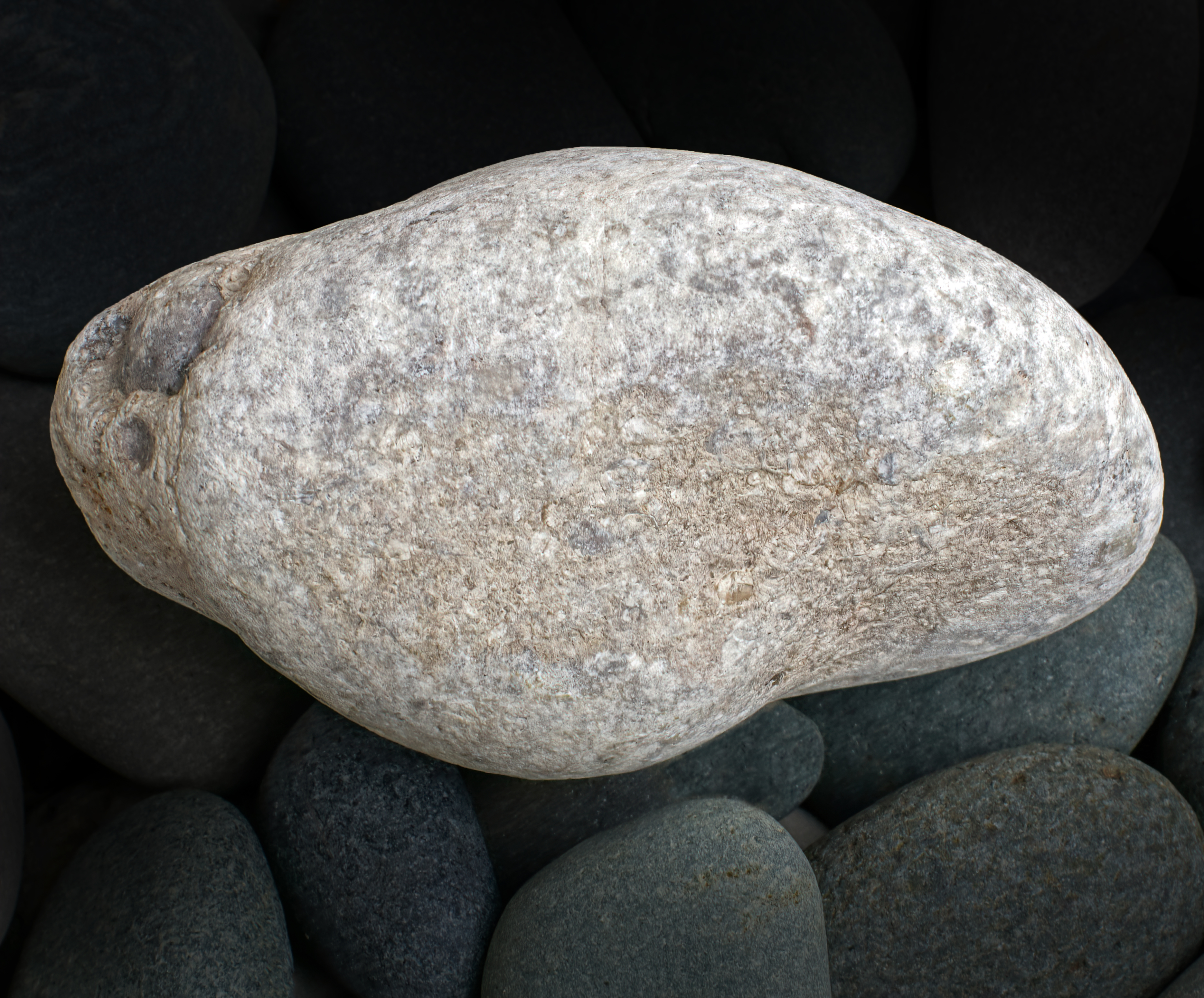
    Petoskey Stone (Side View) Lake Michigan

    I found the above Petoskey Stone on Oval Beach in Southwestern Michigan. This sample is rough and raw and unpolished. It’s smoothness and wear is a good example demonstrating Lake Michigan’s natural polishing process produced by perpetual winds, waves, and sand movement. It’s a fairly large sample at least the size of a man’s fist. The sideview of it, shown right, reveals the stem where the coral attached to the ancient seafloor. It’s kind of rare to see this because so many of these coral fossils are sanded down and polished for their intricate beauty and sold as gifts and keepsakes.

    Each individual coral hexagon structure called, corrallite, is visible in most Petoskey Stone fossils. Corallites held a single animal (polyp) which opened a mouth to expose tentacles. The tentacles took in food and were also used to sting other organism or even neighboring coral tentacles that came too close. Calcite, silica, and other minerals replaced the original corallite exoskeleton. For addition fossillady photos and information specifically about Petosky Stones click HERE.

    Drawing of Extinct Hexagonaria, percarinata “Petoskey Stone” Living on Cliffside
    Favosites “Honeycomb” Coral Fossils “Charlevoix Stones” found on SW Michigan Beach

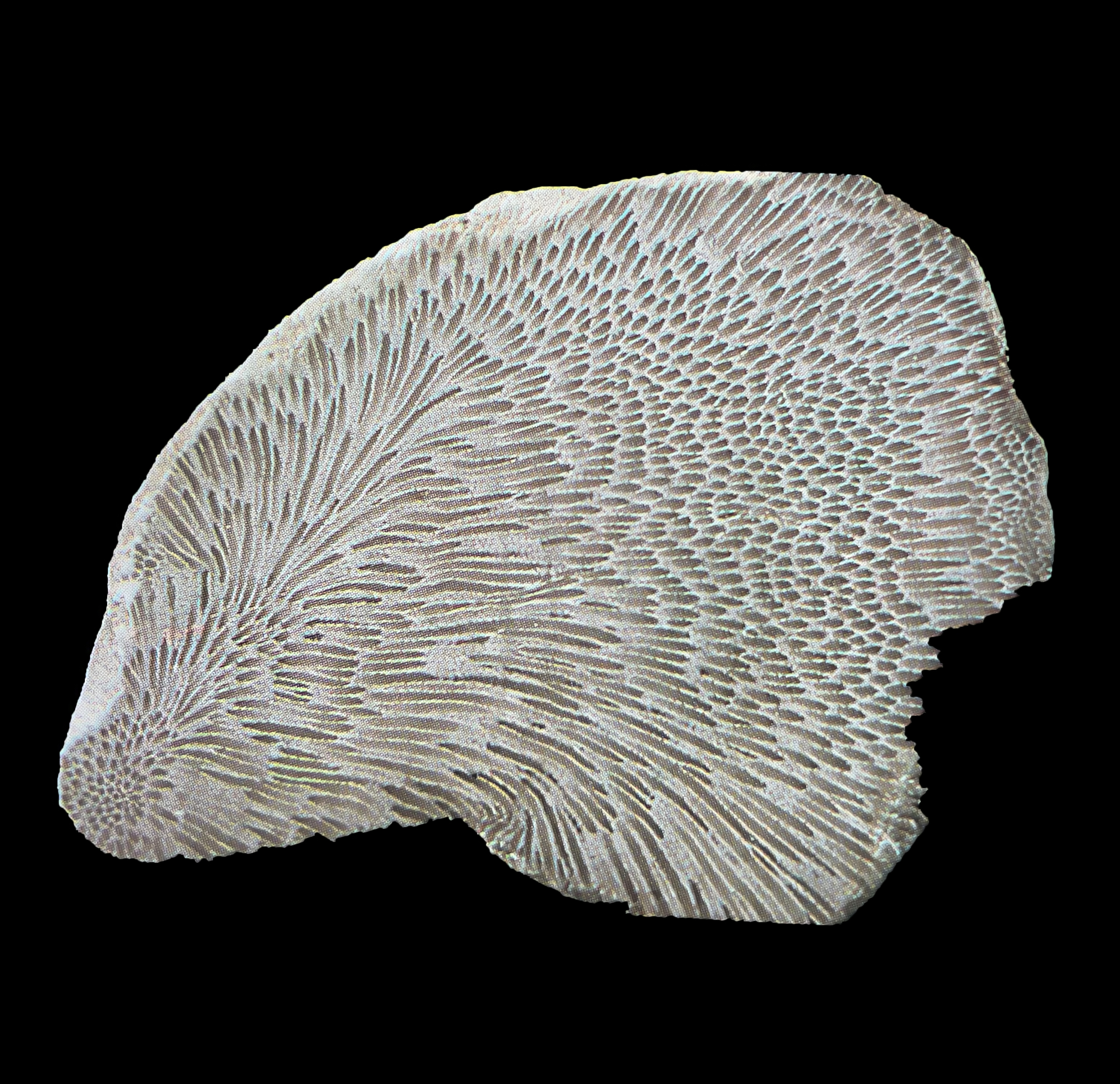
    Favosites “Honeycomb” Coral Fossils

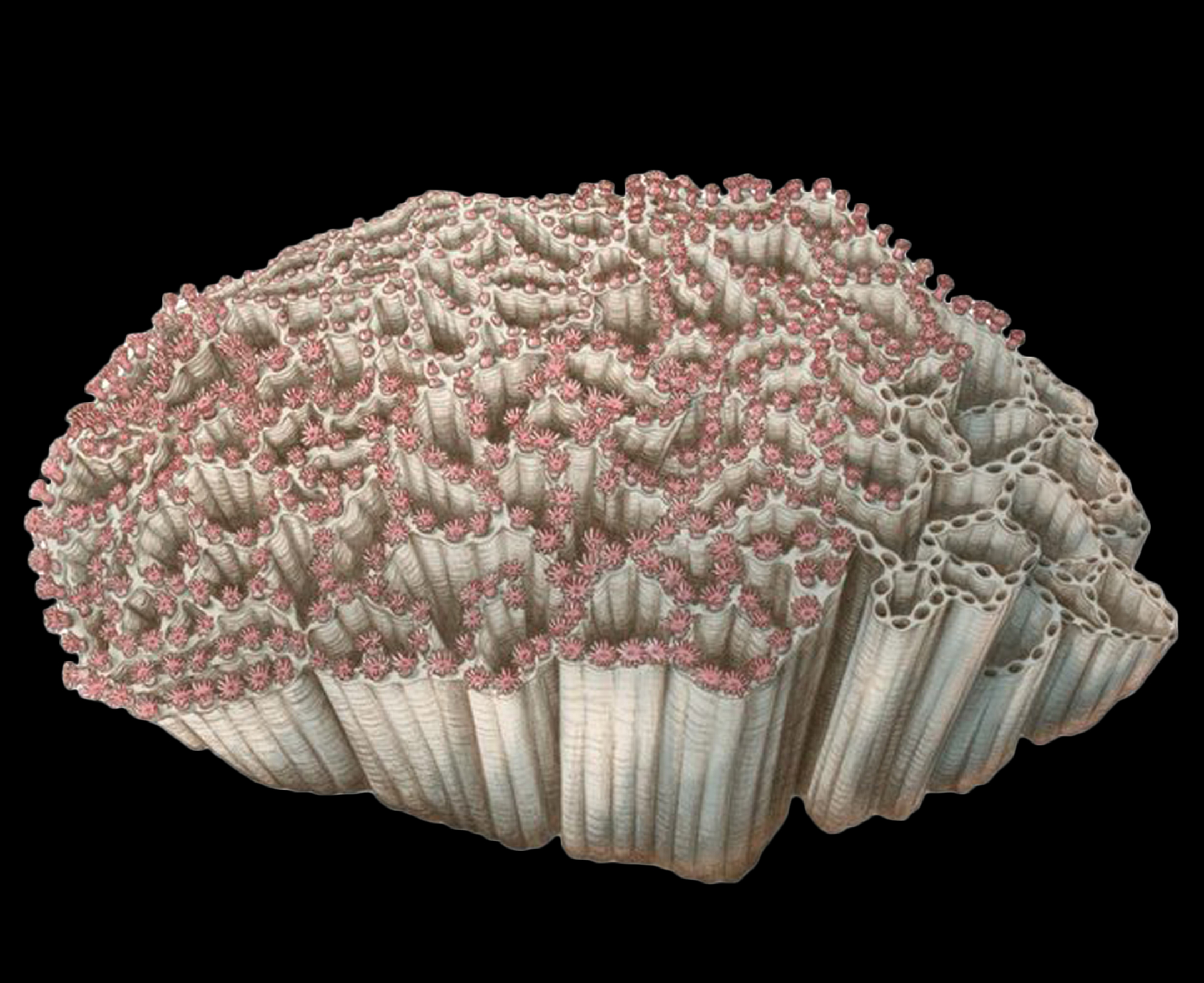
    Favosites fossils are fairly common to find if you live in Northern Michigan, particularly near Charlevoix, but they are more rare to find in Southwestern Michigan where I found the above samples on the beach. Favosites is a genus of corals that belonged to the extinct order of “tabulate” colony corals. Gathered together they created colorful reefs thriving in warm, shallow seas during the same time period as the “Petoskey Stone” extinct corals, which I described above. The favosites can easily be identified by the honeycomb patterns enfolding their exterior fossil remains. These where the casings supporting their individual living coral polyps that could retract inside or stretch out, as with all coral species. Consequently, they are often referred to as, “Honeycomb Corals”, but they are also called “Charlevoix Stones” due to their dominant appearance in that region of Michigan.

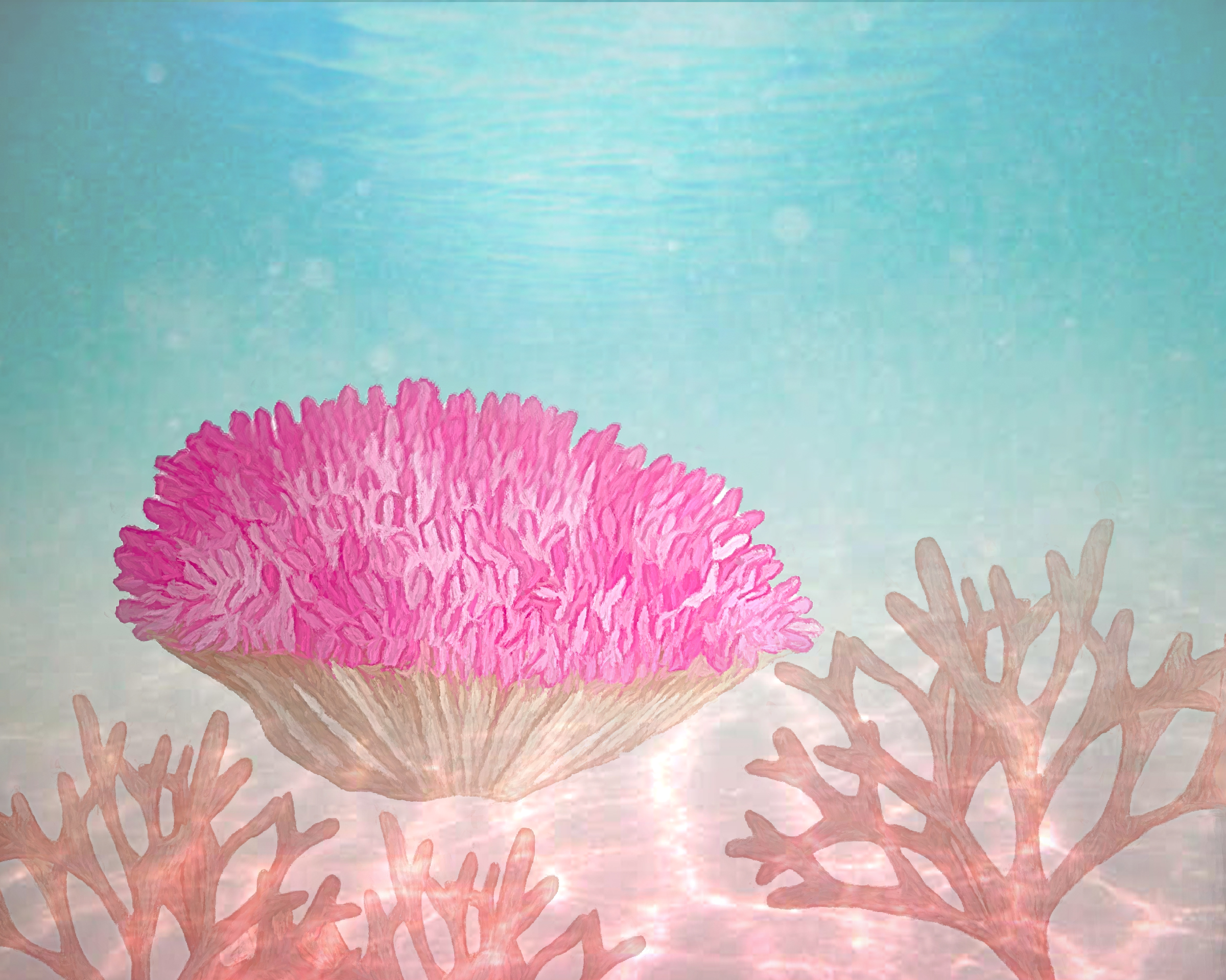
    Drawing of Favosites Coral “Honeycomb Coral” with polyps out!
    Favosite Fossil

    The tabulae (horizontal internal layers) of favosites were built outward as the organism grew. These layers can clearly be seen in the fossil photos provided. The walls between each corallite (cup housing for the individual animal polyps) were pierced by pores known as mural pores which allowed a transfer of nutrients between polyps. For more photos and information specifically about favosites in another fossillady article go HERE.

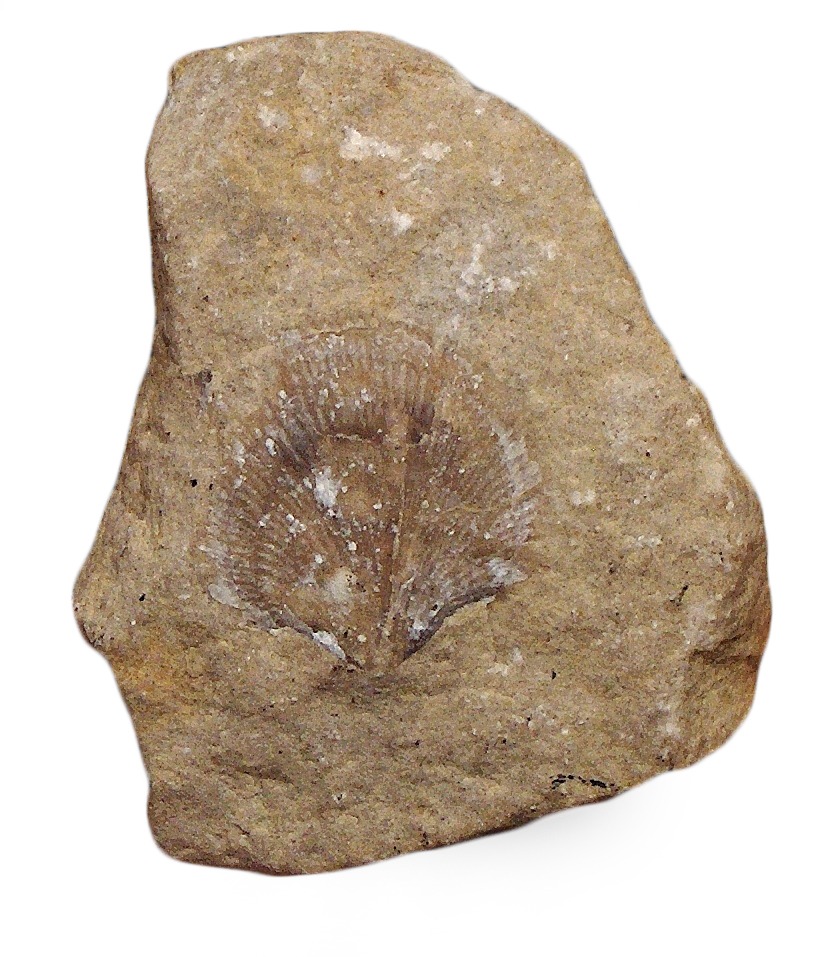
    Brachiopod Fossil found on Lake Michigan Beach

    Brachiopod Fossils

    No other organisms typify the Age of Invertebrates more than brachiopods. They were the most abundant animals during the Paleozoic Era, except for maybe trilobites. Due to their abundance, paleontologists use them to date rocks and other fossils found in the same rock strata. Countless billions accumulated on the ocean floor with over 30,000 forms. Today there are far fewer species, only around 300, which live mostly in cold, deep ocean environments.

    Brachiopods look similar to clams but are very different inside. Also, clams (pelecypods) have uneven-shaped shells, but both top and bottom halves are identical. Brachiopod possess symmetrical shells, left to right, but the bottom shell is smaller. Brachiopods are commonly called “lampshells” due to some species displaying a similar shape as a Roman oil lamp.

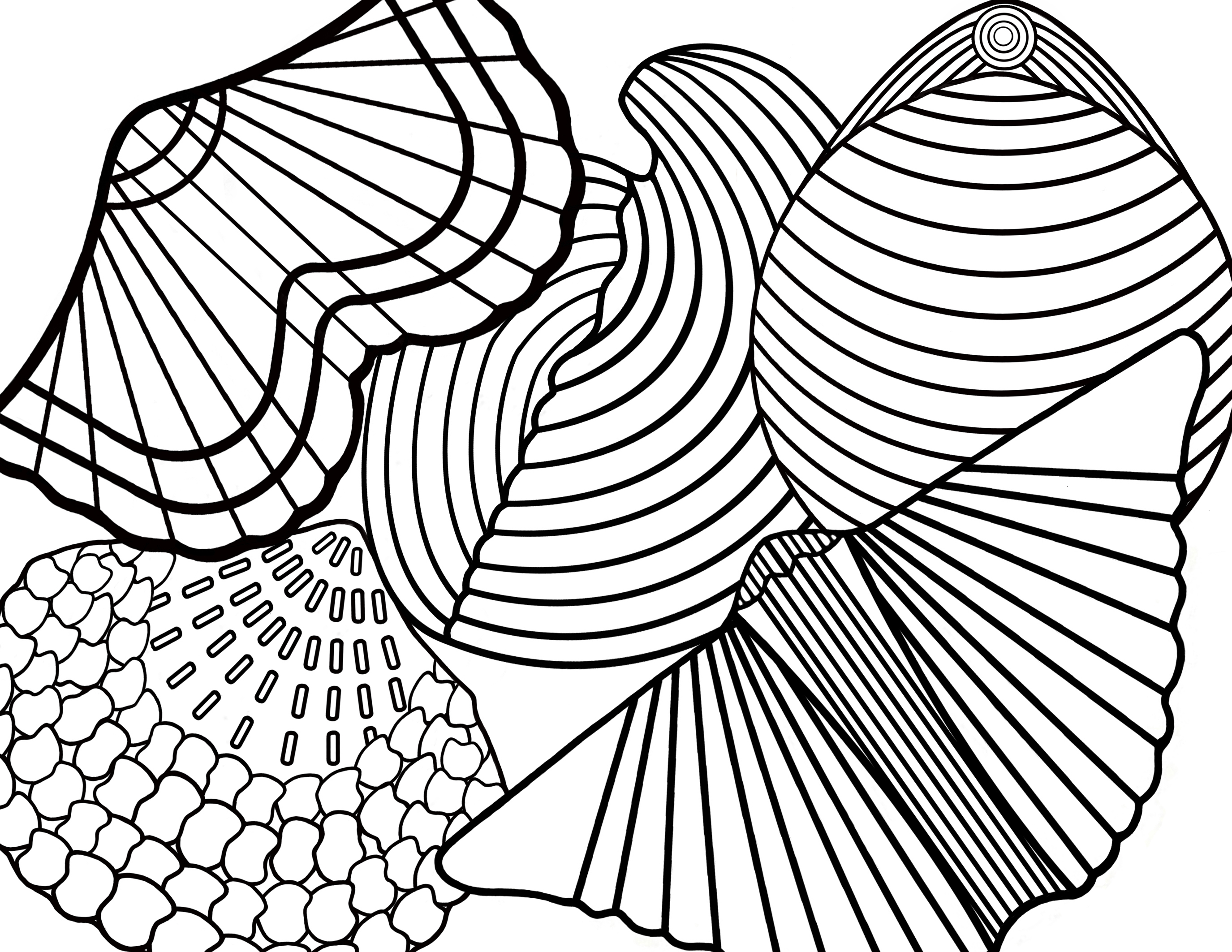
    Varied Shapes of Brachiopods Drawing (sample page from fossillady coloring book)

    Brachiopods live in communities attached to objects by a muscular foot called a “pedicle”. They strain water in and out of their shells, filtering microorganisms with a crown of feathery tentacles called “lophophores”. They come in a variety of interesting shapes as demonstrated in this image included in my fossil coloring book available for sale! More interesting information about brachiopods by fossillady described HERE!

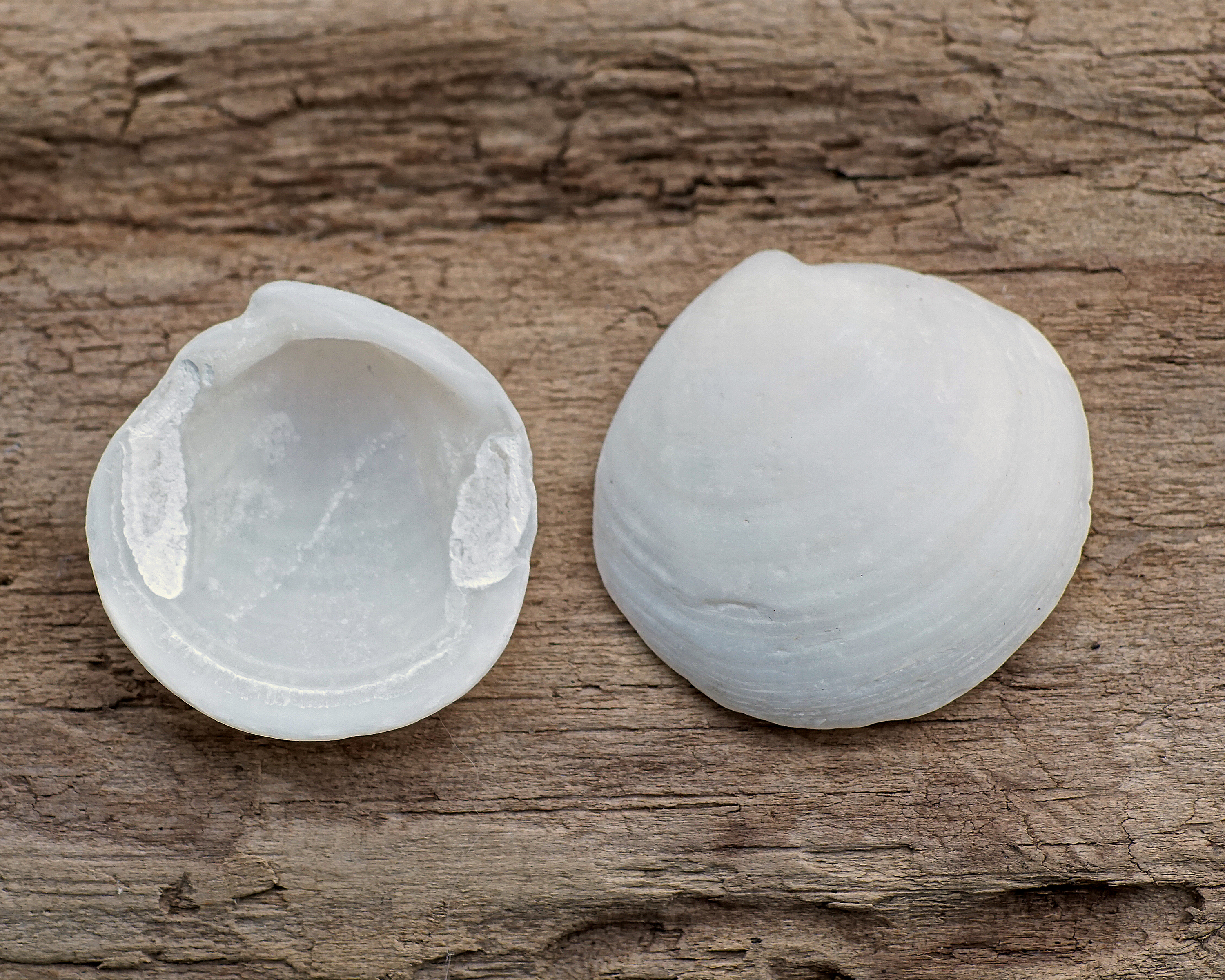
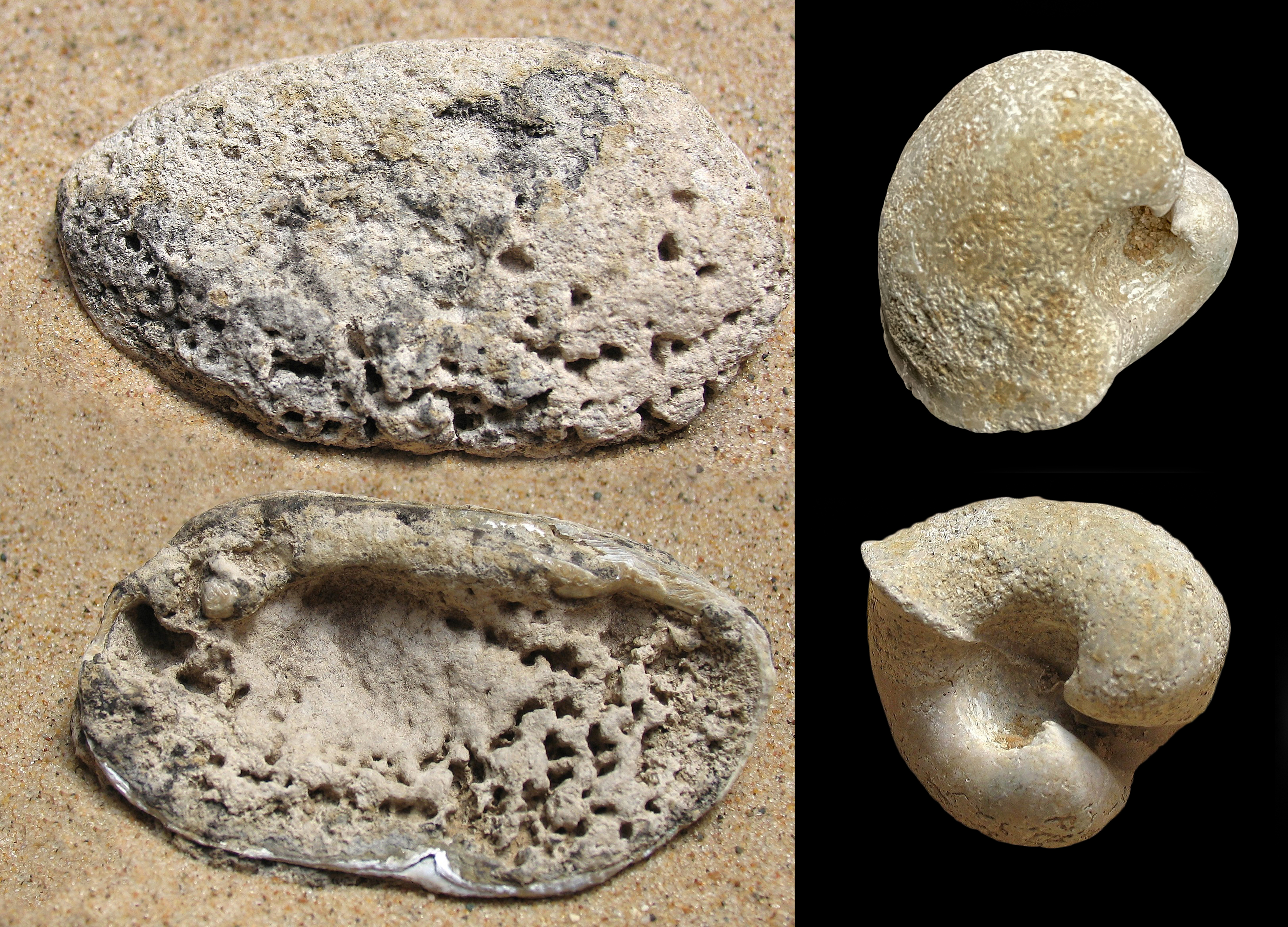
    Clam Fossils found on Lake Michigan beach

    Clam Shell Fossils

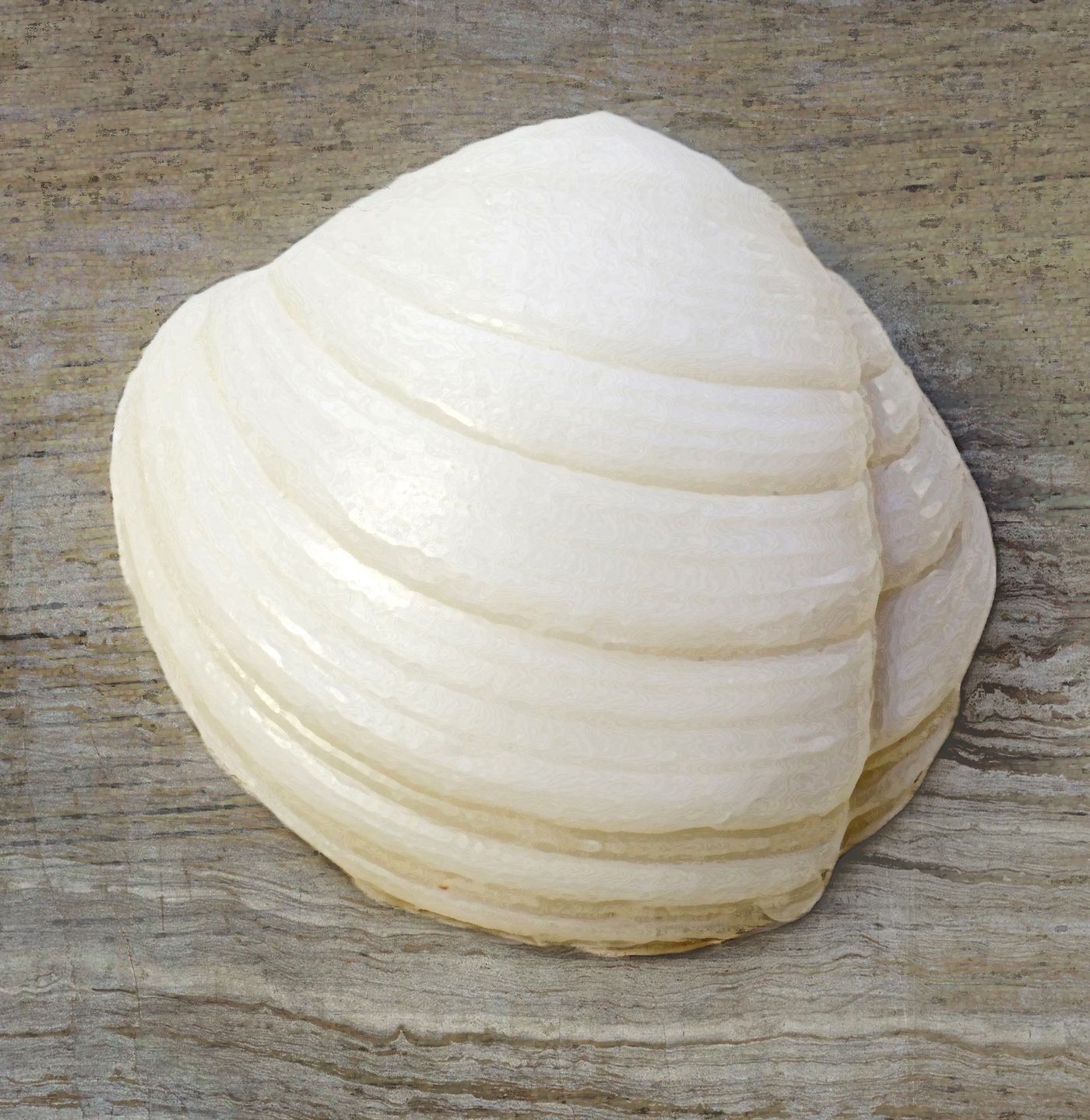
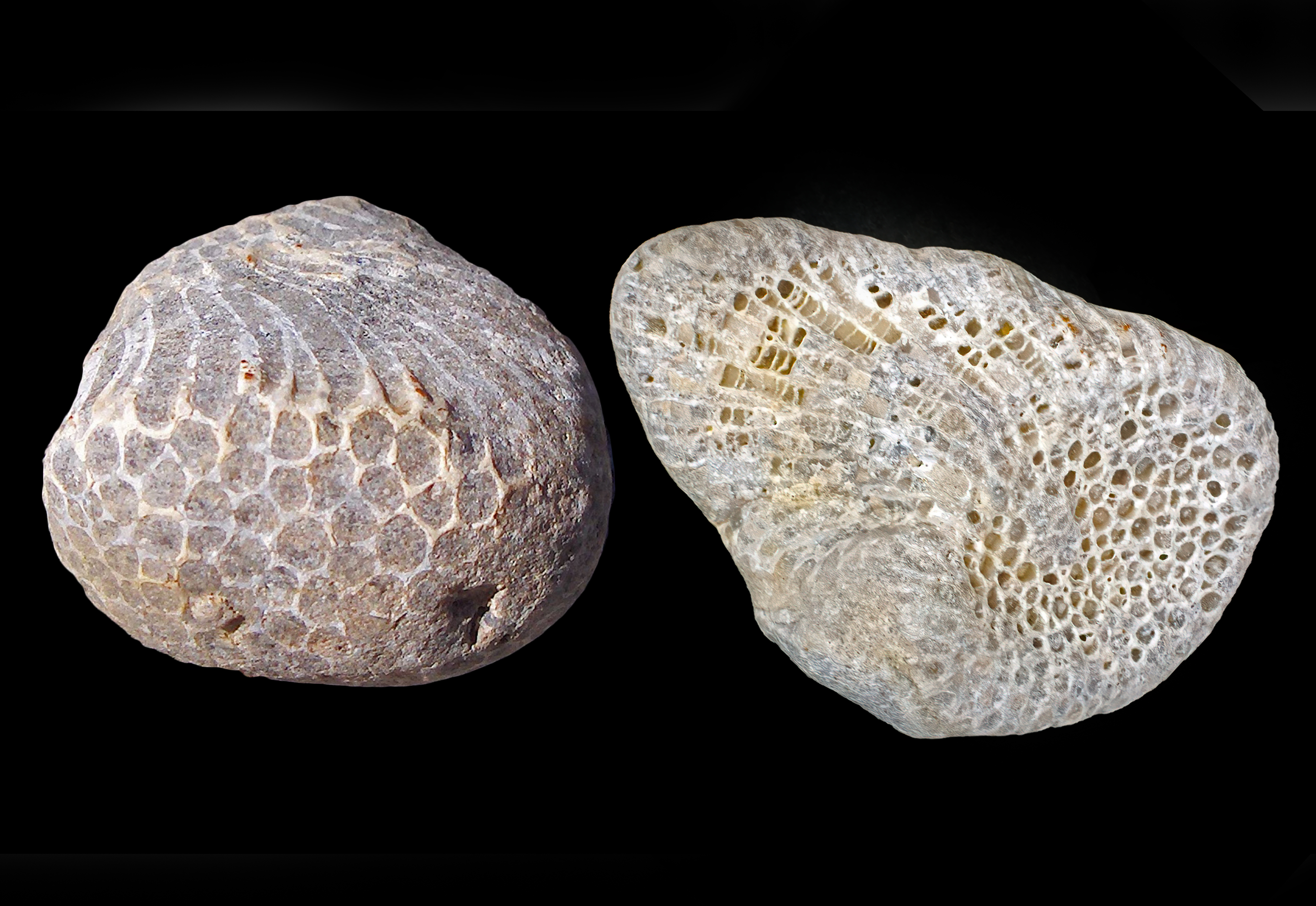
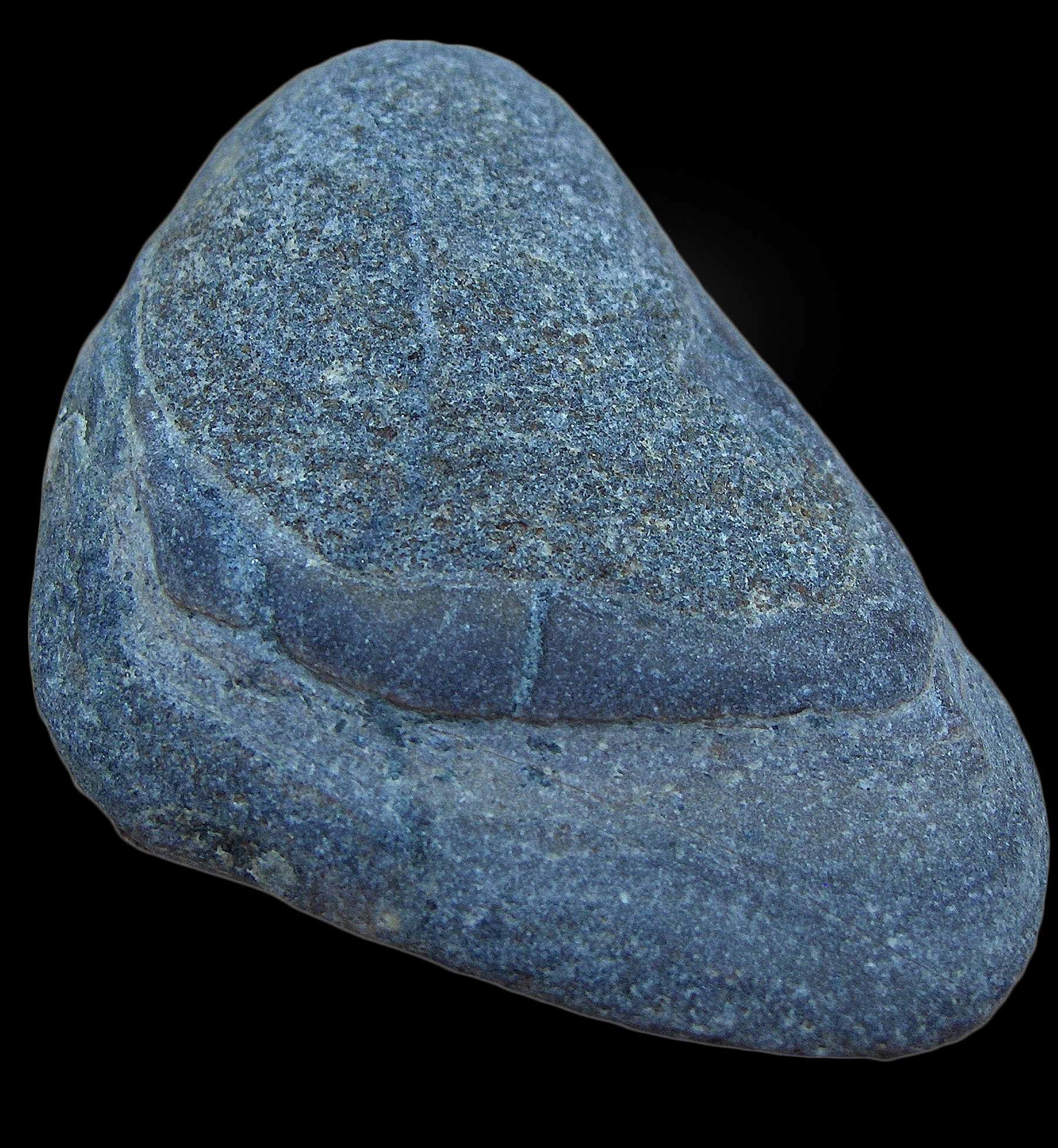
    I found these clam fossils on the shore of Oval Beach in Southwestern Michigan. The sample above left clearly reveals hardened muddy sediment that has completely encrusted the clam shell inside and out. The samples above right and below (dark grey) are examples of mold casts of the animal’s shells, where sediment and minerals permeated inside the shell after the animal died. Their smooth surfaces are the telltale demonstration of Lake Michigan’s sand, wind and water movement acting as a polisher.

    “Clam” can be a term that covers all bivalves. Some clams bury themselves in sand and breathe by extending a tube to the water’s surface. Bivalve oysters and mussels attach themselves to hard objects, and scallops can free swim by flapping their valves together. All types lack a head and usually have no eyes, although scallops are a notable exception. With the use of two adductor muscles, clams can open and close their shells tightly. Very fittingly, the word “clam” gives rise to the metaphor “to clam up,” meaning to stop speaking or listening.

    Bivalves have occupied Earth as early as the Cambrian Period 510 million years ago, but they were particularly abundant during the Devonian Period around 400 million years ago. Their fossils are discovered in all marine ecosystems and most commonly in near shore environments. In 2007, off the coast of Iceland, a clam was discovered that was estimated to be about 507 years old. It was declared the world’s oldest living creature by researchers at Bangor University in North Wales. For more in-depth information about extinct clam species click HERE.

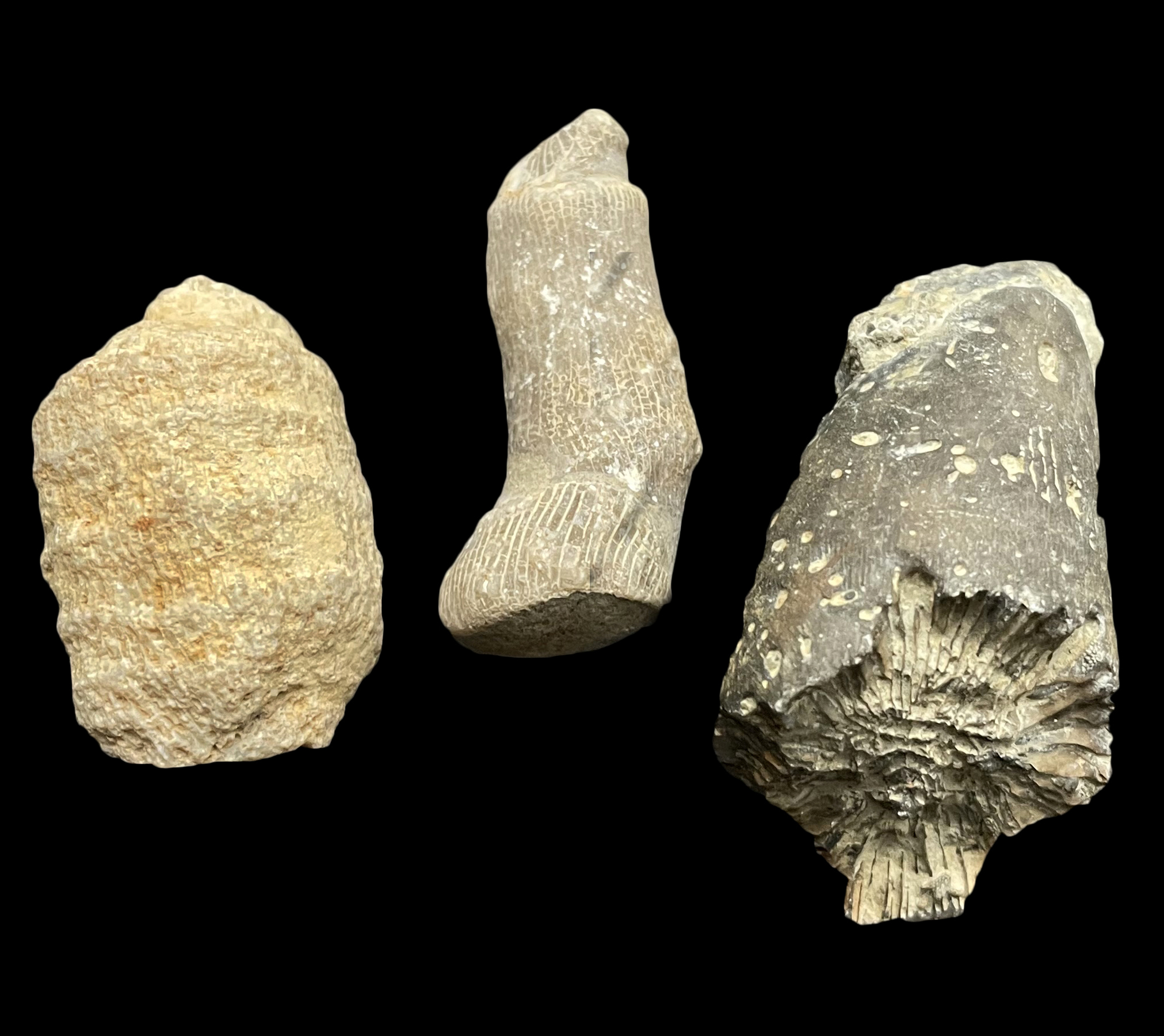
    Horn Corals found on Lake Michigan Beach

    Horn Coral Fossils

    It’s always exciting to find these curious horn coral fossils when combing the beach for something interesting to discover. Horn corals are a genus of corals that belonged to the extinct order of “rugose” corals which appeared as early as 450 million years ago until about 250 mya. That’s an astounding 200 million years living on Earth. Their name derives from their unique horn-shaped chamber with its wrinkled (or rugose) wall. When viewed from its widest opening, it looks like a pinwheel from where the coral polyps once poked out in order to sift microorganisms passing by in the ocean currents. Some species grew two meters high off the seafloor. They were mostly solitary animals, with a few exceptions that grew in mass colonies. For more information and photos about horn corals you can visit another fossillady article specifically about them HERE.

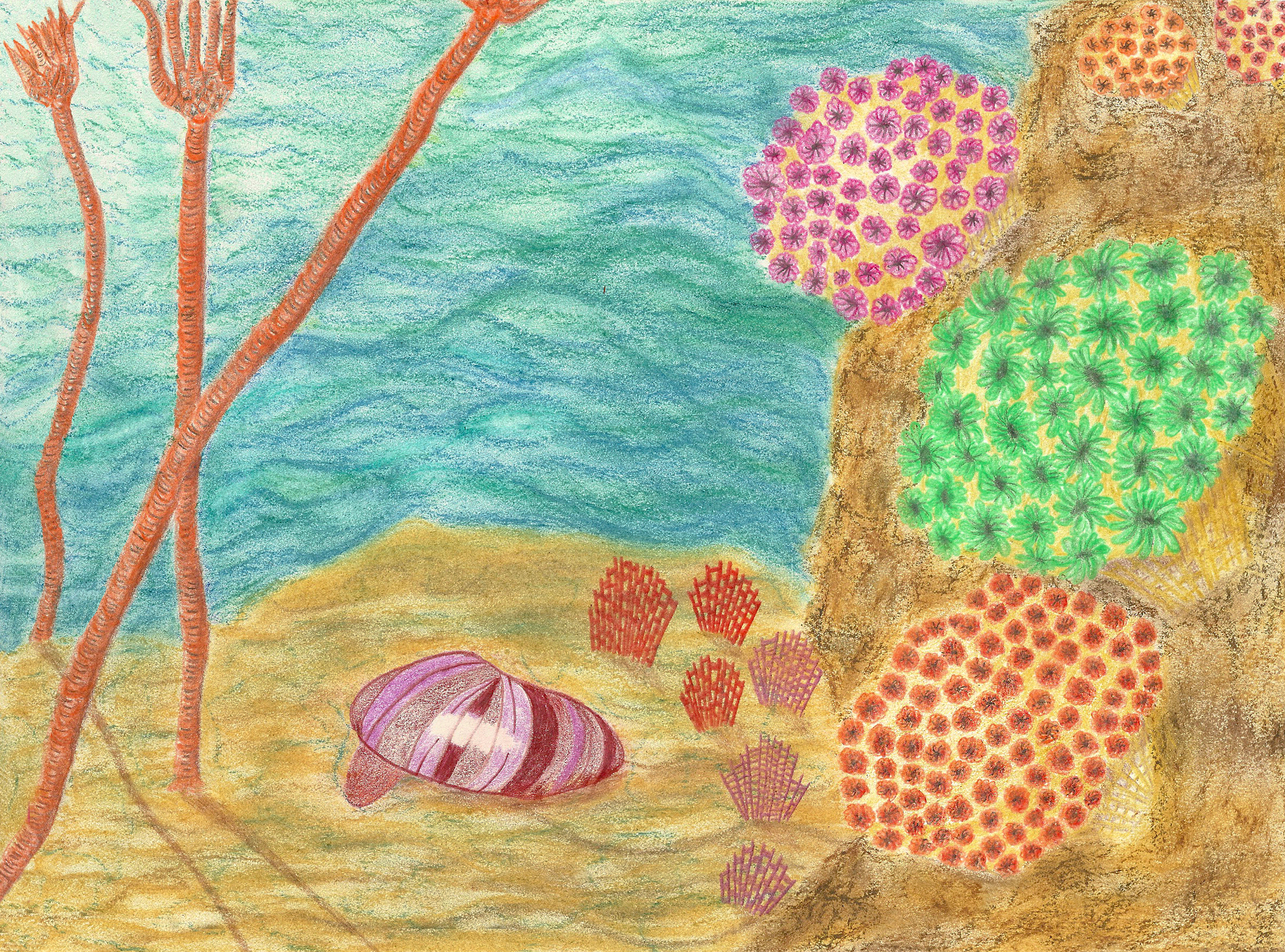
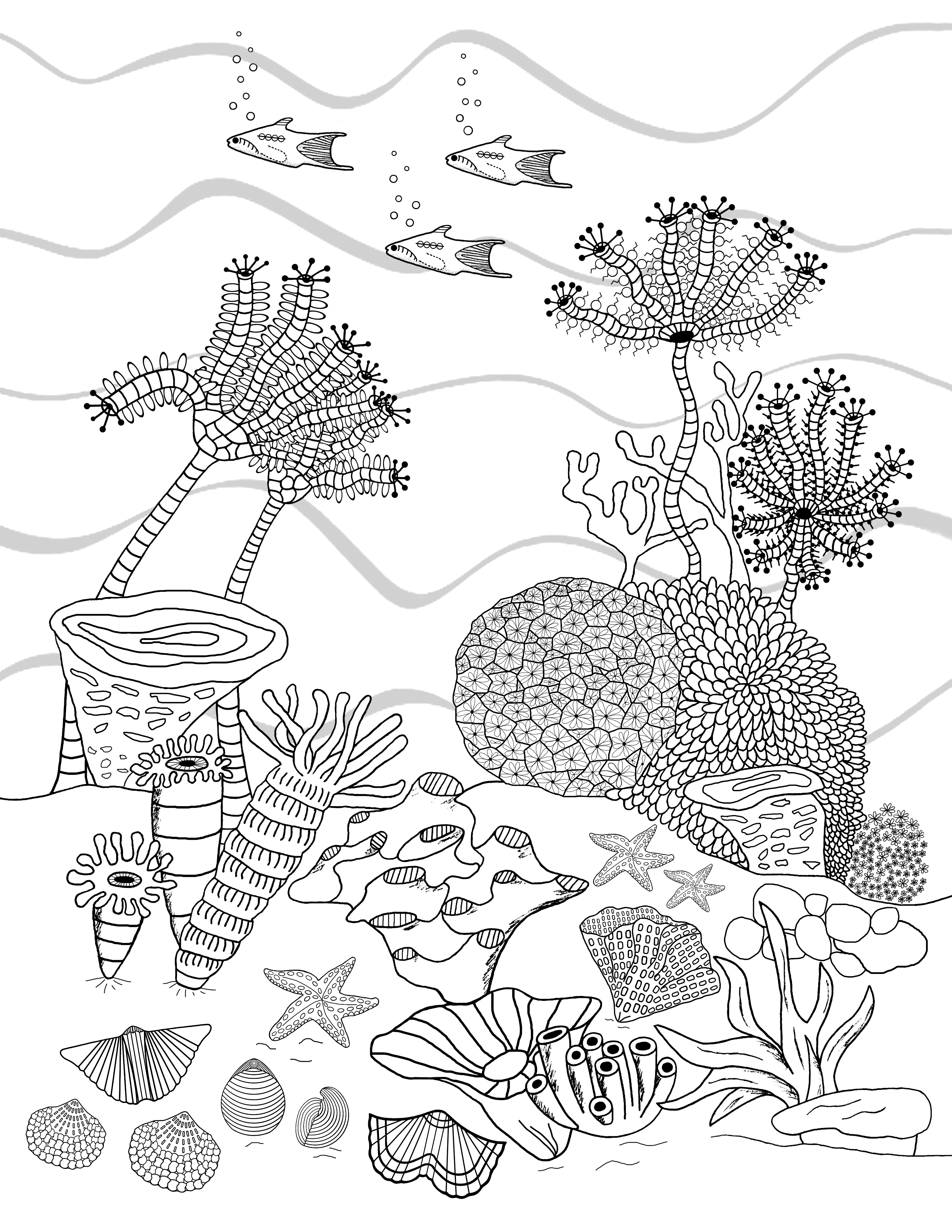
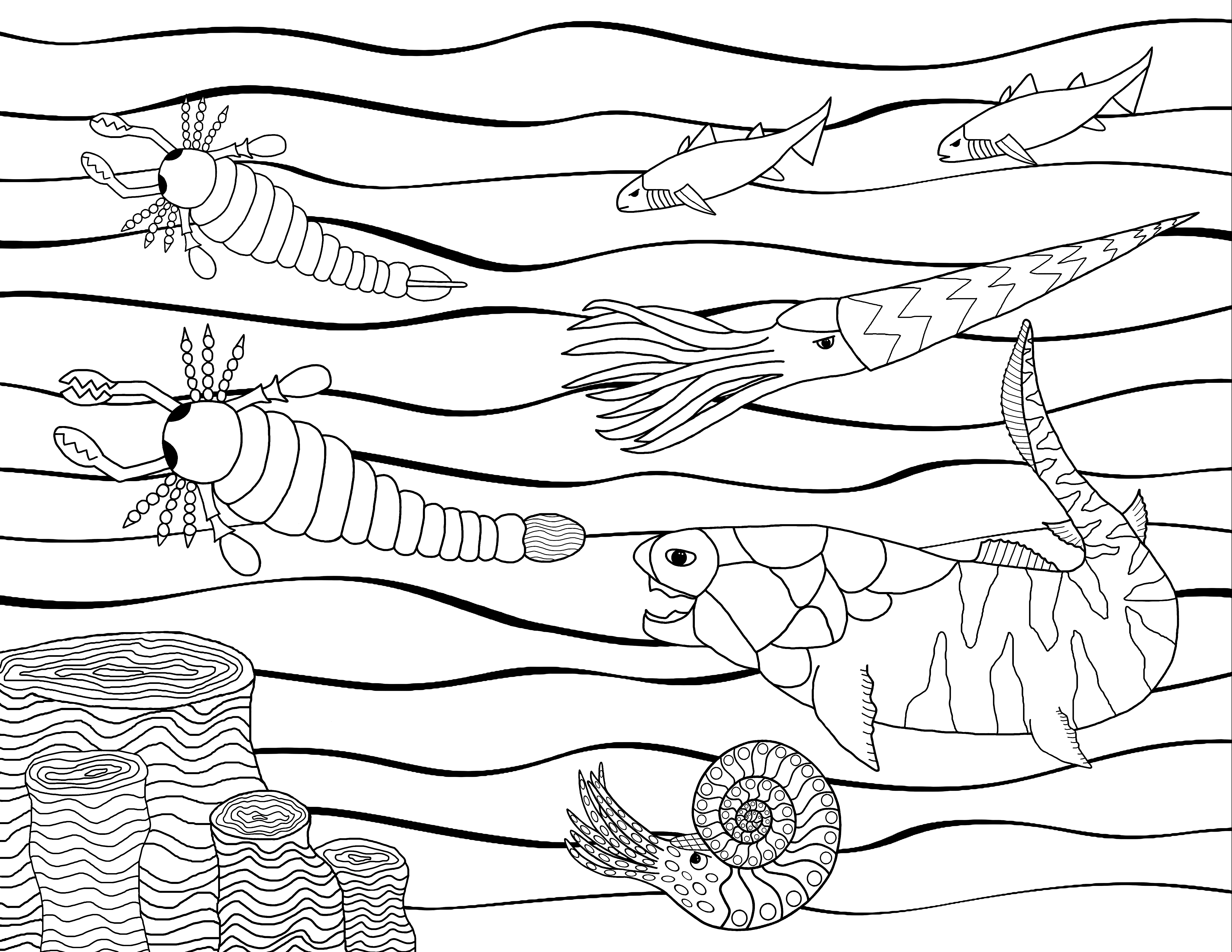
    Fossillady Coloring Book Drawing of Paleozoic Coral Reef

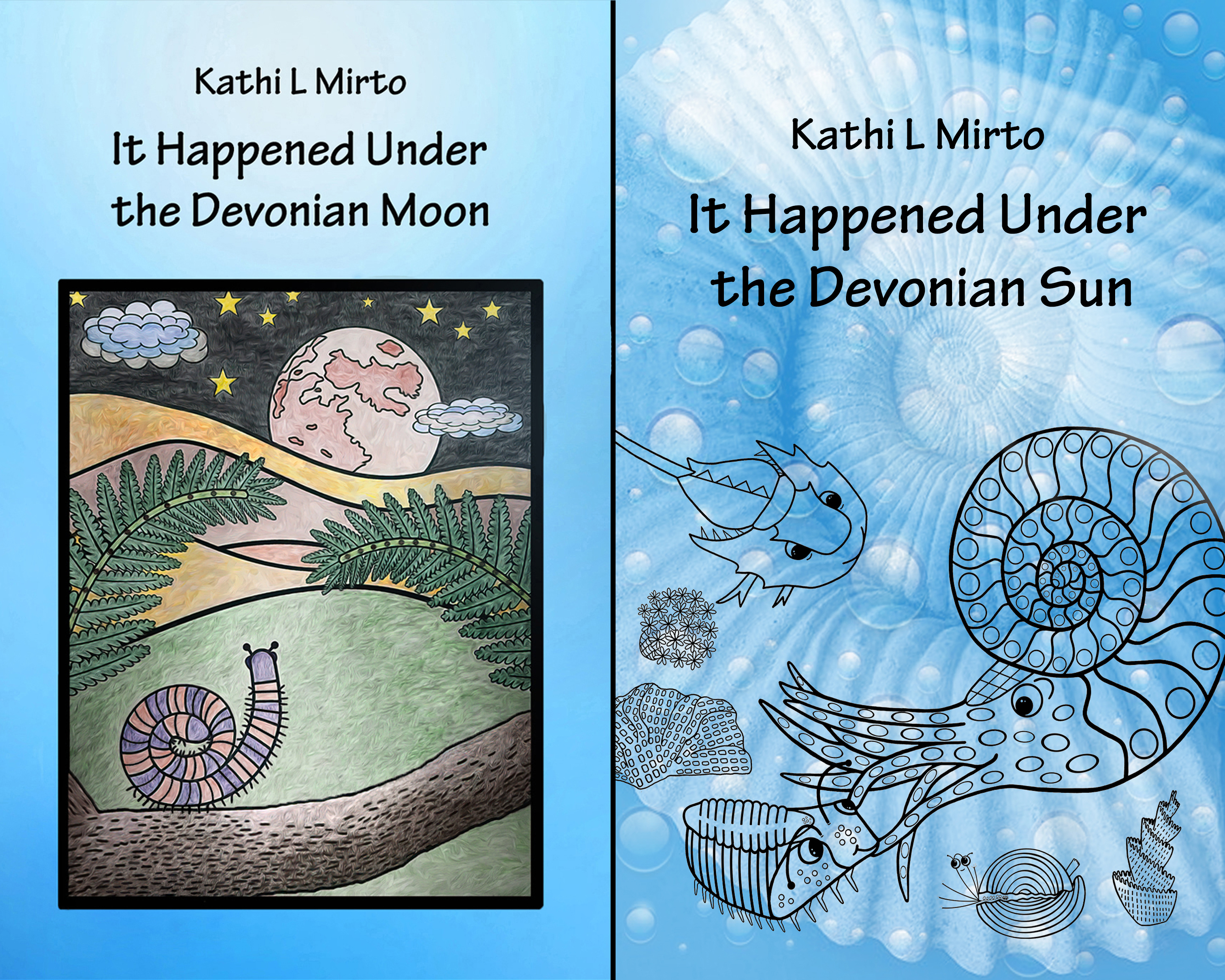
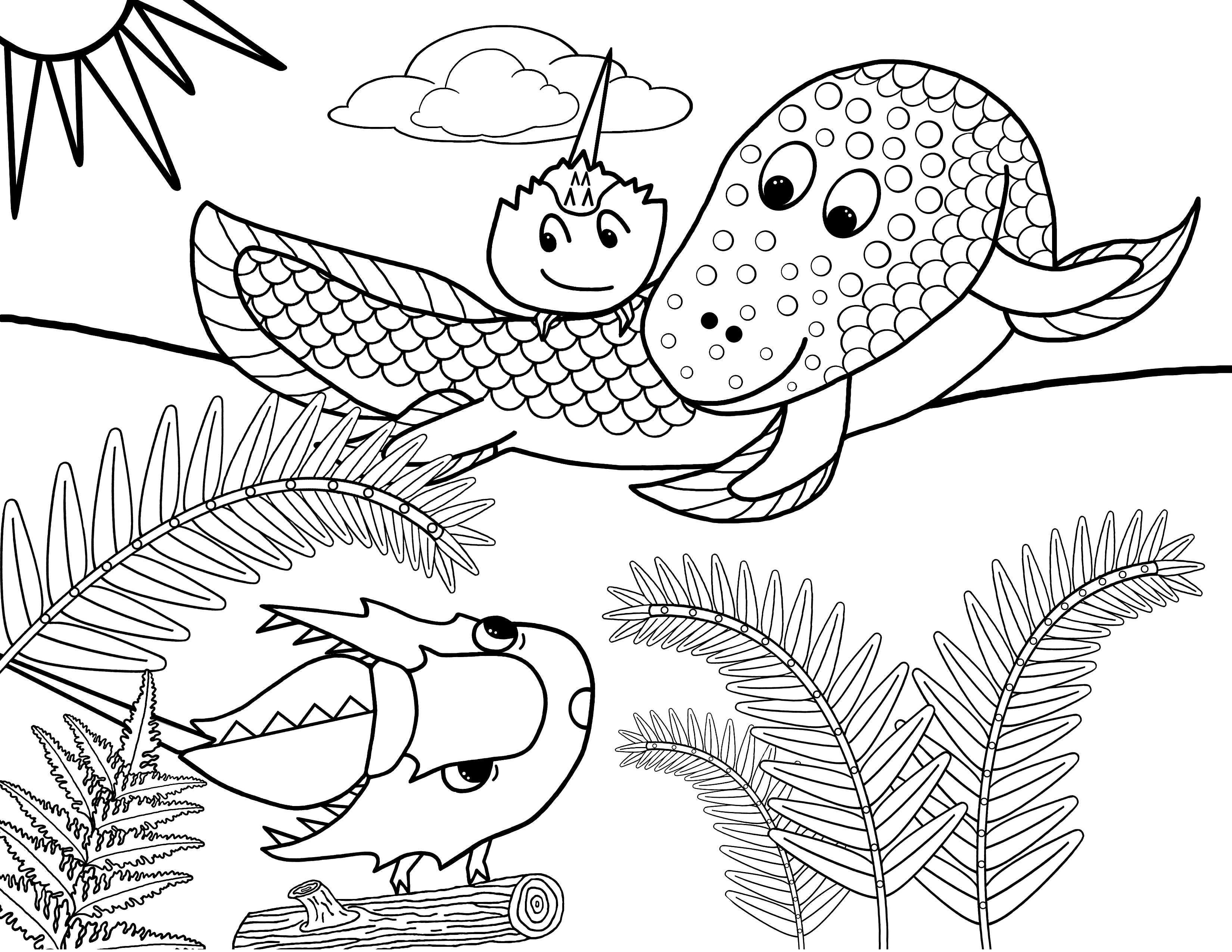
    This is a page from my coloring book I illustrated featuring a Paleozoic coral reef vista. It includes horn corals and the other extinct invertebrate animals which I have outlined in this article. See if you can identify them. For purchase of the coloring book or my two fiction books centered on Paleozoic insights that educate as they entertain, you can go to Amazon or IngramSpark.

    Hayisites “Chain Coral” Fossils found on Lake Michigan Beach

    Chain Coral Fossils

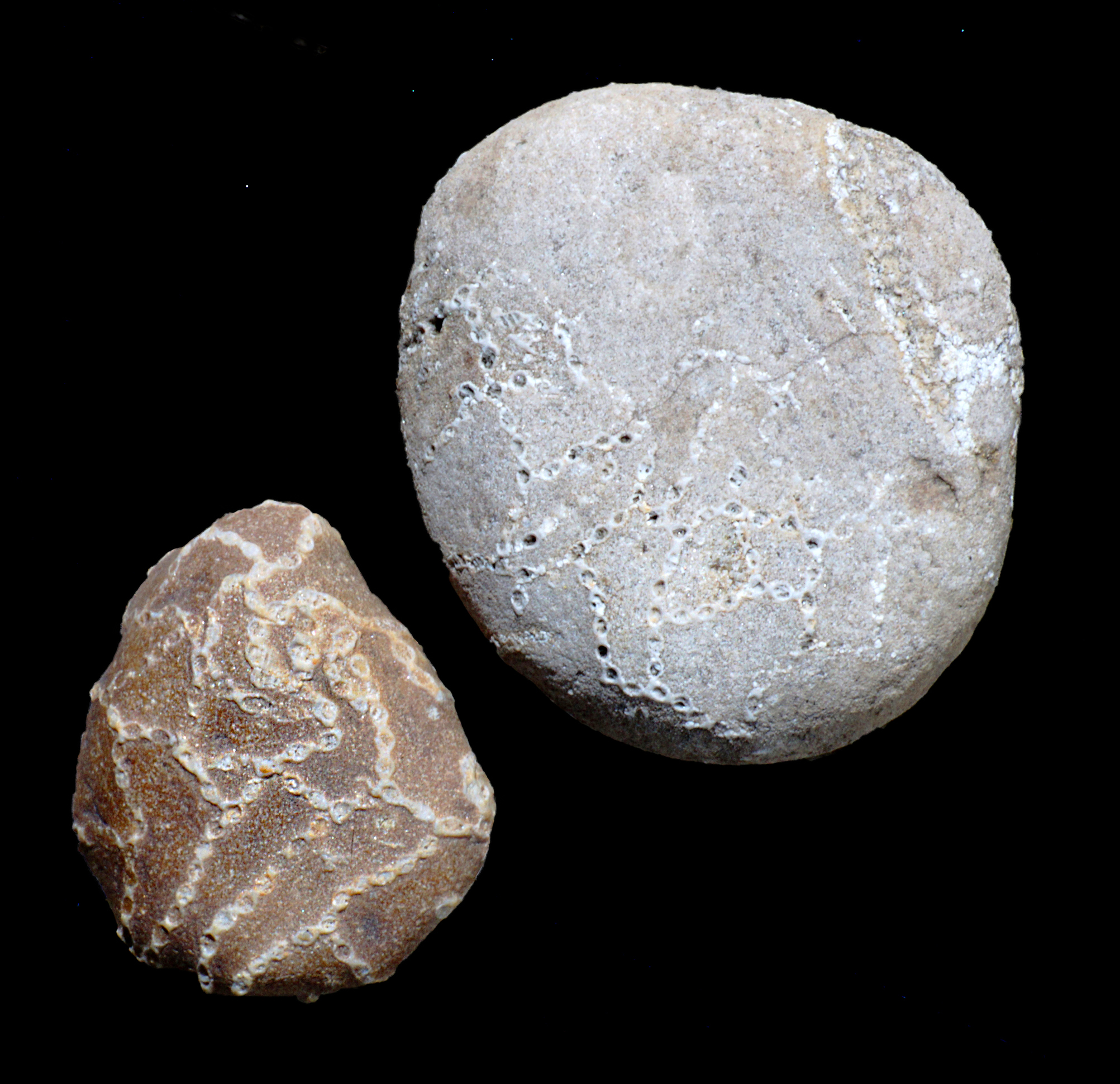
    The trail of chains in these beach-smoothed fossil stones is another occasional fun and interesting find from our Michigan beaches. “Chain Coral” is a common name given to the genus “Halysites” coral from the order “Tabulate” colony corals. Halysites survived from the Ordovician Period (starting around 480 mya) through the Silurian Period (ending around 416 mya). As with most coral polyps, they possessed stinging cells, but the polyps were mainly used to grasp plankton floating by in the ocean currents. As their coral polyps continued to multiply, they added more links to the chain, sometimes building large limestone reefs.

    Halysites “Chain Coral” with polyps out
    Stromatolite Fossil Stone found on Lake Michigan Beach

    Stromatolite Fossils

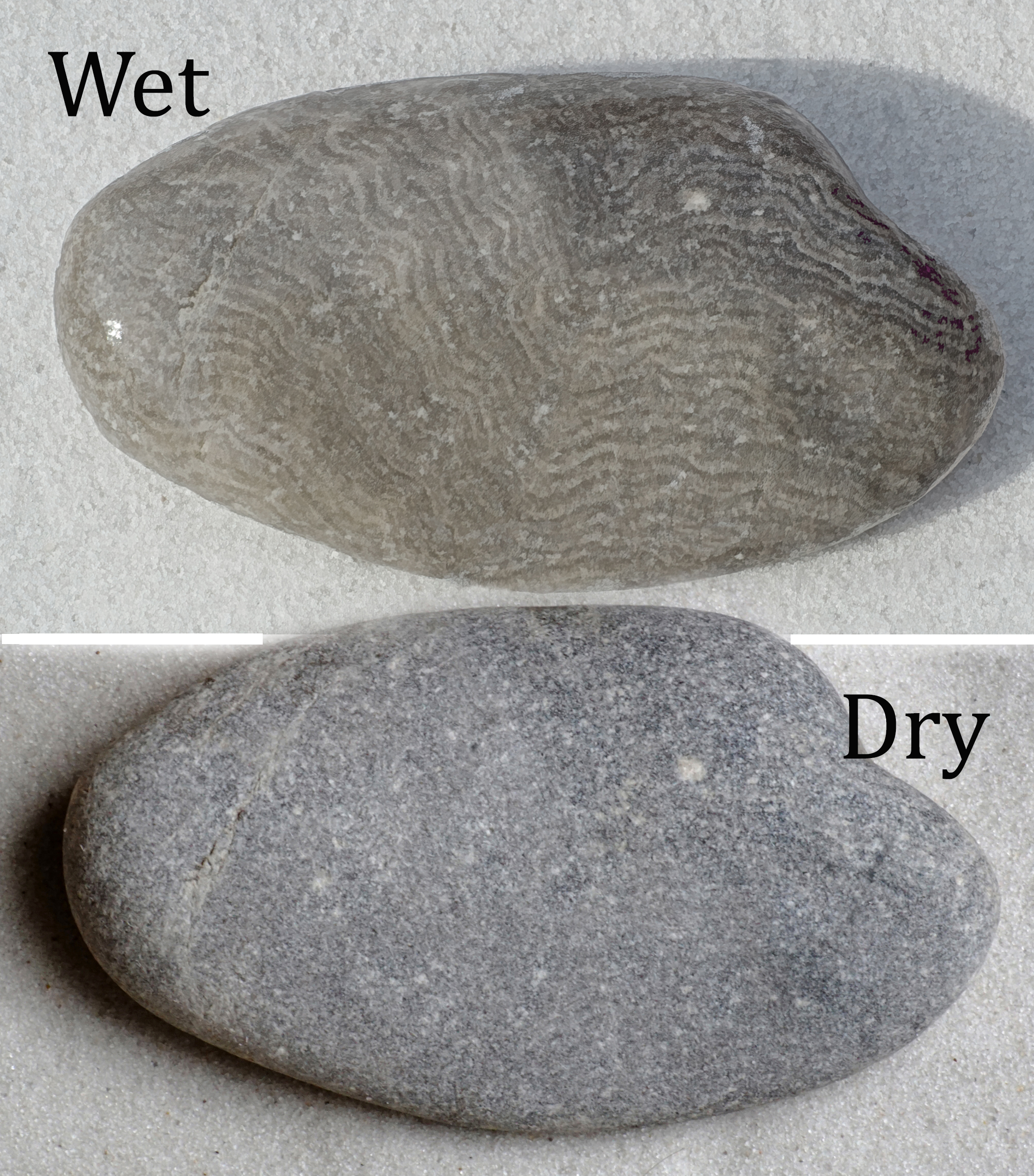
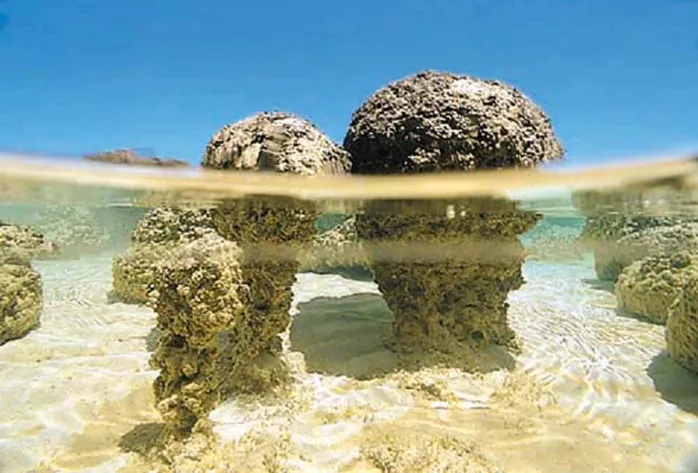
    You’re combing the beach and pick up a common looking smooth stone and admire its sleek texture. You wet the stone and suddenly layers of striations are revealed. That’s what happend with this fossil stone that I found on the beach. It turned out to be a stromatolite fossil and I learned that they are the oldest of all fossils, dating as far back as 3.5 billion years. Their heyday was long before the Cambrian creatures evolved (stromatolites actually paved the way for their existence). Stromatolites were simple cyanobacteria capable of photosynthesis. Their structures grew solid, layered, and varied, some of which looked like giant mushrooms reaching eight feet tall. Through photosynthesis, they changed Earth’s atmosphere from carbon-dioxide-rich to oxygen-rich. Before 1956, scientists believed they were extinct until living stromatolites were discovered in Shark Bay of Australia. Since then, there have been many more stromatolite discoveries around the globe. For more photos and information about stromatolites you can go to this fossillady article specifically about them HERE.

    The stromatolites forming today in the shallow waters of Shark Bay, Australia are built by colonies of microbes. Credit: University of Wisconsin-Madison

    For purchase of the coloring book illustrated by myself or my two fiction books featuring Paleozoic insights that educate as they entertain geared toward middle grade kids to adults, you can go to Amazon or IngramSpark.

    All rights reserved © Fossillady 2026
    Share this:

    • Share on Pinterest (Opens in new window) Pinterest
    • Share on Facebook (Opens in new window) Facebook
    • Print (Opens in new window) Print
    • Email a link to a friend (Opens in new window) Email
    • Share on LinkedIn (Opens in new window) LinkedIn
    • Share on Reddit (Opens in new window) Reddit
    • Share on X (Opens in new window) X
    Like Loading...
    General Comment Lake Michigan Fossil Finds brachiopod fossilbryozoan fossilclam fossilCoral FossilsDevonian Fossilsfossil arthorn coral fossilLake Michigan fossilsMichigan Fossilspaleozoic fossilsPetoskey Stonestromatolite fossil

    Common Beach Stone Identification (Including Dolomite, Geode, Quartzite, Syenite, and More)

    January 12, 2026 by Fossillady
    I Found a Rock on the Beach and Wondered

    A favorite pastime for beachgoers of the Great Lake states is combing the beaches for interesting treasures. Beachcombing can be a very settling and spiritual experience. I have enjoyed collecting many kinds of treasures along the shores of Lake Michigan, but in particular, beach stones. Follow along to learn interesting facts and identifcation of the assorted types of beach stones, both rare and common!

    • Rocks Featured:
    • Syenite
    • Rhyolite
    • Pumice
    • Dolomite
    • Milky Quartz
    • Geode
    • Presque Island Serpentine
    • Quartzite
    • Unakite
    • Dolerite (Diabase)
    • Pegmatite
    • Conglomerate
    • Banded Metamorphic
    • Quartz Veining
    • Wishing Stones/Heart Stones

    If there is a specific rock you are looking for that is not included here in this article, you can try my other Lake Michigan beach stone article HERE which features basalts, gabbro, septarian brownstone, limestones, granite, diorite, gneiss, schist, sandstone, silt stone, mudstone, clay stone, geode, chalcedony, and agate.

    Syenite Boulder found on Lake Michigan Beach

    Syenite

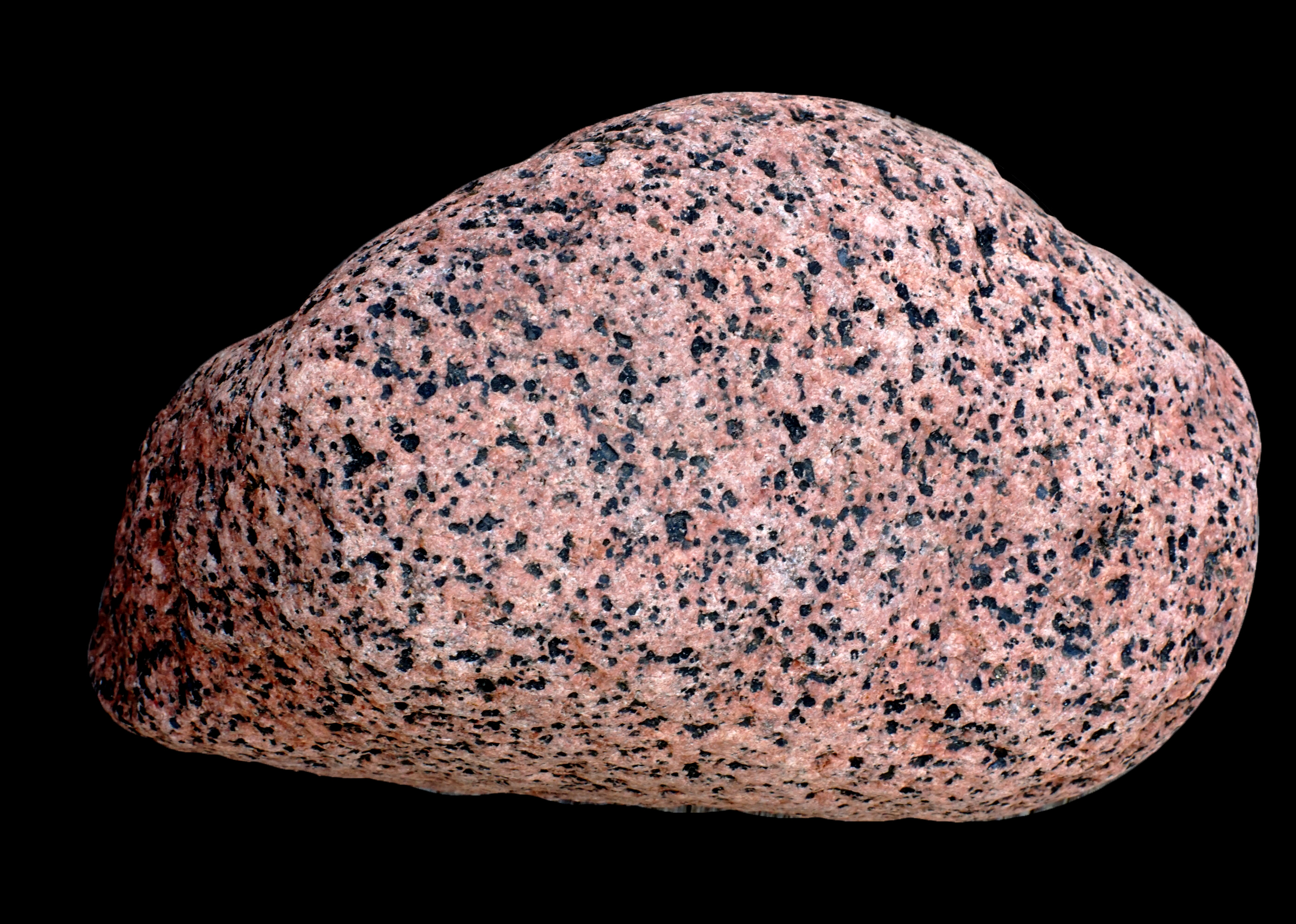
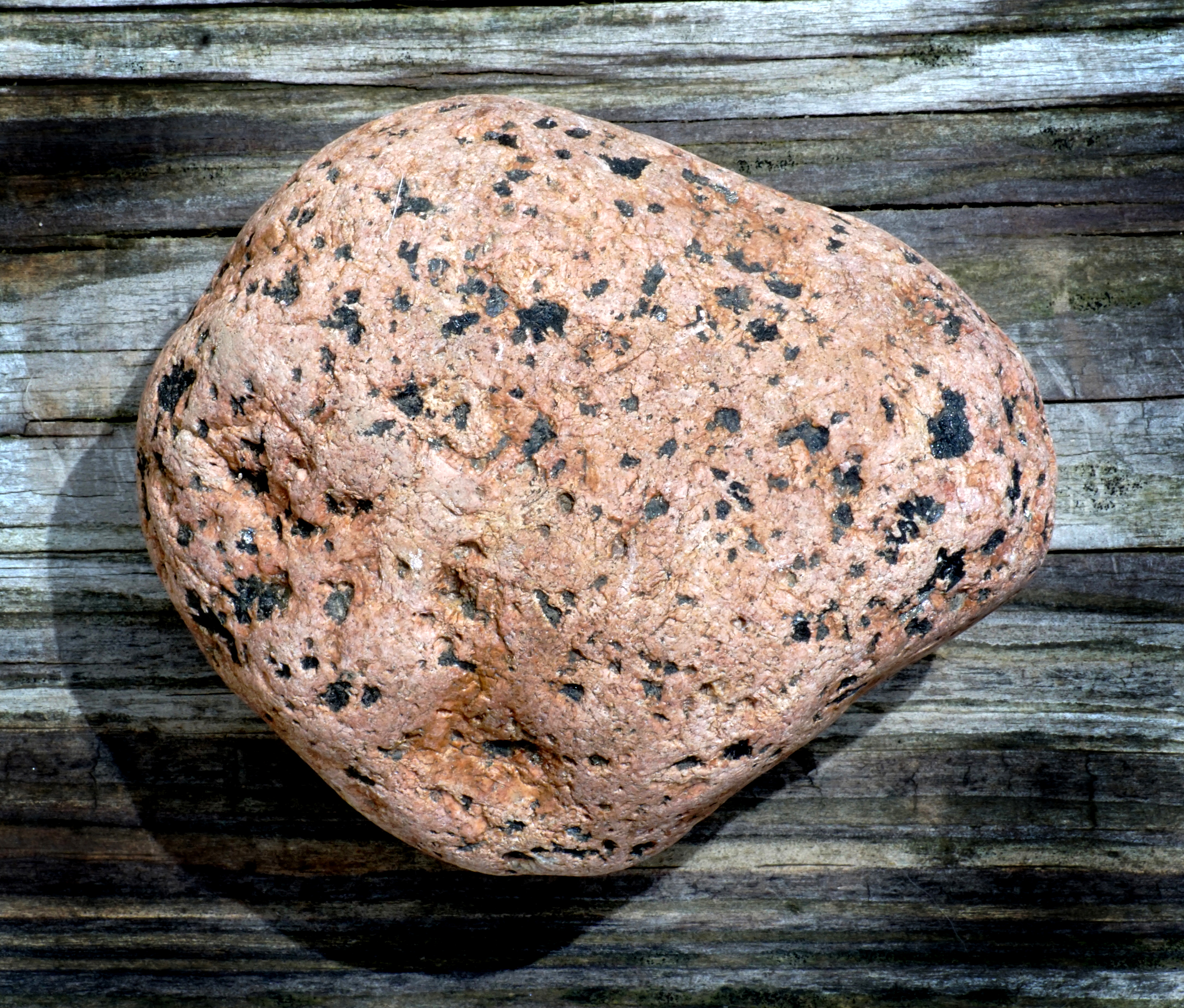
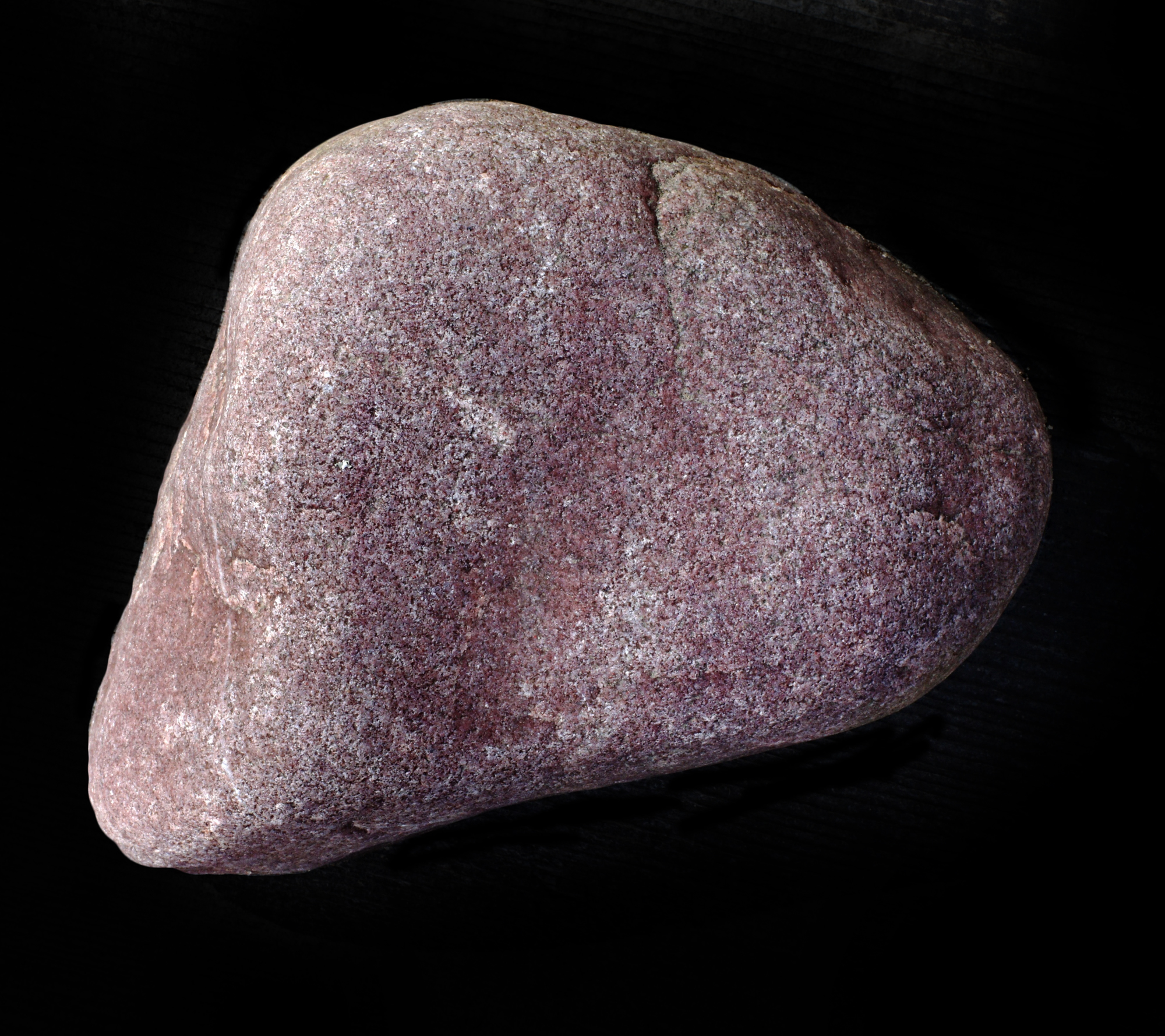
    Syenite, attractive and colorful, is a medium to coarse grained igneous rock related to granite which solidifies slowly (INTRUSIVE TYPE) within the Earth’s crust in a similar manner as granite. Whereas quartz is an important mineral in granite, it’s lacking in syenite. Careful examination will show that syenite is composed of long prisms of the dark minerals, hornblende or feldspar, rather than the scaly biotite mica, which is another chief component of granite. The pink coloring of syenite is due to the presence of alkali feldspar which predominates in syenite, but this rock type is found in a wide variety of colors depending on certain minerals. Consequently, syenite could be augite syenite, hornblende syenite, mica syenite, or nepheline syenite.

    Syenite found on Lake Michigan Beach

    Syenite is not the most common rock found along Lake Michigan beaches so it’s a thrill to find them with their pink and pinkish-orange polk-a-dot patterns! Syenite is occasionally used as a substitute in place of granite for a building material.

    Left Photo -Top and Left: Rhyolite, Right: Granite —— Right Photo: Rhyolite

    Rhyolite

    Rhyolite is a felsic (silica-rich) volcanic igneous rock with the same mineral content as granite, only unlike granite, it cools fast (EXTRUSIVE TYPE) as the molten rock nears or settles over the surface of Earth’s crust. When these magmas erupt, a rock with two grain sizes typically forms. The larger crystals that form just beneath the surface cool at a slower pace and are known as phenocrysts. The smaller, undetectable crystals that form at or above the surface cool quicker and are known as ground mass with a micro-crystalline matrix.  Rhyolite commonly appears in shades of pink, gray, brown, green, or orange, and frequently shows beautiful banding or mottling from various minerals like quartz and feldspar. While light gray to pink is very common, reddish hues, from light pink to deep purplish-red are also common. Notice the two distinct grain sizes. Rhyolite typically forms in continental volcanic eruptions and is rarely produced at oceanic eruptions. Rhyolites are known from all parts of the Earth and from all geologic ages.

    Left: Porphoritic Rhyolite Right: Banded Rhyolite

    Porphorytic Rhyolite. In order to understand this rock, you need to know what “porphorytic” or “porphyry” means. Simply, these are igneous rocks with one mineral (phenocryst) that exhibits a larger grain size than the dominant minerals (ground mass). The obvious differing grain sizes are quite apparent in porphorytic rocks as seen in the porphorytic rhyolite sample above left.

    Michigan’s Igneous Rocks The igneous volcanic rocks of Michigan, including rhyolite, granite and basalt for example, are very old. The rock material slowly seeped through cracks and crevices in the Earth’s crust during the molten state. If you hold a sample of igneous rock in your hand, you’re holding something that likely formed a billion years ago or more . . . amazing when you think about it!

    Rhyolite Pumice Beach Stone

    Rhyolite Pumice

    Rhyolite Pumice. Due to its high silica content, rhyolite lava is very viscous . . . it flows slowly, like toothpaste squeezed from a tube. Also, it tends to pile up forming lava domes. The thick viscosity traps gas bubbles and if rhyolite magma is gas-rich, it can erupt explosively, forming a frothy solidified magma called pumice (a very lightweight, light-colored, vesicular, or pitted, form of rhyolite), which includes ash deposits. Pumice is most common from silica-rich (felsic) magmas like rhyolite and dacite, but it also occurs with andesite, trachyte and even basalt, resulting in different colors, from pale to black, but always as a glassy, gas-filled volcanic rock. 

    Notably, eruptions of granite magma can produce rhyolite, pumice, obsidian, or tuff. These different rock types can all be found in the products of a single magma eruption. These rocks have similar compositions but different cooling conditions.

    • Explosive eruptions produce tuff or pumice.
    • Effusive (slow) eruptions produce rhyolite or obsidian if the lava cools rapidly.

    Various Colored Dolomite Boulders Found on Lake Michigan Beach

    Dolomite Rock

    There is considerable confusion about the name of this rock. The problem is that dolomite is both a mineral and a rock type. Dolomite rock is a sedimentary rock derived from limestone with a high percentage of the mineral dolomite. Limestone and dolomite rock are often indistinguishable in the field so geologists will often carry diluted hydrochloric acid to test the rocks. Limestone is strongly effervescent in acid, while dolomite reacts very weakly.

    Dolomite rock originates in warm, shallow marine environments where calcium carbonate accumulates from shells, crinoids, algae, or coral fragments, the same as does limestone. It is widespread within the Cambrian Period strata throughout the world. Limestone and dolomite rock also share the same color ranges: white to light gray, yellowish, greenish, pinkish, purplish, and even black are possible. Like limestone, dolomite rock can also exhibit fossils, but not as commonly. Dolomite rates higher on the Mohs hardness scale and you can feel the difference in your hands. I have collected several dolomite boulders from the beach in a variety of colors. They do make lovely landscape decorations!

    Various Colors of Dolomite Beach Stones

    How does dolomite form? Dolomite stone forms in several ways, but the main method is from a former limestone that was precipitated by calcium “magnesium” carbonate (mineral dolomite) through the action of magnesium-bearing water percolating the limestone or limy mud and replacing the limestone calcium carbonate minerals of aragonite and/or calcite.

    Milky Quartz found on Lake Michigan Beach

    Milky Quartz

    Quartz Basics: Did you know quartz is the single most abundant mineral on the planet? Quartz is made up of the elements silicon and oxygen, otherwise known as silica. Quartz can form large, six-sided crystals over rocks or can be found within rock cavities such as with granite, yet it also can fill rock vesicles (gas bubbles) during the cooling process of molten rock. Quartz can be found in a wide range of sizes such as masses larger than a basketball or crystal points smaller than a pea. Other quartz varieties are named for their different colors caused by impurities permeating during the crystallization process. For example, amethyst contains impurities of iron and aluminum, smoky quartz is colored by aluminum, and red quartz is iron-stained.

    Milky Quartz Nuggests found on Lake Michigan Beach

    Milky quartz is the most common variety of crystalline quartz (crystals too small to be seen with the naked eye). Several varieties of quartz are microcrystalline These include agate, jasper, chert, chalcedony and more. The cloudiness of milky quartz comes from microscopic inclusions of fluids, gas, or both that have been encased in the crystal from the time the crystal first grew. The inclusions have spoiled the crystal for optical purposes and for the use in jewelry-making gemstones. Holding the milky quartz up to the sun, the light can be seen through the translucence of this stone. We find these quite often and in a rounded, polished form due to the weathering action of the beach windblown sand.

    Broke-open Geode found on Lake Michigan Beach

    Geodes

    Geodes are one of the less-common finds on our beaches, but it’s very exciting when you do find one. Geodes begin their formation as volcanic rock hollowed out by gas bubbles. But they can also form in areas other than volcanoes. In sedimentary rocks, geodes can start out as animal burrows, tree roots, or mud deposits, which over time form the hollow cavity within the rock while the outer edges harden and form a sphere. Mineral-rich ground water infiltrates the cavity and after many years, the minerals crystallize into various colors depending on the mineral content such as quartz and amethyst for example.

    Presque Isle Serpentine Beach Stones

    Presque Isle Serpentine

    Presque Isle stones are quite rare finds on our Southwest Michigan beaches, but exciting to discover. These heavily veined cobble beach stones likely originated from Presque Isle Park in Marquette, Michigan, of Upper Michigan, a significant  forested peninsula bordering Lake Superior. One source I found states it is serpentinized peridotite (serpentinite rock) of the Mona Formation, which is Archean in age, 2.6 billion years ago. Peridotite is the dominant rock of the upper part of the Earth’s mantle either as solid blocks and fragments or as crystals accumulated from magmas that formed in the mantle.

    Presque Isle Formation: It begins with peridotite, a dense, coarse-grained igneous rock consisting mostly of the minerals olivine and pyroxene with lesser amounts of chromite, plagioclase, and amphibole varying in compositions. Peridotite is ultramafic, meaning it is a rock that contains less than 45% silica. It is high in magnesium, reflecting the high proportions of magnesium-rich olivine, with appreciable iron. The Serpentinization process (usually with ultramafic rock, as with peridotite) is changed by the addition of water, heat, and pressure into the crystal structure of the minerals found within the rock. Serpentinization of peridotite into serpentinite (the metamorphic equivalent) is a common example of this process. The unusual veining is more of a mystery because of its intricacy, but I have explained a little bit about quartz veining below. At any rate, we can all agree, Presque Isle Stone formation is complicated!

    Quartzite

    Quartzite Boulder found on Lake Michigan Beach

    Quartzite is a metamorphic rock composed almost entirely of sandstone. The sandstone is altered by heat, immense pressure, and chemical activity. These conditions recrystallize the sand grains and the silica cements and binds them. The result is a network of interlocking quartz grains of incredible strength. Because it is so hard and dense, quartzite has not been quarried as extensively as other stones such as limestone, sandstone, and granite.

    Quartzite Beach Stone

    Quartzite ranks high on the Mohs hardness scale as one of the most physically durable and chemically resistant rocks found on Earth. When mountain ranges are worn down by weather and erosion, less-resistant rocks are destroyed, but the quartzite remains. Quartzite is also a poor soil former. Unlike feldspars which break down to form clay minerals, the weathering debris of quartzite is quartz.

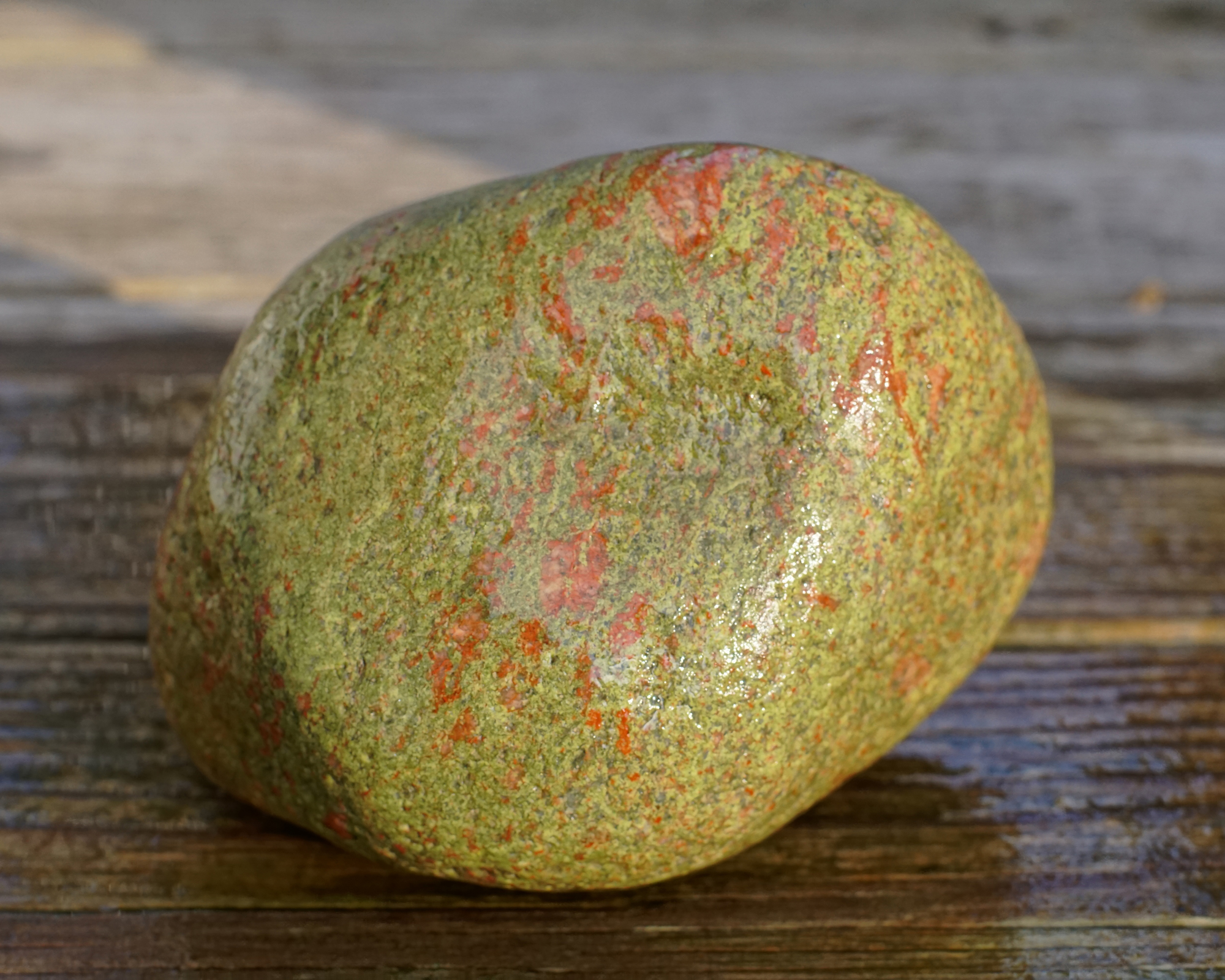
    Unakite Rock Boulder found on Lake Michigan Beach (wet brings out the colors)

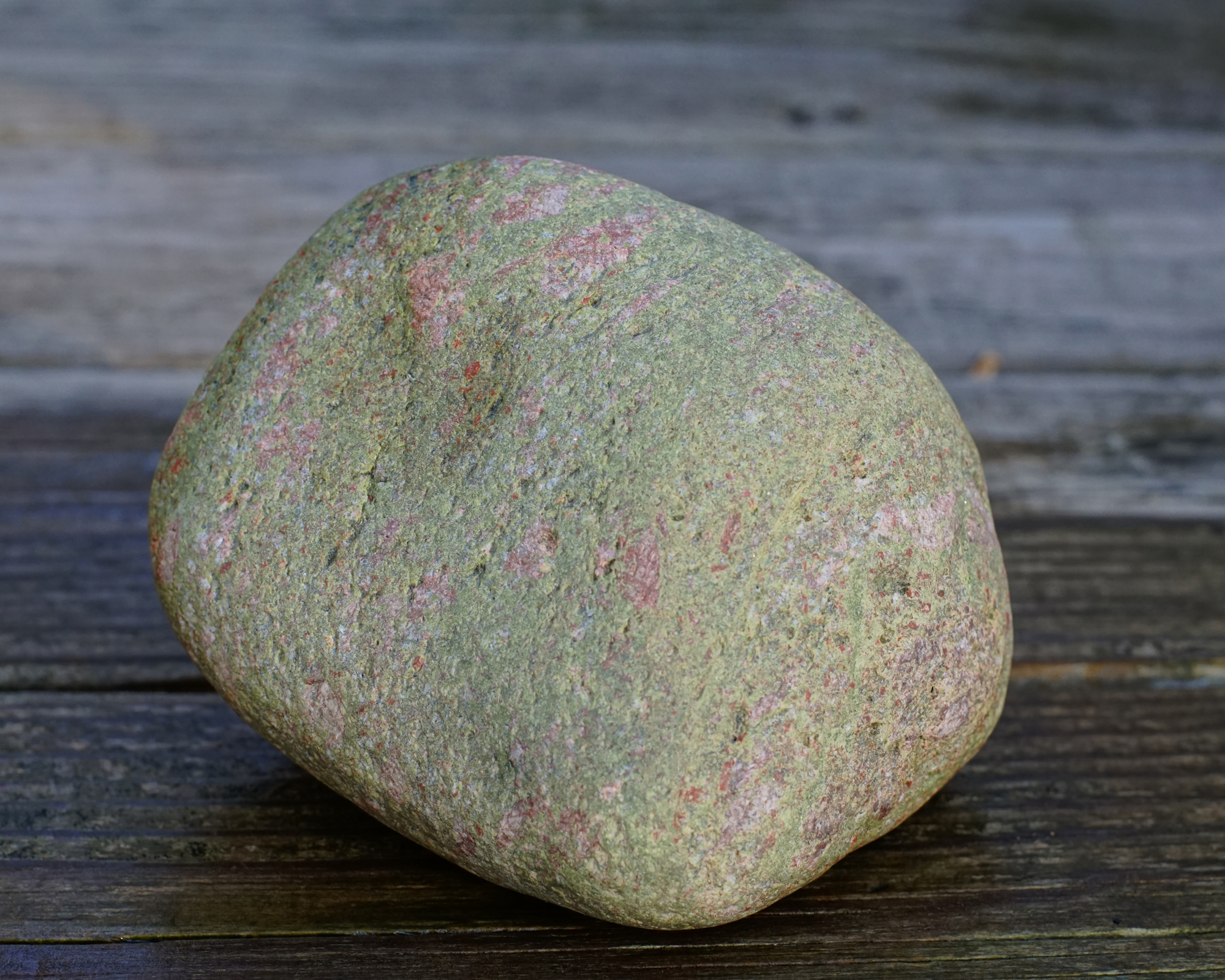
    Unakite is a metamorphic rock of granite with a mixture of pink orthoclase feldspar and transformed plagioclase feldspar into the green mineral epidote; it may or may not also contain quartz. Another name for it is Epidote Granite. It has mistakenly been called Unakite Jasper, but jasper is a form of quartz colored by iron oxide inclusions. Some Unakite will show pinkish-orange toned inclusions as the Feldpar has turned darker than the salmon-pink you may see in other pieces. Sometimes you will see litttle to barely visible green Epidote in Orange Unakite. 

    Unakite Beach Bouldera

    .

    In everyday uses, Unakite is found in construction and architecture. Crushed up, Unakite is used on highways and drainage rocks. It is also easy to polish and makes for a beautiful stone for flooring tiles, paving stones, stair treads, countertops, and jewelry.

    .

    .

    .

    .

    Diabase Boulder found on Lake Michigan Beach

    Diabase (Dolerite)

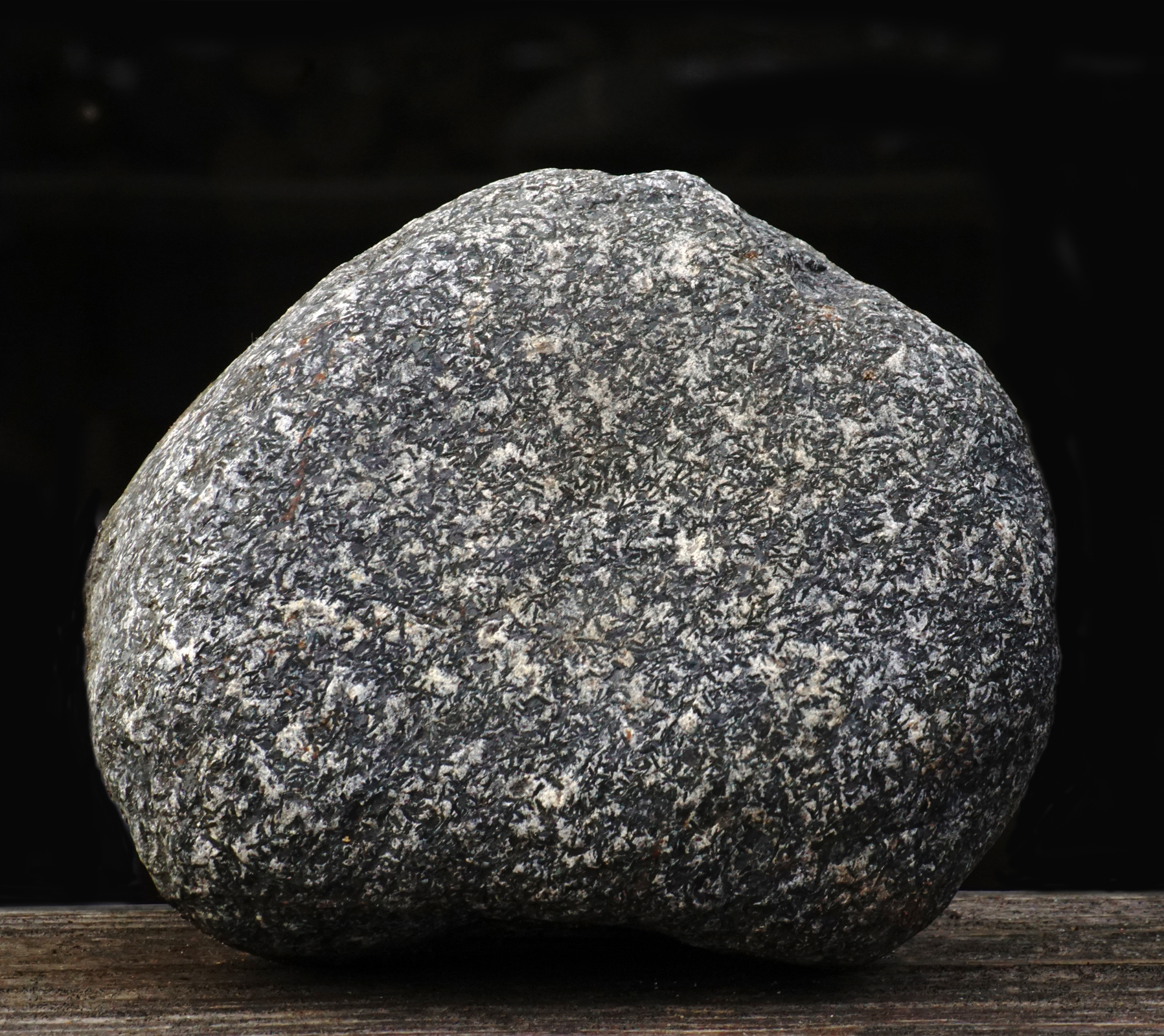
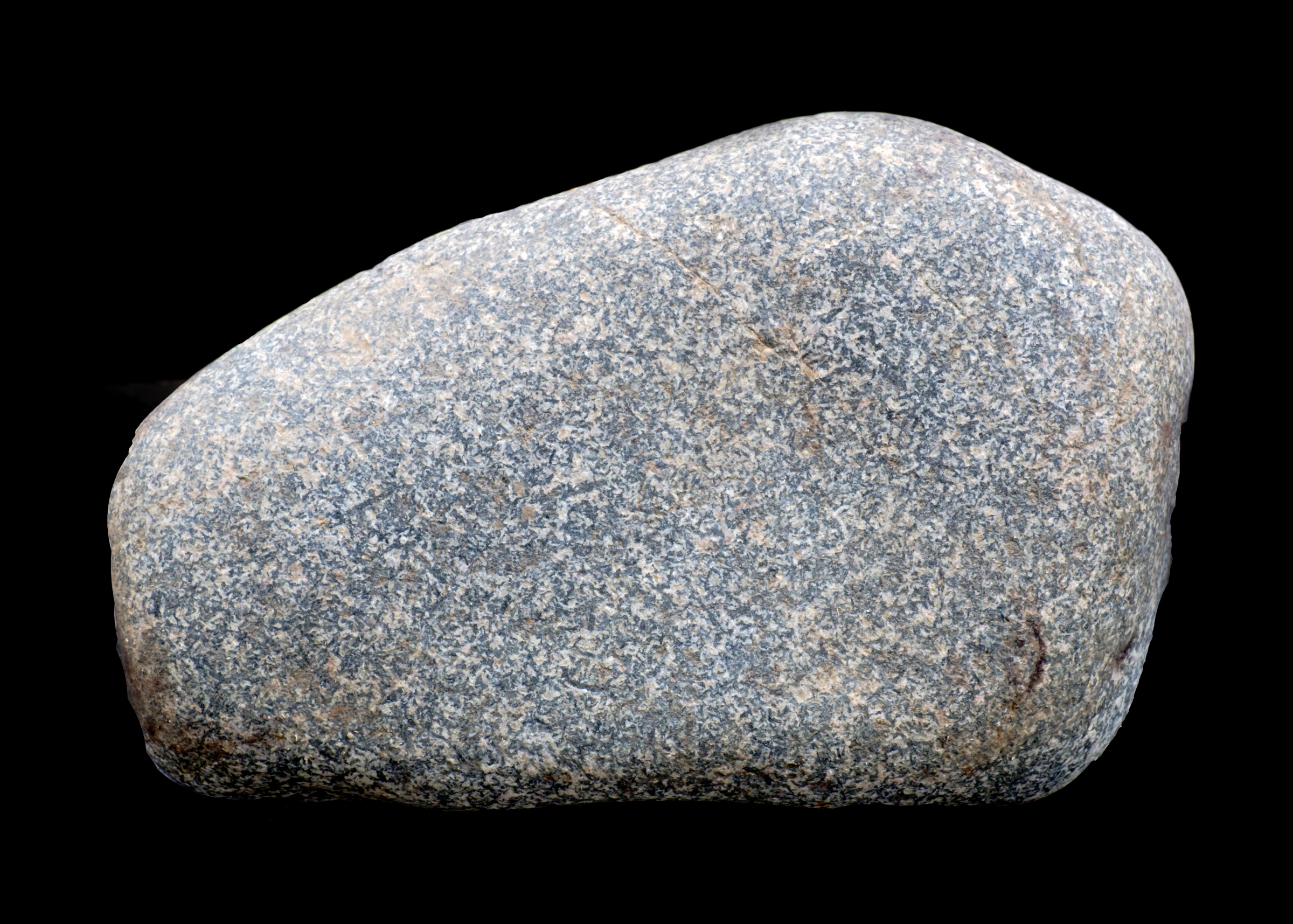
    Diabase (older term”dolerite”) is a dark rock that may have light-colored, lath-shaped (flakey, elongated) grains. Like basalt, rhyolite, and gabbro, diabase is a Michigan volcanic rock, only less commonly found along the shoreline as a beach-worn cobbler or boulder stone.

    Diabase is equivalent to gabbro and basalt in composition, but between them in texture. The term “microgabbro” is sometimes used to refer to such rocks, but they cooled closer to Earth’s surface, hardening much faster, and therefore have far fewer visible crystals than gabbro. They are classed as separate rocks because of the peculiar lath-shaped crystals of “plagioclase” lime-feldspar minerals (mostly labradorite) in a groundmass of the “pyroxene” mineral, augite.

    To review plagioclase minerals: Any member of the series of abundant feldspar minerals usually occurring as light-colored, glassy, transparent-to-translucent, brittle crystals. To review pyroxene minerals: Any member of a large class of rock-forming silicate minerals, usually dark-colored, generally containing calcium, magnesium, and iron, and typically occurring as prismatic crystals.

    Diabase Rock Boulder found on Lake Michigan Beach

    Diabase minerals of lesser importance are magnetite, olivine, ilmenite, hornblende, biotite, and chlorite, among others. Note: Specimens with few visible crystals can easily be confused with basalt, and a microscope would be necessary to distinguish the two.

    Why do the lighter feldspar crystals often appear fuzzy, stick-like in shape, in diabase rock? This is because they crystallized first, forcing the other, darker minerals to squeeze in around them, which distorted the feldspar. This is the opposite of what generally happens in rock formation; the dark minerals tend to crystallize first. Colors can vary with diabase from gray to black, greenish black, and brown.

    Pegmatite Beach Stone

    Pegmatite

    Pegmatite is extreme plutonic igneous coarse-grained granite that forms during the final stage of magma’s crystallization (intrusive type). They are extreme because they contain exceptionally large crystals made of feldspar, quartz, and mica, as with granite. Many of the crystals range from several inches to a foot or more in diameter. It is the parent rock of many gemstones including topaz and tourmaline and rare and valuable minerals such as beryl. Note: Even though the above pegmatite beach stone sample has large, coarse grains, Lake Michigan has ground them down, molding the stone into a round ball, demonstrating the powerful tumbling action of the wind, waves, and sands of the inland sea.

    Pegmatite is seldom seen in large masses but is usually found in veins cutting through other kinds of rock, such as granite and diorite. Pegmatite should not be confused with porphyritic granite, as the two can be distinguished by the relative size of the mineral grains. In pegmatite, the crystals are uniformly large, unlike porphyritic granite which usually one mineral is in large crystals within the finer groundmass.

    Pegmatite

    Other Pegmatites: Granite, Gabbro and Syenite

    To indicate the mineral composition—or to make things even more complicated—pegmatite can be “granite pegmatite,” “gabbro pegmatite,” “syenite pegmatite,” and any other plutonic rock name combined with “pegmatite” are possible. My first beach stone sample reminds me of the salt-and-pepper grains contained in diorite, so it could possibly be “diorite pegmatite.” Note: I featured diorite, gabbro, and granite in another photo essay about beach stones, but will briefly explain them here.

    • Diorite is primarily composed of feldspar and various dark-colored minerals, which explains its black and creamy white coloring with a salt-and-pepper pattern.
    • Granite is composed of four materials: feldspar, mica, quartz, and hornblende minerals. These minerals themselves come in a variety of forms, giving granite a much larger variety than diorite or gabbro.
    Conglomerate “Pudding Stone”
    Conglomerate “Pudding Stone”

    Conglomerate “Pudding Stones”

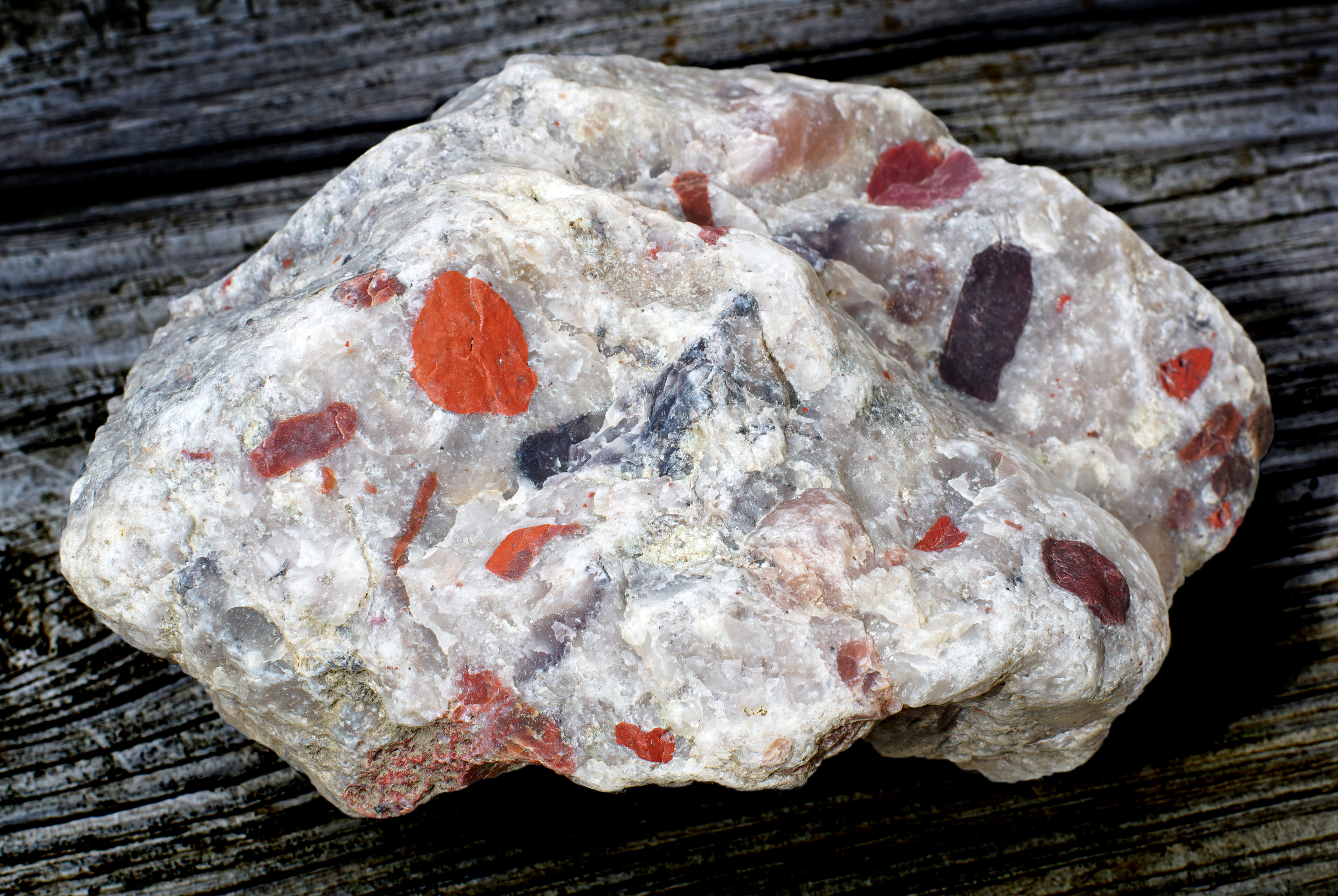
    Conglomerates are sedimentary rocks with inclusions of rock pieces of various sizes, colors and shapes cemented with sand and pebbles by dissolved minerals. Heat and pressure over long periods of geological time mold the mixture and hold it together. The pebbles and small rocks in a conglomerate are typically rounded, a feature that differentiates them from “breccias” where the larger stones in the mix are angular. Conglomerates or “pudding stones” are not the most common rocks I find on the beach but are, nevertheless, an occasional find.

    Banded Metamorphic Beach Stones

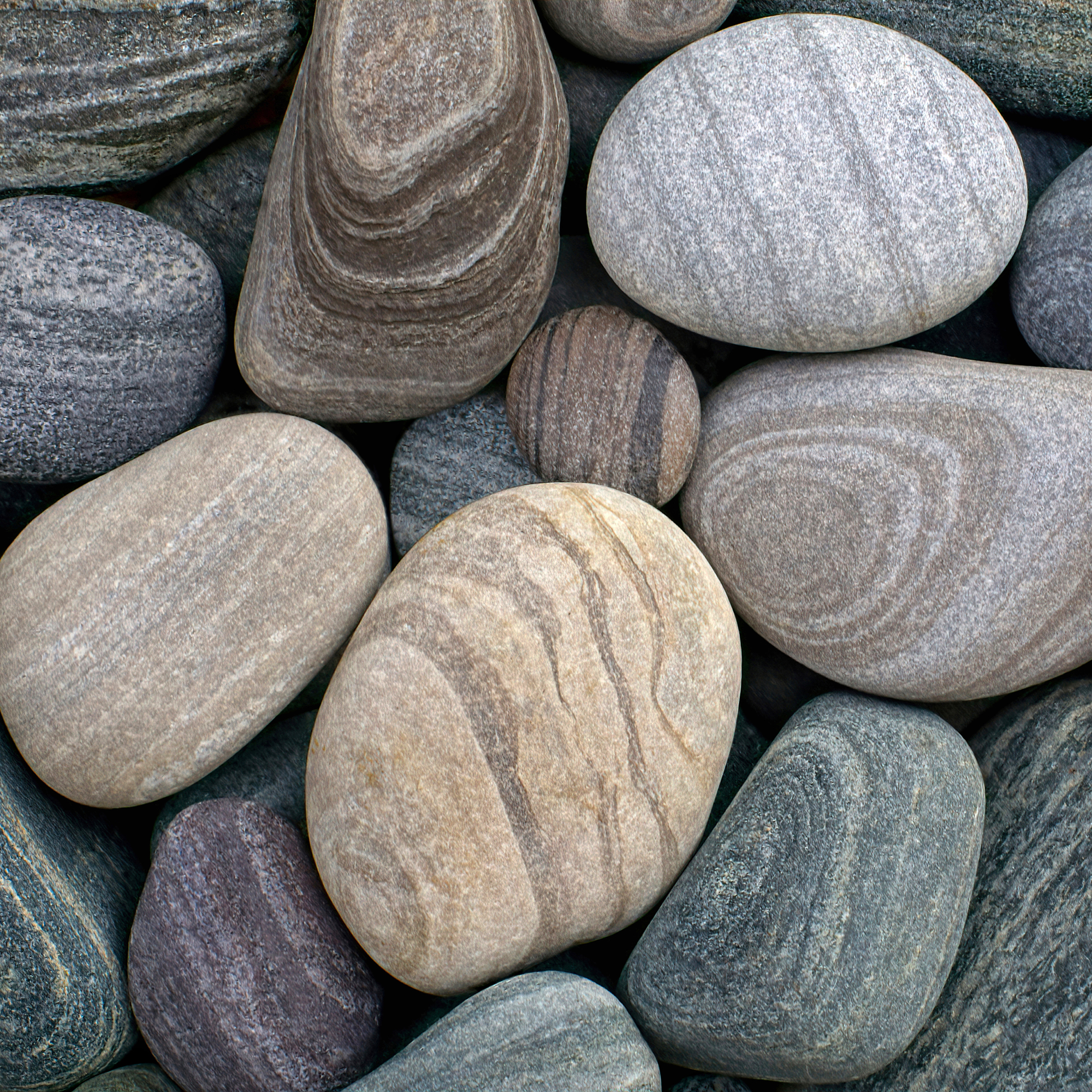
    Banded Metamorphic Beach Stones

    I’ve always been attracted to these banded beauties and have fun arranging them in my rock garden or photographing them into works of art. The samples directly above are metamorphic basalt. To briefly review metamorphic rocks: Metamorphism involves the alteration of existing sedimentary or igneous rocks by either excessive heat and pressure or through the chemical action of permeating fluids. This alteration can cause chemical changes or structural modifications to the minerals making up the rock.

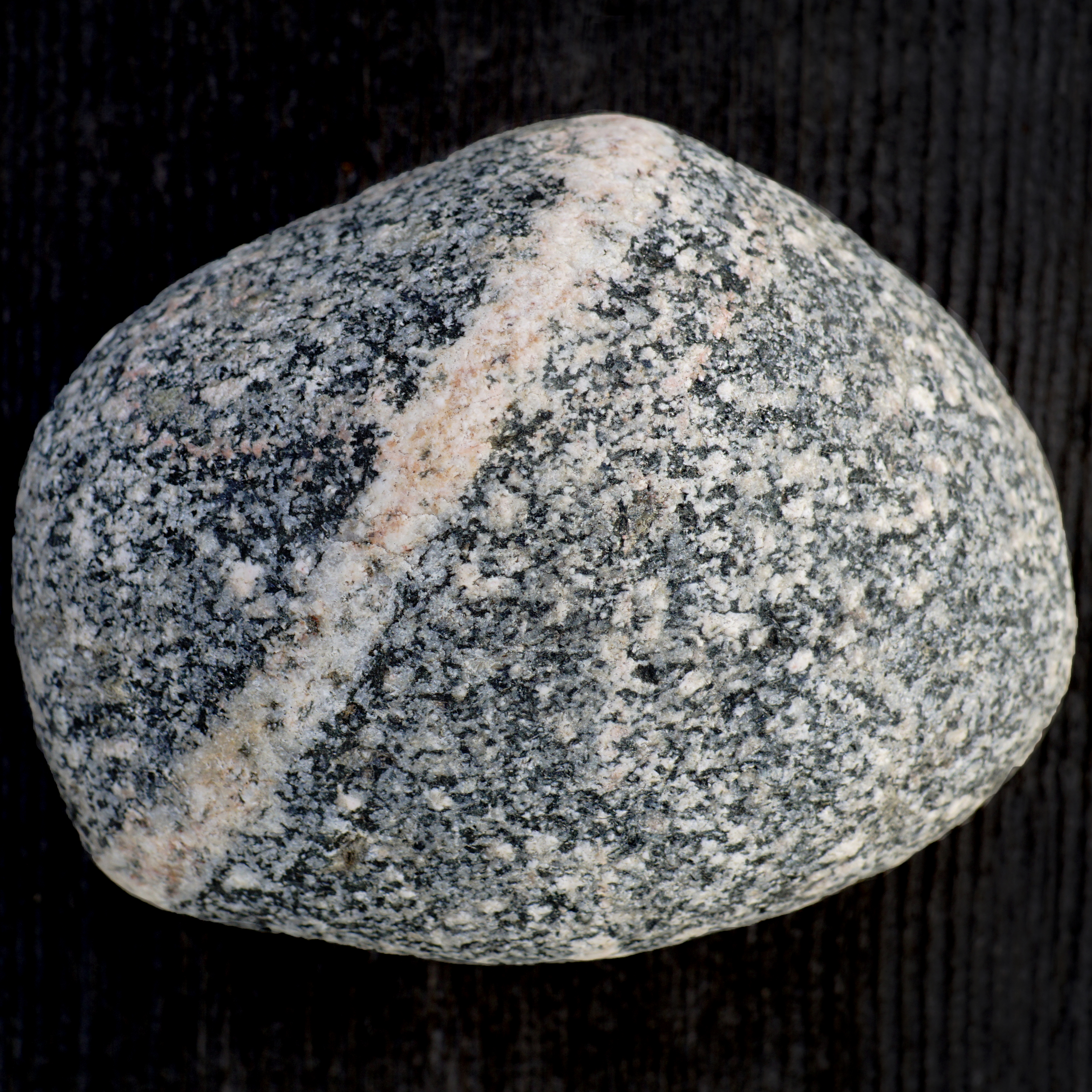
    My best guess is all but one of these stones shown above are metamorphic granite. Top left might be metamorphic diorite. We find quite a few of these pretty stones on the beach.

    Metamorphic Rock Traits

    • Because their mineral grains grew together tightly during metamorphism, they’re generally strong rocks.
    • They’re made of different minerals than other kinds of rocks and have a wide range of colors and lusters.
    • They often show signs of stretching or squeezing, giving them a striped appearance.

    Quartz Veining in Various Rock Types

    Quartz Veining

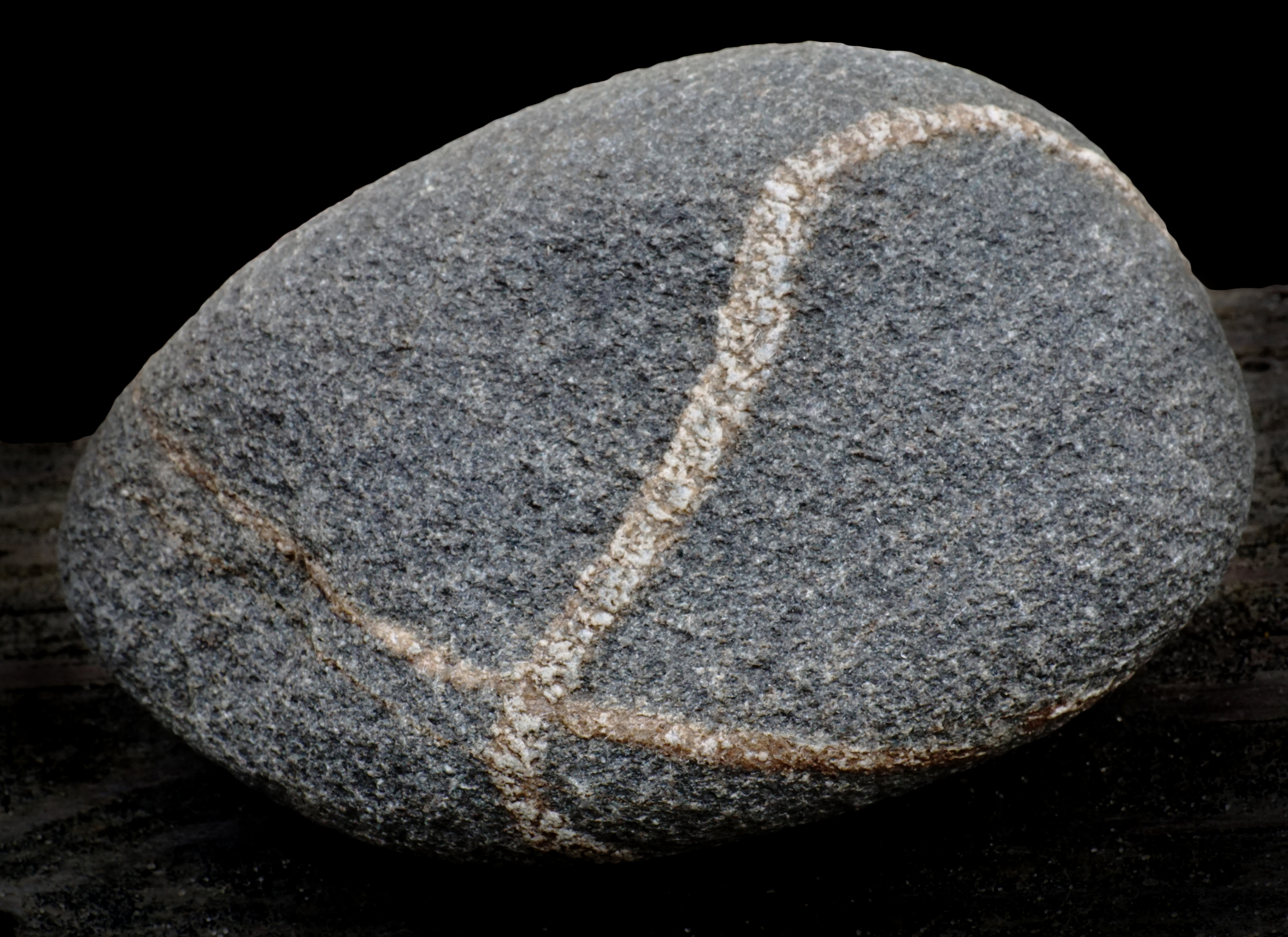
    The striking quartz veins running through the rocks shown above certainly elicit curiosity. One can’t help but marvel and wonder how. There are a few methods, but the simplest way happens when exposed cracks in rocks are filled-in with mineral-rich groundwater deposits. While quartz is a very common mineral filling in cracks in rocks, other minerals such as calcite, feldspar, gold, silver or iron-oxides are possible. Cracks in rocks can form during folding of the rock in mountain-building processes, or by shattering during tectonic events, or by a decrease in pressure during the uplift of rock. Yet another method of veining may happen when molten rock has cooled down and shrank, then after cracks are exposed, hot brines may migrate through the cracks and crevices in the host rock, depositing various minerals which may or may not crystallize.

    Wishing Stones and Heart Stones

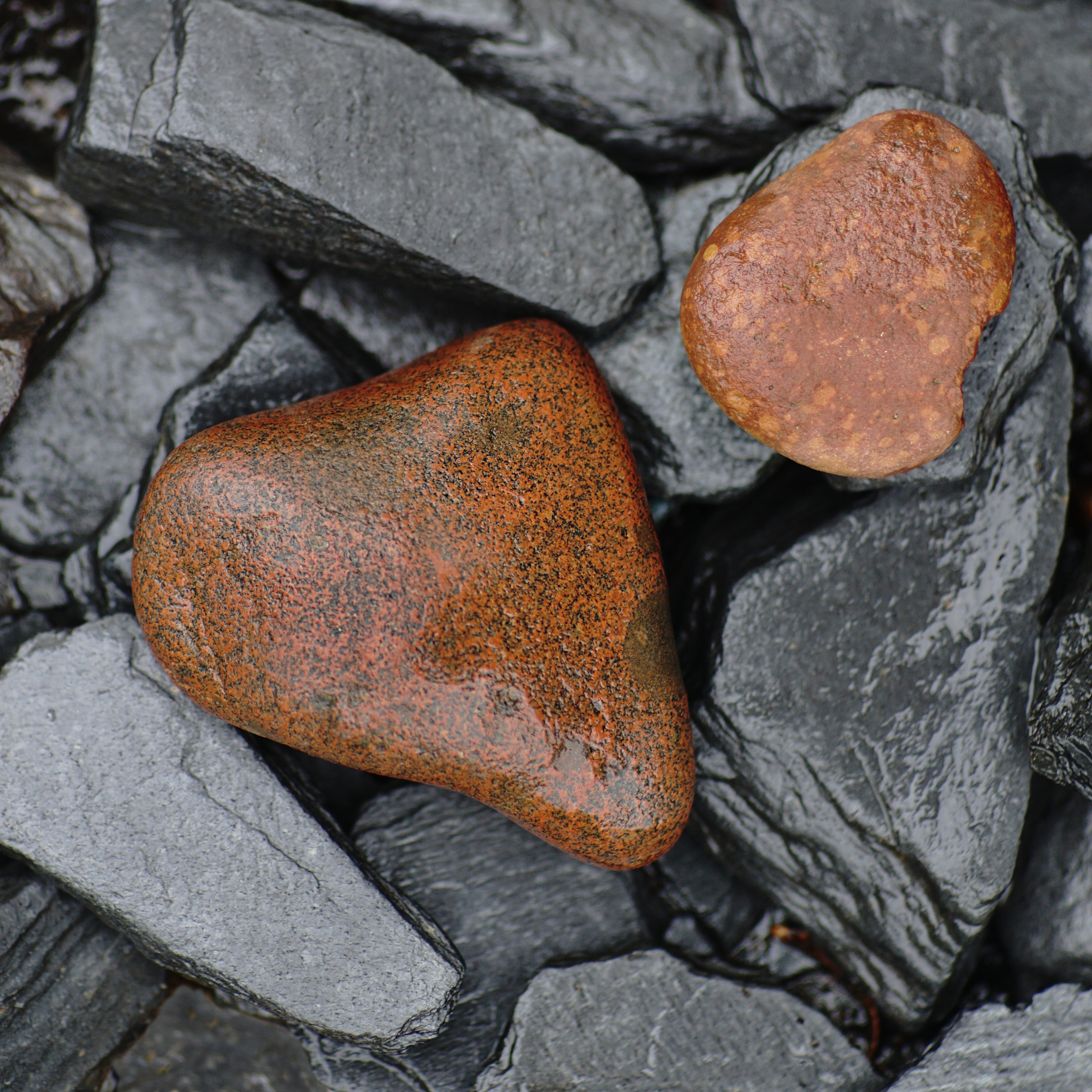
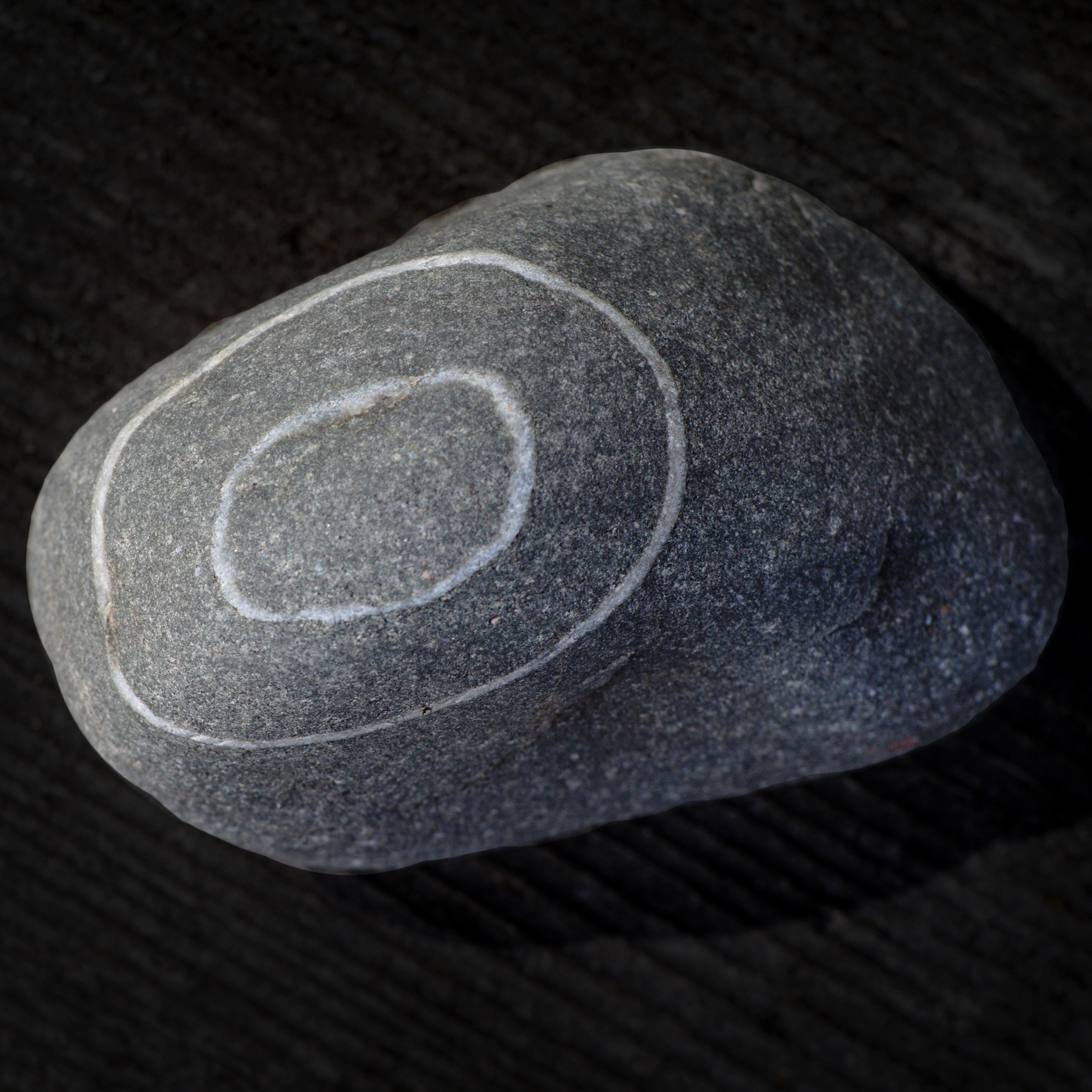
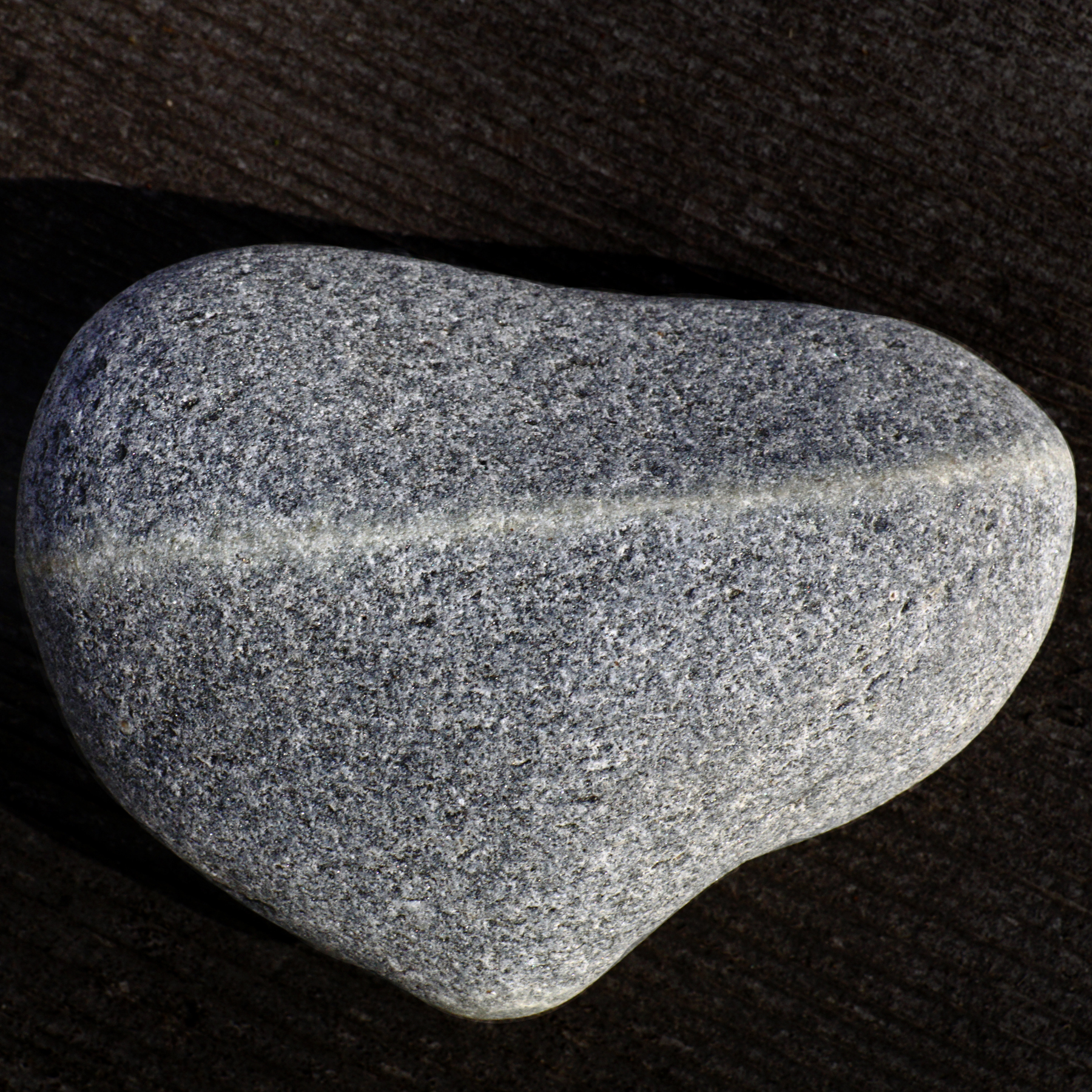
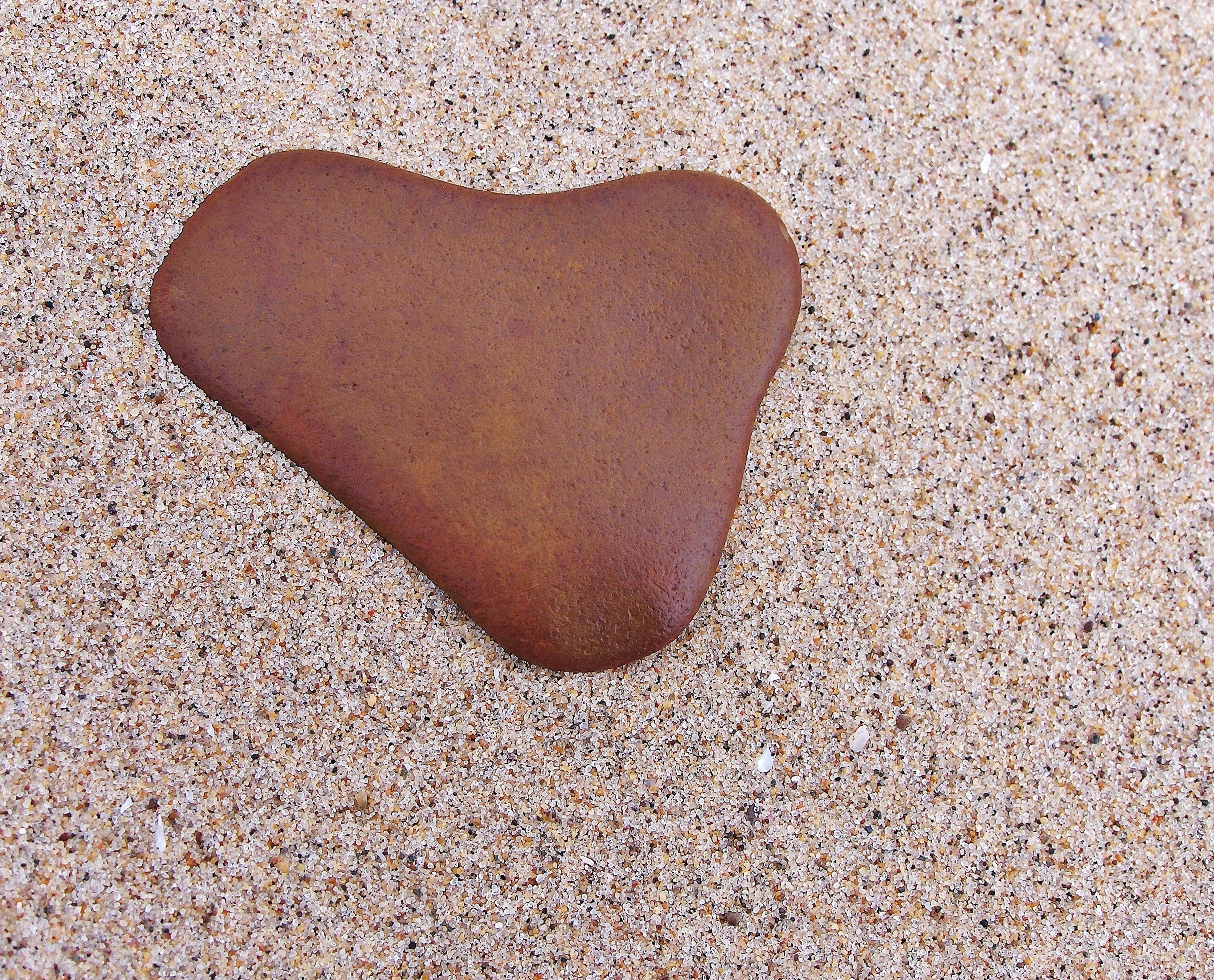
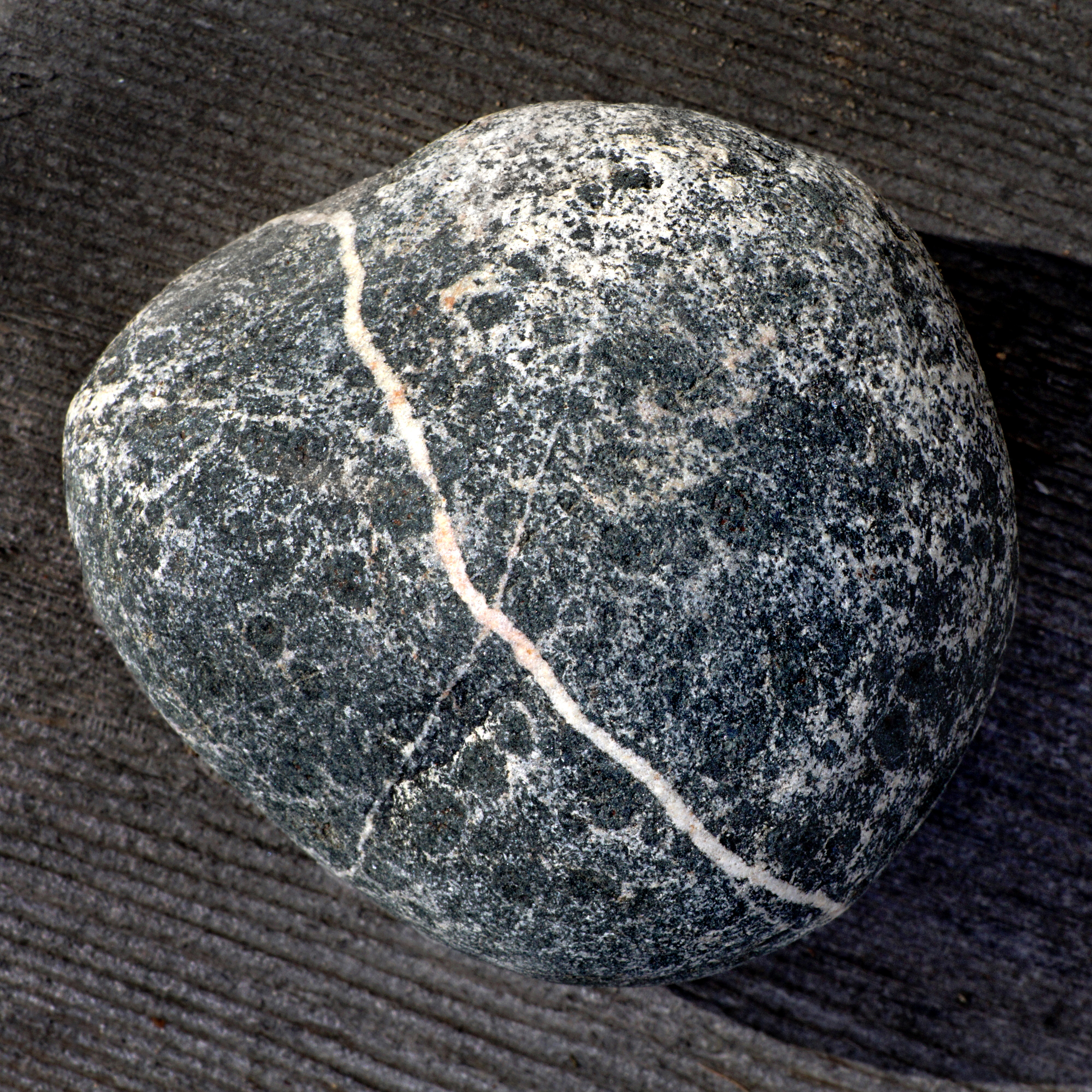
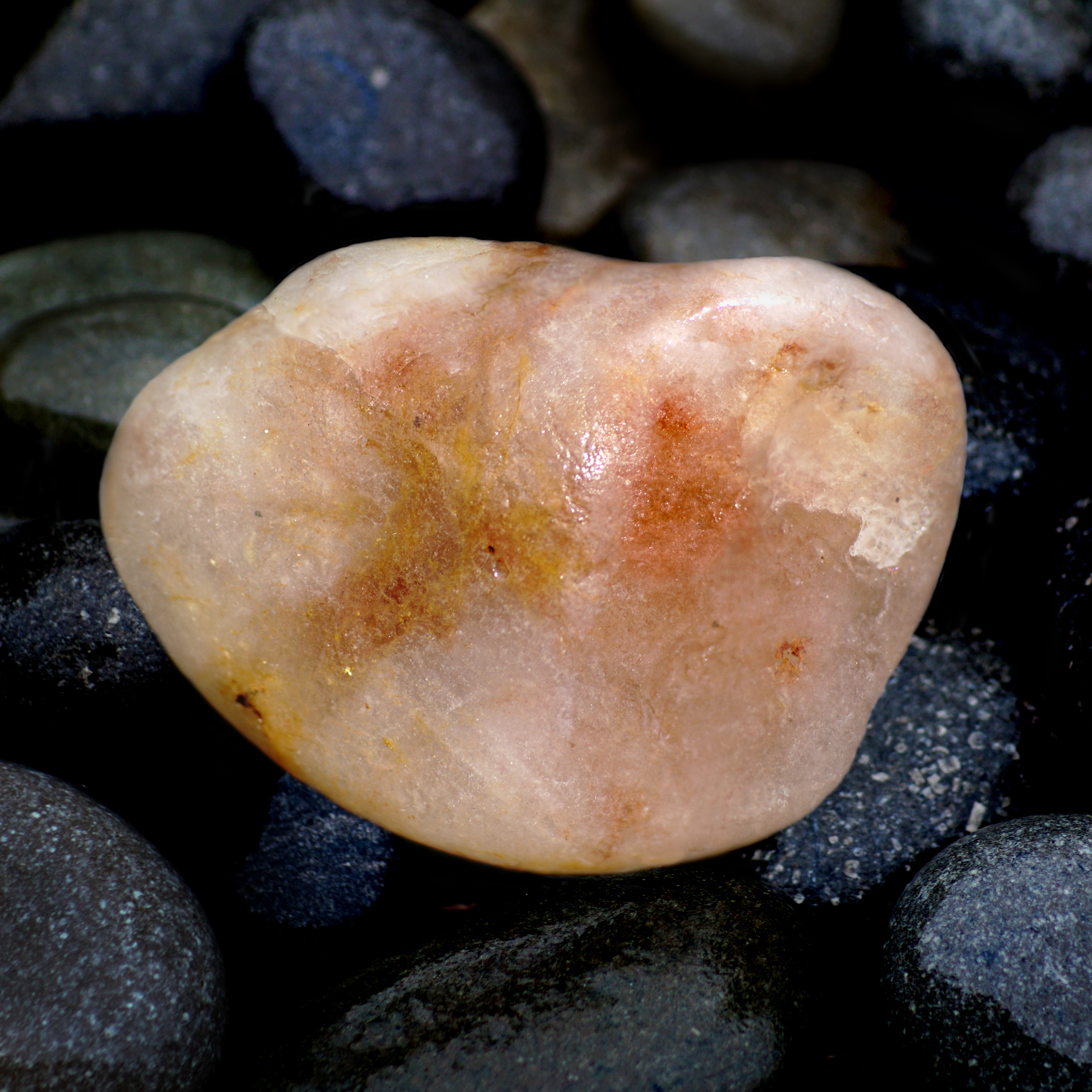
    Just for fun, a “wishing stone” is a stone with a distinct vein running through it, but in order to be a true “wishing stone,” the rock can show only one single vein and it must encircle around the entire stone without any breaks! If you’re lucky enough to find one, the legend says to close your eyes, make a wish, then throw the stone into the water as far as you can and your dream wish will come true. The wishing stone in the photo (above left) is shaped like a heart, which makes it even more special. Speaking of heart shaped stones, they are another favorite stone that collectors love to find. I have quite a few in my collection, some large enough to arrange around the garden! I like to think of them as warm messages or hellos from loved ones who have passed.

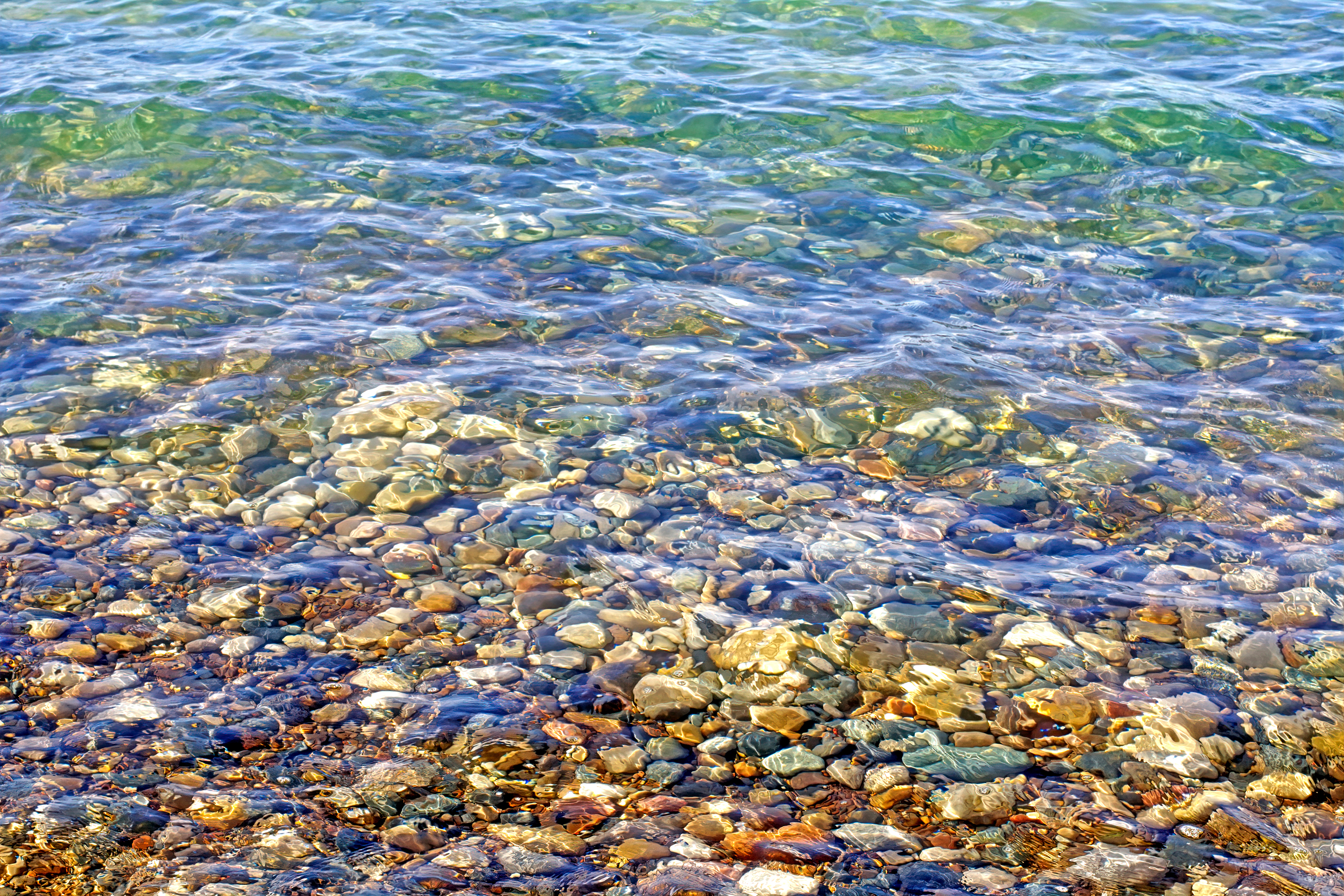
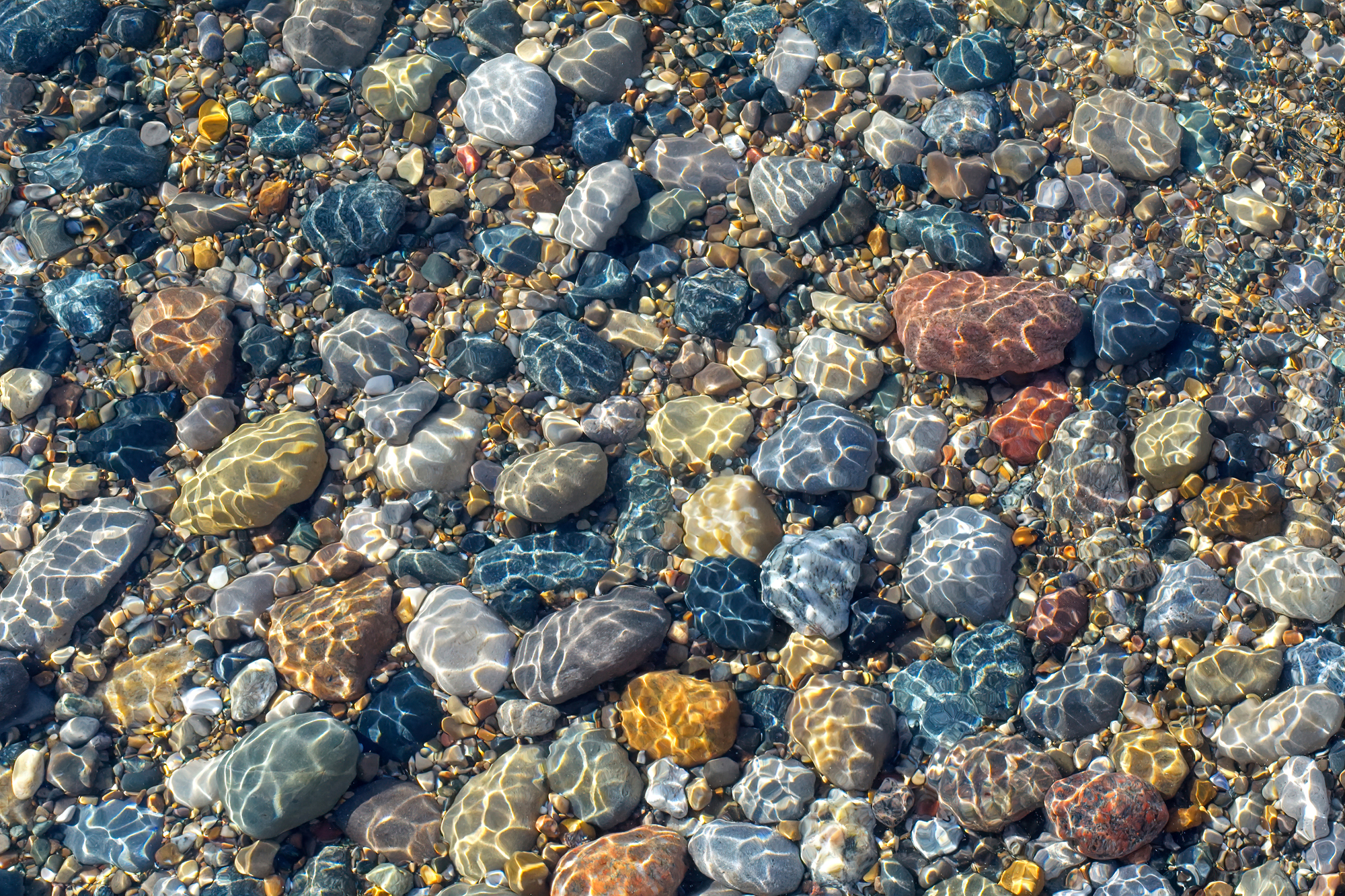
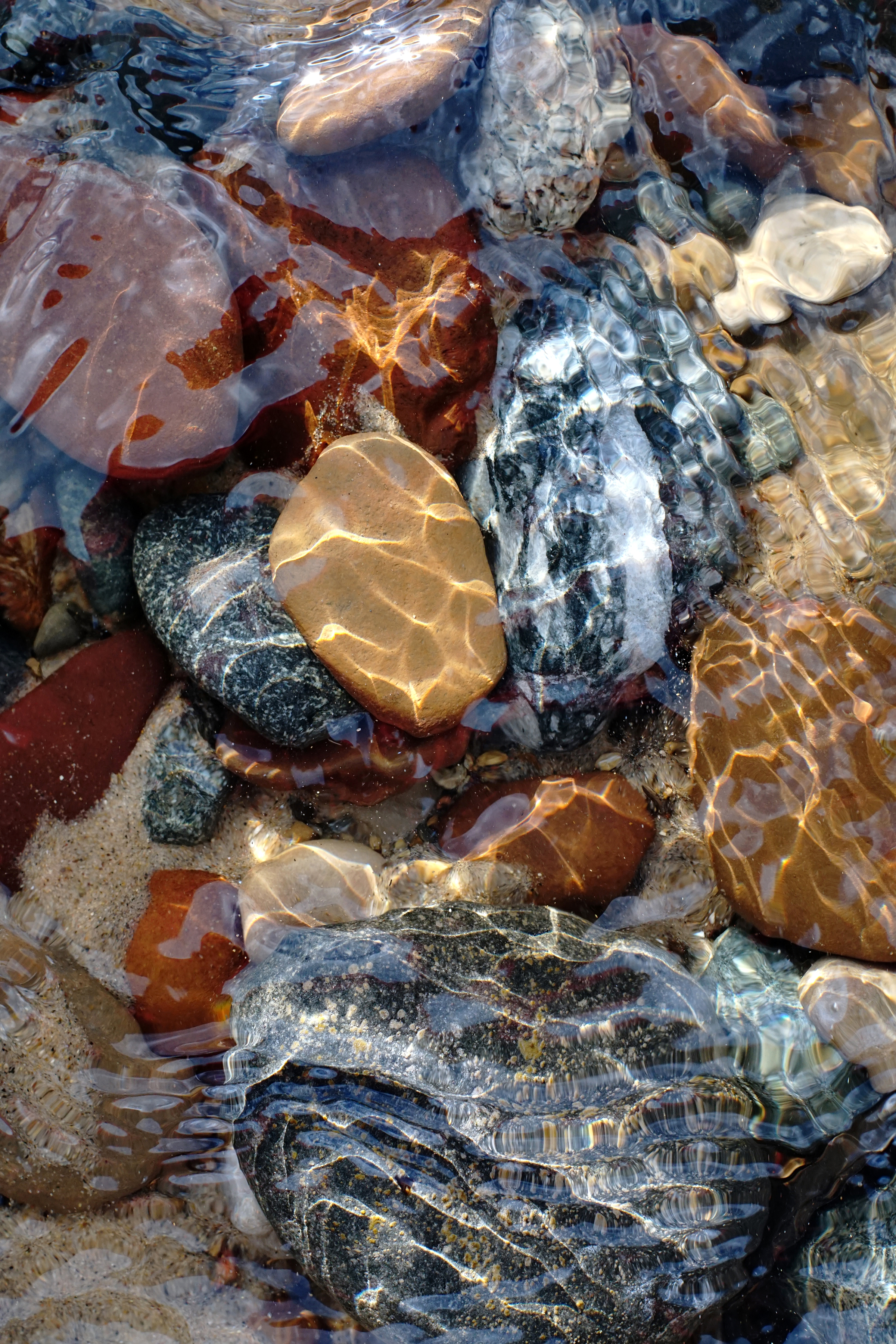
    I leave you with a lovely photo of a sunlit creek filled with cobblestones where it flows into Lake Michigan!

    Share this:

    • Share on Pinterest (Opens in new window) Pinterest
    • Share on Facebook (Opens in new window) Facebook
    • Print (Opens in new window) Print
    • Email a link to a friend (Opens in new window) Email
    • Share on LinkedIn (Opens in new window) LinkedIn
    • Share on Reddit (Opens in new window) Reddit
    • Share on X (Opens in new window) X
    Like Loading...
    Rocks beach stonesgeologyLake Michigan stonesrock factsrock identificationrock photos

    Identifying Rocks of Lake Michigan (Septarian, Agate, Gabbro, Basalt and More)

    January 10, 2026 by Fossillady
    I Found a Rock on the Beach and Wondered

    A favorite pastime for beachgoers of the Great Lake states is combing the beaches for interesting treasures. Beachcombing can be a very settling and spiritual experience. I have enjoyed collecting many kinds of treasures along the shores of Lake Michigan, but in particular, beach stones. Follow along to learn interesting facts and identifcation of the assorted types of beach stones, both rare and common!

    • Listing of Beach Stones and Beach Boulders found on Lake Michigan sandy shores:
    • Basalt (5 types)
    • Gabbro
    • Septarian
    • Limestone (4 types)
    • Granite (2 types)
    • Diorite
    • Gneiss
    • Schist
    • Sandstone
    • Jacobsville Redstone
    • Siltstone
    • Mudstone
    • Claystone
    • Chalcedony
    • Agate

      In case you have a specific rock you were looking for not listed here, you can try my other article on Lake Michigan beach stones HERE which includes in order Syenite, Rhyolite, Pumice, Dolomite, Milky Quartz, Presque Isle Serpentine, Quartzite, Unakite, Diabase, Pegmatite, Conglomerate, Banded Metamorphic Rocks, Quartz Veining, and for fun, Wishing and Heart Stones.

      Note: Beach stones and rocks are smoothed and rounded as a result of the wind and waves pushing the stones against the sand, acting as a polisher. The degree of smoothness is also an indication of how far a stone has traveled from the site of its original formation. The smooth rocks feel so wonderfully warm and healing to the touch!

      Basalt Stones found on Lake Michigan Beach

      Basalt

      Rocks are made up of minerals, and minerals are made up of elements. You can easily look up which minerals make-up any type of rock including basalt described further below in this article. Basalt is volcanic rock, the original rock of Earth’s crust. It covers more of Earth’s surface than any other rock. It is formed from ancient molten rock that cooled quickly when it reached the surface (called “extrusive type”). This is the reason for its fine-grain and heavy-density before gas bubbles, crystallization, or foreign materials infiltrate the rock. Basalt is typically grey to dark grey, but can rapidly weather to brown or rust-red due to oxidation of its iron rich minerals and can further exhibit a wide range of shading due to regional geochemical processes.

      Most extrusive igneous rocks in Michigan were formed from ancient, quiet, lava flows which reached the surface through long cracks and crevices in the Earth’s crust; also, from remnants of mountain peaks that have withered away. Just imagine, when you find a basalt rock on the beach, you’re likely holding in your hand at least a billion-year-old chunk of Earth. Below is a brief description of four special types of basalt; Ophitic, Vesicular, Amygdaloidal and Porphyry.

      Ophitic Basalt found along Lake Michigan Beaches

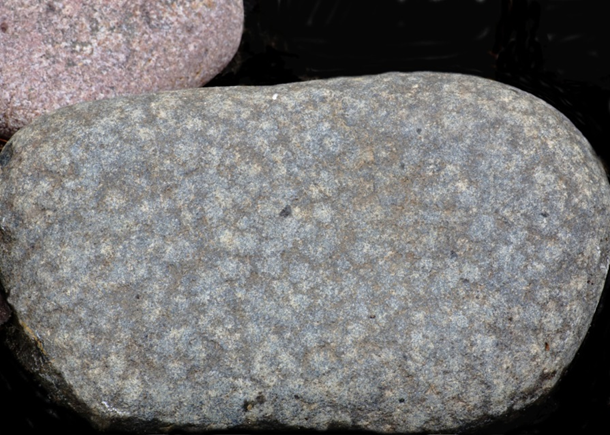
      Ophitic Basalt

      Ophitic Basalt looks like a basalt rock that has been decorated with light-colored snowflakes. The snowflakes are formed from tiny feldspar crystals within the basalt lava. Because the feldspar crystals eroded at different rates than the basalt base, there is often a slightly mottled texture to these stones. The sample above was a small boulder found on the beach and was quite heavy to carry in my arms!

      Vesicular Basalt Beach Stones

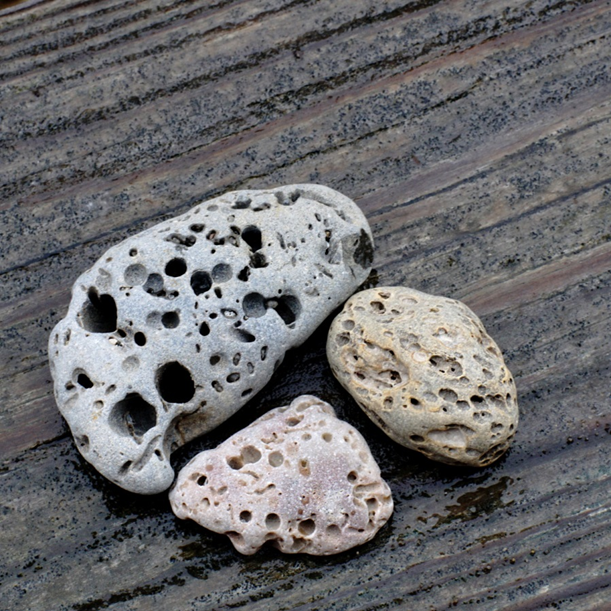
      Vesicular Basalt

      Occasionally, we find these most-curious pitted stones on the beaches. After some research, I finally understand how they got that way. They are called “vesicular basalt,” which means basalt with textures, and if the deep pits (vesicles) cover more than half the surface of the rock, it’s called scoria. What causes the vesicles or pits in the rock? The basalt-making molten rock cools down quickly before gas bubbles from deep inside Earth’s surface have the chance to make their way out. When the lava reaches the atmosphere, the bubbles inside can blow out, leaving spherical-pitted impressions.

      Amygdaloidal Basalt Beach Stone

      Amygdaloidal Basalt

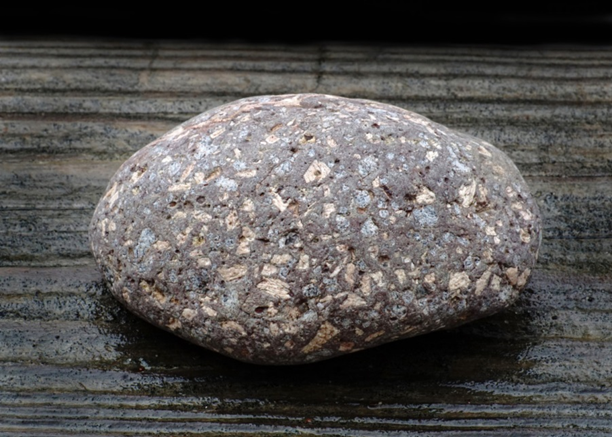
      This is what can happen, yet later; the vesicles (holes) can fill in with other minerals and the fillings are called amygdules. The basalt is then referred to as amygdaloidal basalt. If the lava flow is in motion when the blowholes are being formed, the holes may be drawn out and elongated, as you can see in the sample above.

      Basalt Porphyry Beach Stone

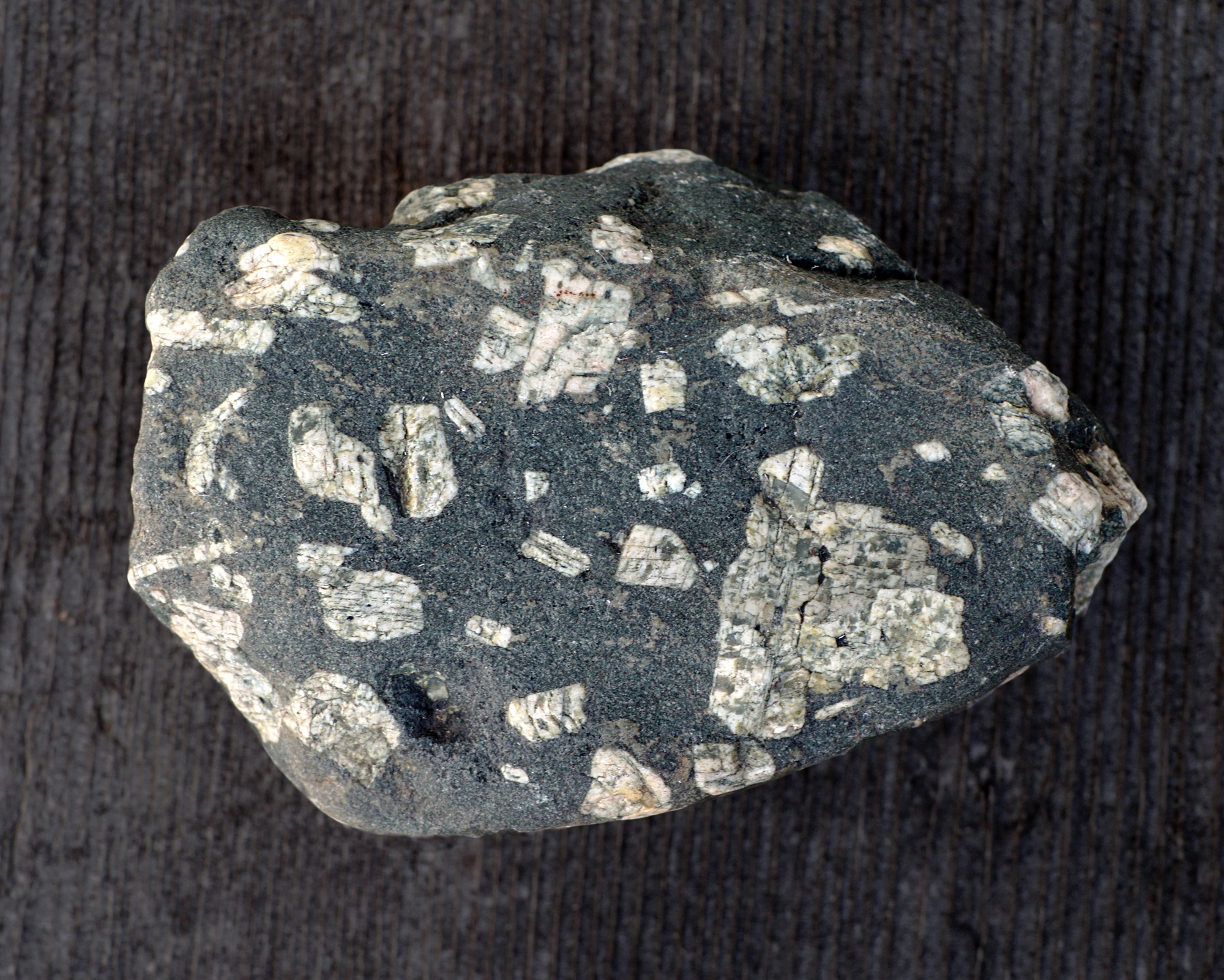
      Basalt Porphyry

      What is porphyry? In various rock types (in this case, basalt), when you see large crystals of a mineral embedded within other finely ground minerals making up the mass, it’s porphyry or porphyritic rock. (You can tell the porphyry basalt apart from the above amygdaloidal basalt sample by the absence of empty pits). The porphyry beach stones are more rare to find. This sample of basalt has a greenish cast likely due to the inclusion of the mineral olivine; and calcite is likely the mineral speckled within the basalt mass.

      Gabbro

      Gabbro

      Gabbro is igneous rock which cools slowly (intrusive) deep below the Earth’s surface causing its minerals to crystallize. It’s sometimes called “black granite” for its similar, coarse-grain appearance to granite, but a large proportion of its iron-bearing minerals make gabbro heavier and usually darker in color. Gabbro can also be gray and dark green. You may observe fewer light-colored mineral grains. Unlike many other igneous rocks, gabbro usually contains very little quartz, although the sample I collected has a quartz vein running all the way around it.

      Gabbro has the same mineral composition as basalt (olivine and pyroxene silica minerals, with smaller amounts of plagioclase feldspar minerals and mica). But whether basalt or gabbro forms, depends upon the cooling rate of the magma, not its composition. While gabbro is coarse-grained, which cools slowly during the molten stage (intrusive), basalt is fine grained that cools quickly (extrusive).

      Septarian Brown Stones

      Septarian Brown Stones

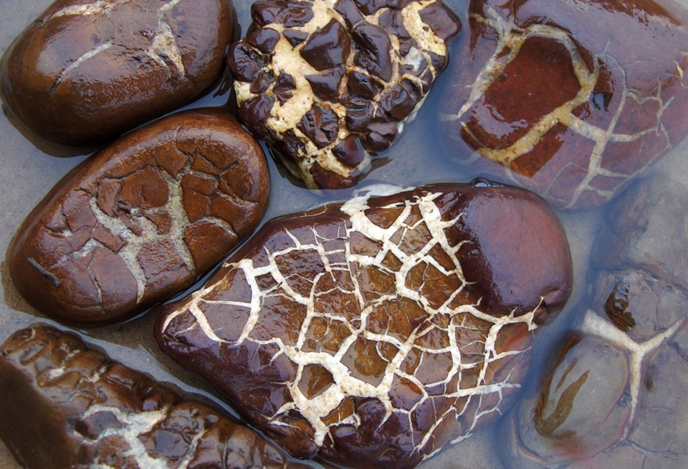
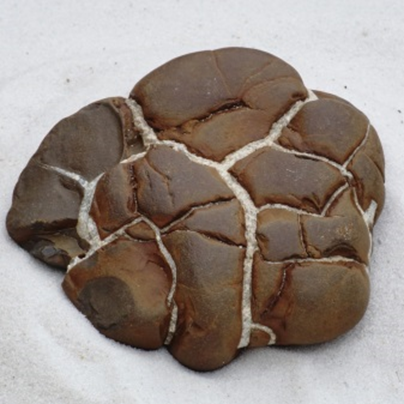
      Interesting how they formed; around 50 million years ago, iron-rich mud and clay formed over a shallow ocean floor that covered much of Michigan and other territories of the USA.  At some point, the water receded drying out the muddy substrate giving way to cracks and fissures. Later, calcite infiltrated the open veins via ground water and gradually filled them in. Then some time after that, pieces broke apart most likely caused by the ice glaciers that scraped and ripped the bedrock. Geologist now identify the rock pieces as Septarian Stones or Septarian Brown Stones.

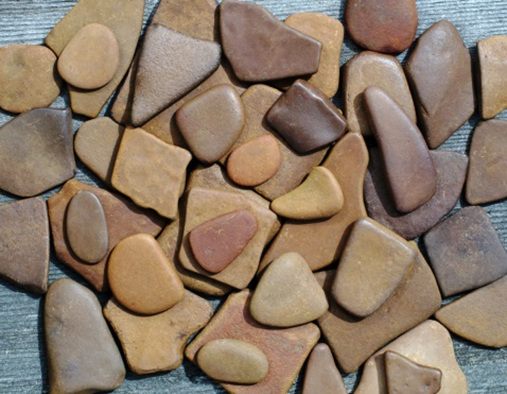
      Septarians are found only in certain areas of Southwestern Michigan and very few other places around the world. Locals call them “lightning stones” or “turtle stones” for the resemblance. The photos below are good examples of the cracking process. Sometimes the stones break completely apart and we find thousands of smoothed, broken-off sections on the beach.

      Brown Mud/Clay Stones Broken Pieces
      Septarian Brown Stone

      Limestone

      Limestone is a sedimentary rock composed mainly of the skeletal fragments of marine organisms such as corals, clams, or mollusks. Its major mineral contents are calcite and aragonite, which are different crystal forms of the compound calcium carbonate. Marine animals grow their shells by extracting calcium carbonate from the water, which is quite fascinating when you think about it! There are several types of limestone lying on the beaches of the Great Lakes. Below is a descripton of four types; Compact, Crinoidal, Fossiliferous and Tuffa Limestone!

      Compact Limestone

      Compact Limestone

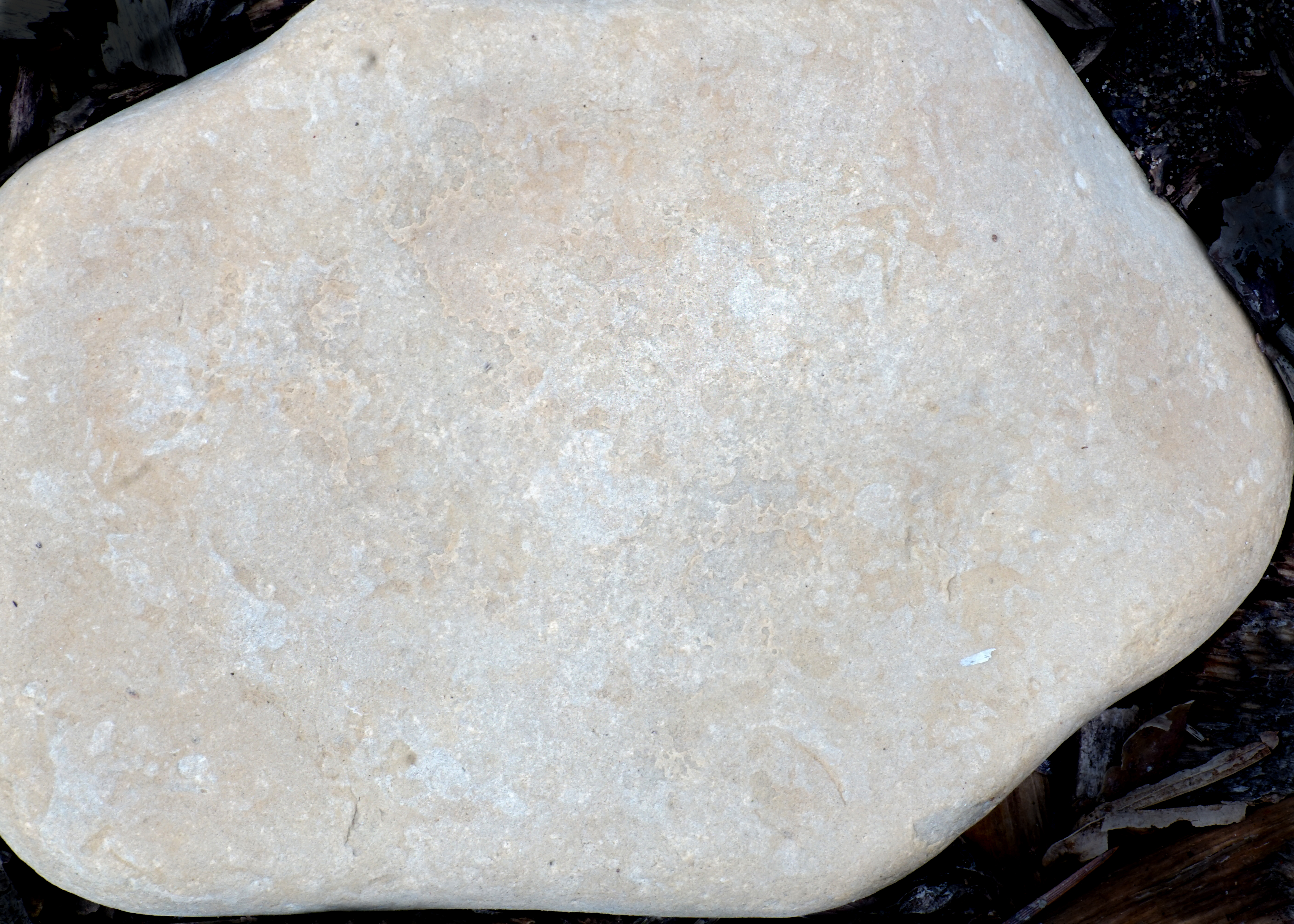
      Compact limestone is composed primarily of tightly packed calcium carbonate derived from the remains of marine organisms. It can vary in color from white, yellowish, pinkish, red, gray, or even black, depending on the presence of other minerals. It has a very fine texture and is denser than other types of limestone. The first sample shown above is a large piece with rounded edges and has been flattened, hence the name “shingle” for flat stones found on beaches.

      Crinoidal Limestone Found on Lake Michigan Beach
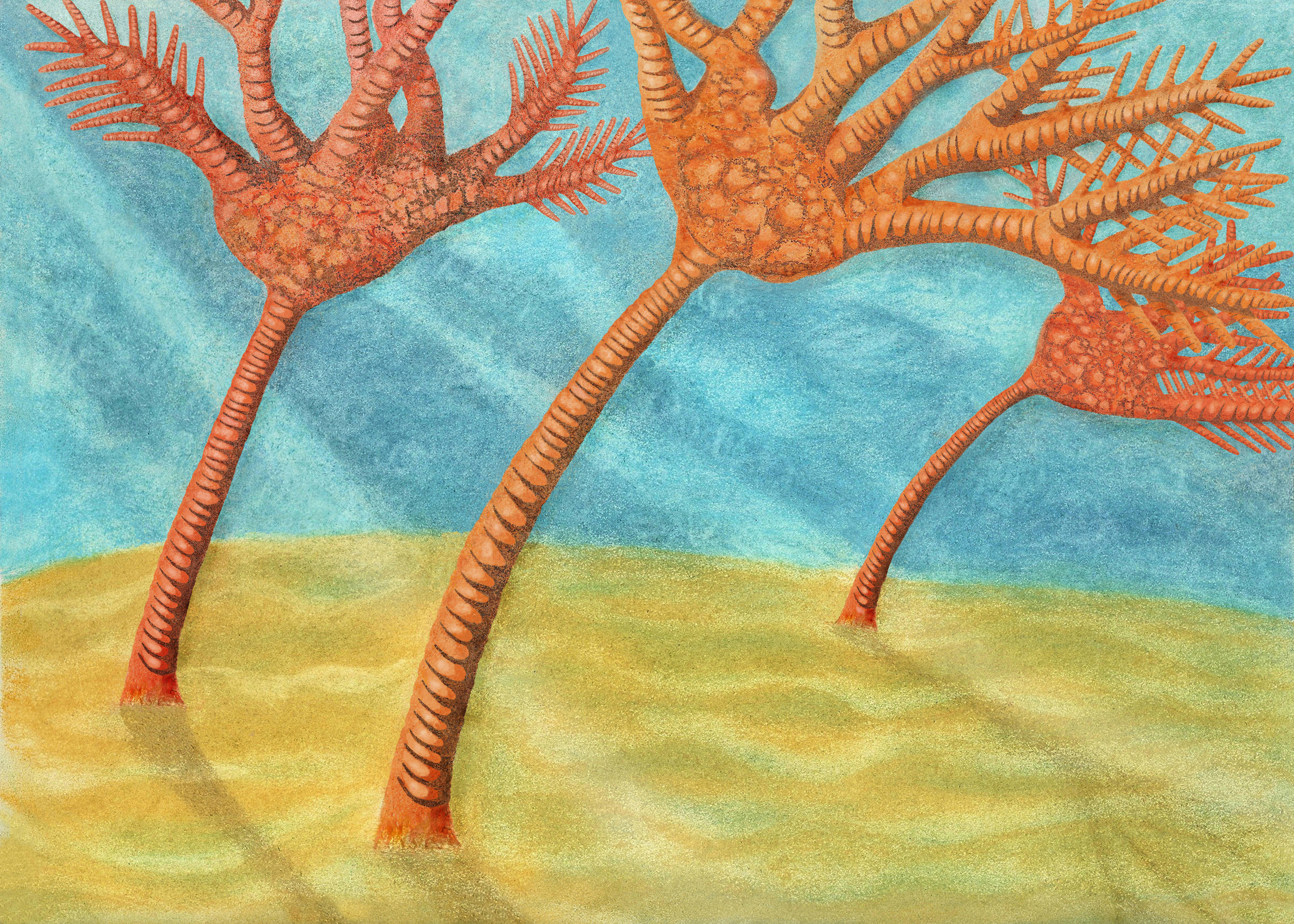
      Extinct Crinoid Ocean Creatures

      Crinoidal Limestone

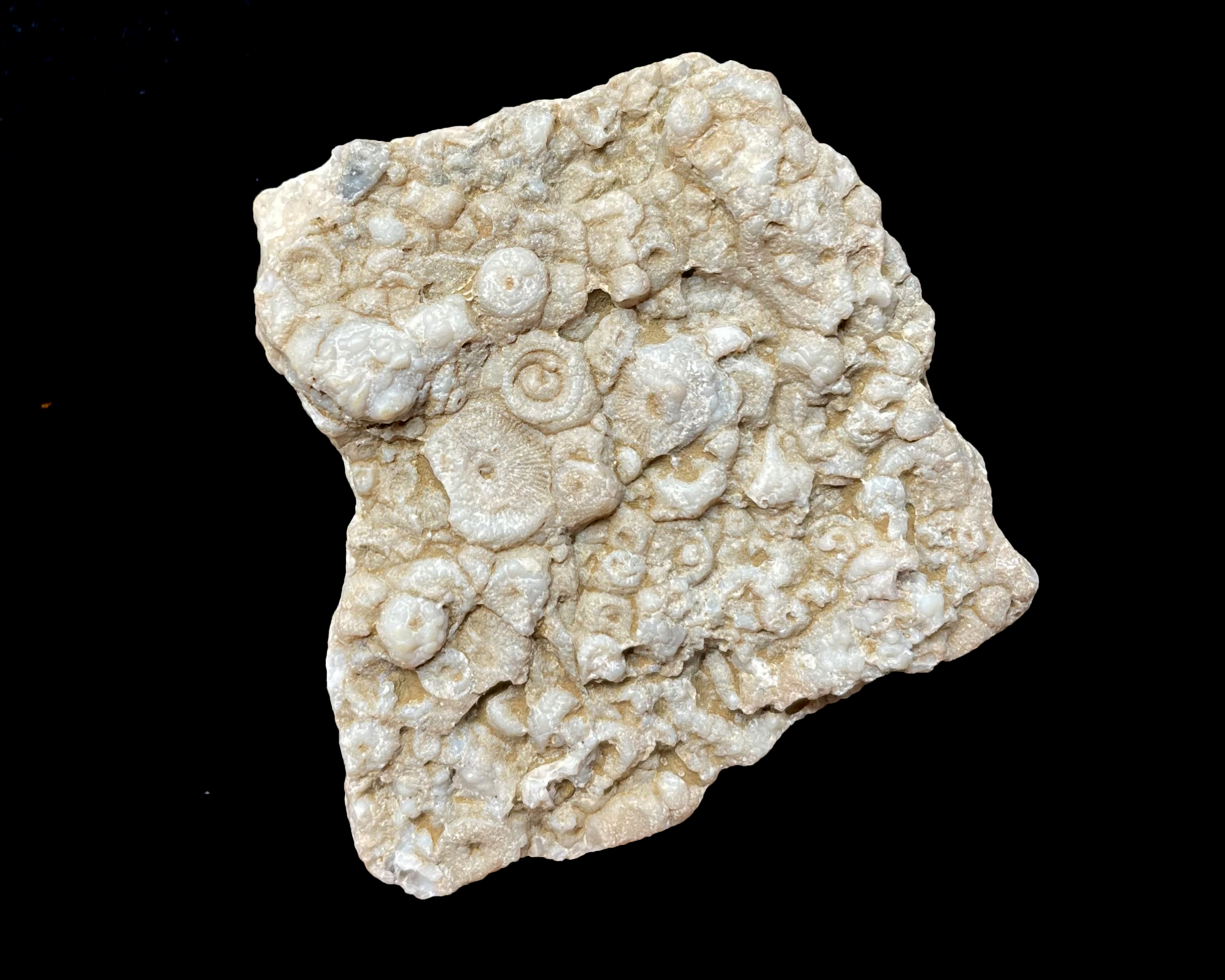
      Crinoidal limestone contains a significant amount of crinoid fossils. Crinoids are extinct invertebrate organisms with limbs that branched out from atop a long narrow stem. They lived as far back as 500 million years ago. They fed by sifting or filtering microorganisms from the ocean water with tentacle like feelers (see drawing). With keen eyes, we sometimes find broken stems from the fossilized remains of these marine creatures or we find individual cheerio-shaped pieces broken off from the stems visibly embedded in the rock samples above and below.

      Fossiliferous Limestone

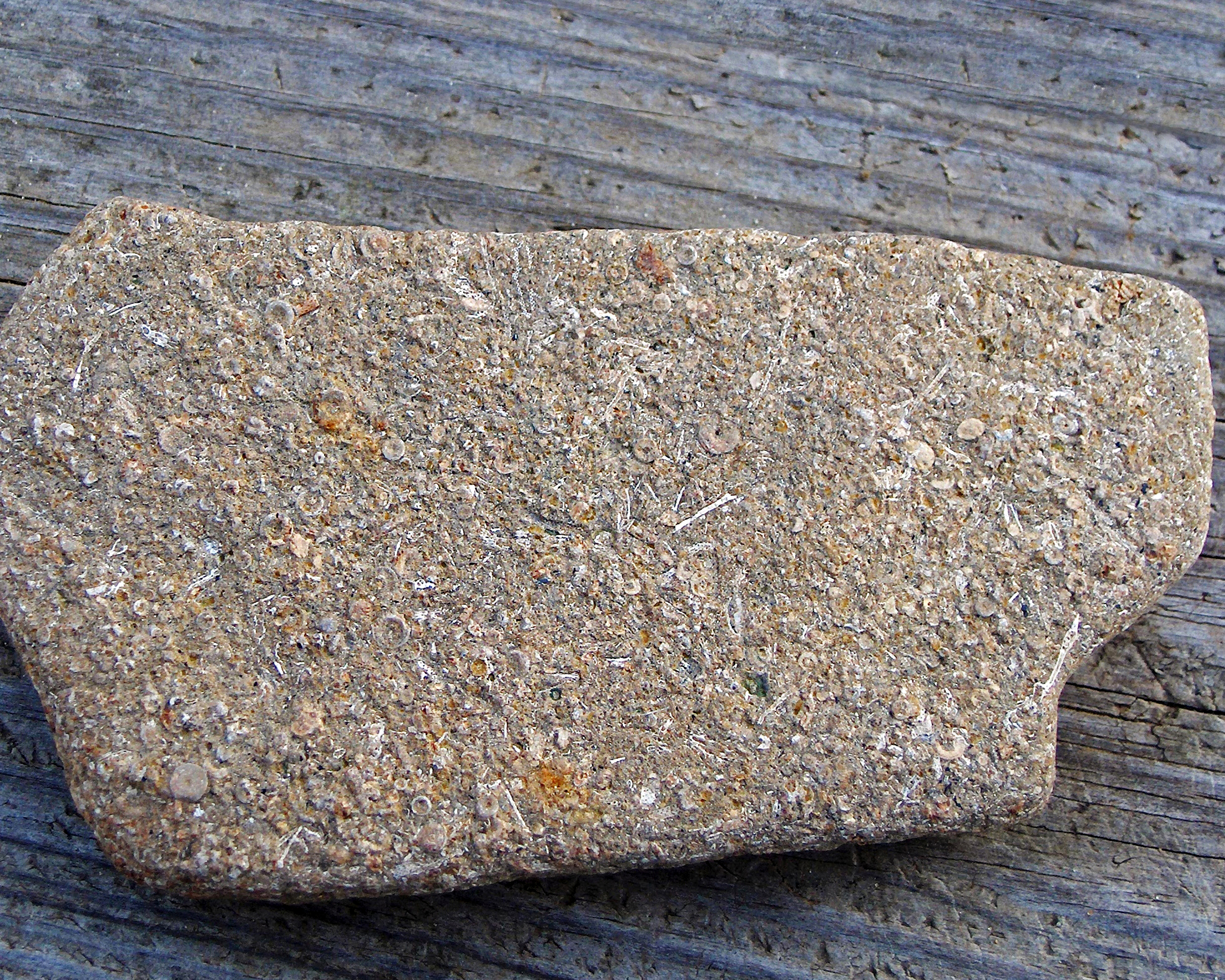
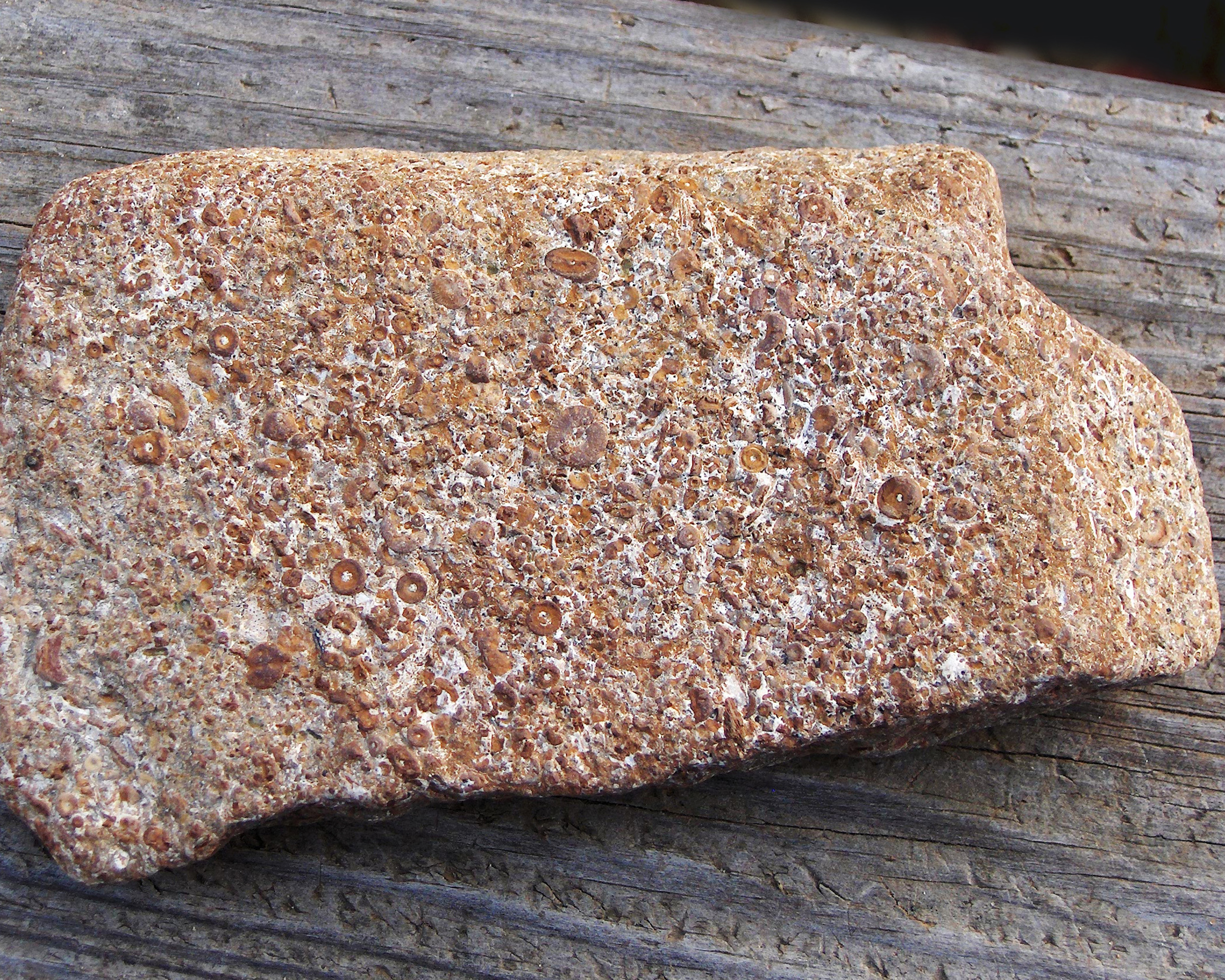
      Fossiliferous limestone (shown above) are found fairly commonly in certain pockets on the beaches of Southwest Michigan. Fossiliferous limestone contains a visible abundance of broken fossil pieces such as the shells of mollusks, clams, crinoids, and other invertebrate organisms. Like other limestone, fossiliferous limestone is composed of the mineral calcite. It can be white, pink, red, reddish brown, gray, and even black, depending on the mineral makeup. We find many reddish-brown colored samples on our beaches due to the infusion of iron.

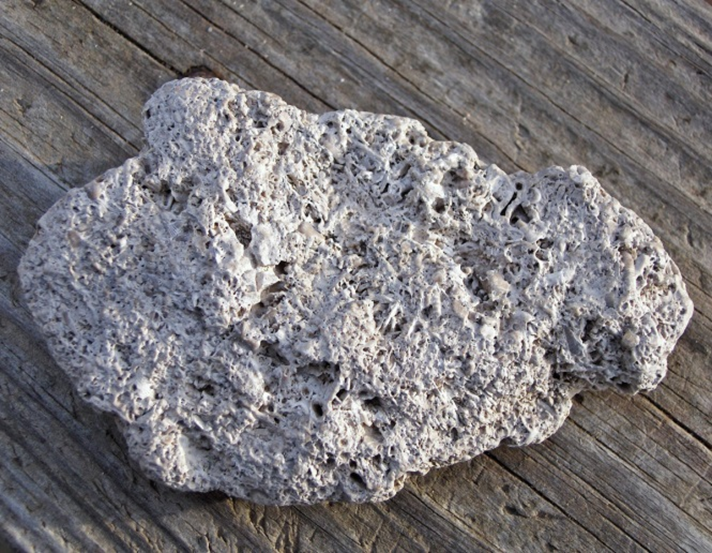
      Tuffa Limestone Found on Great Lakes Beach

      Tuffa Limestone

      Tuffa Limestone is a porous limestone that forms from the precipitation of calcium carbonate, often at a hot spring or along the shoreline of a lake where waters are saturated with the chemical compound.

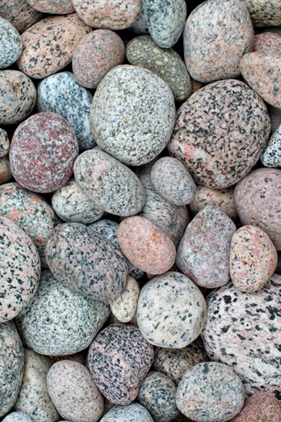
      Granite Beach stones

      Granite

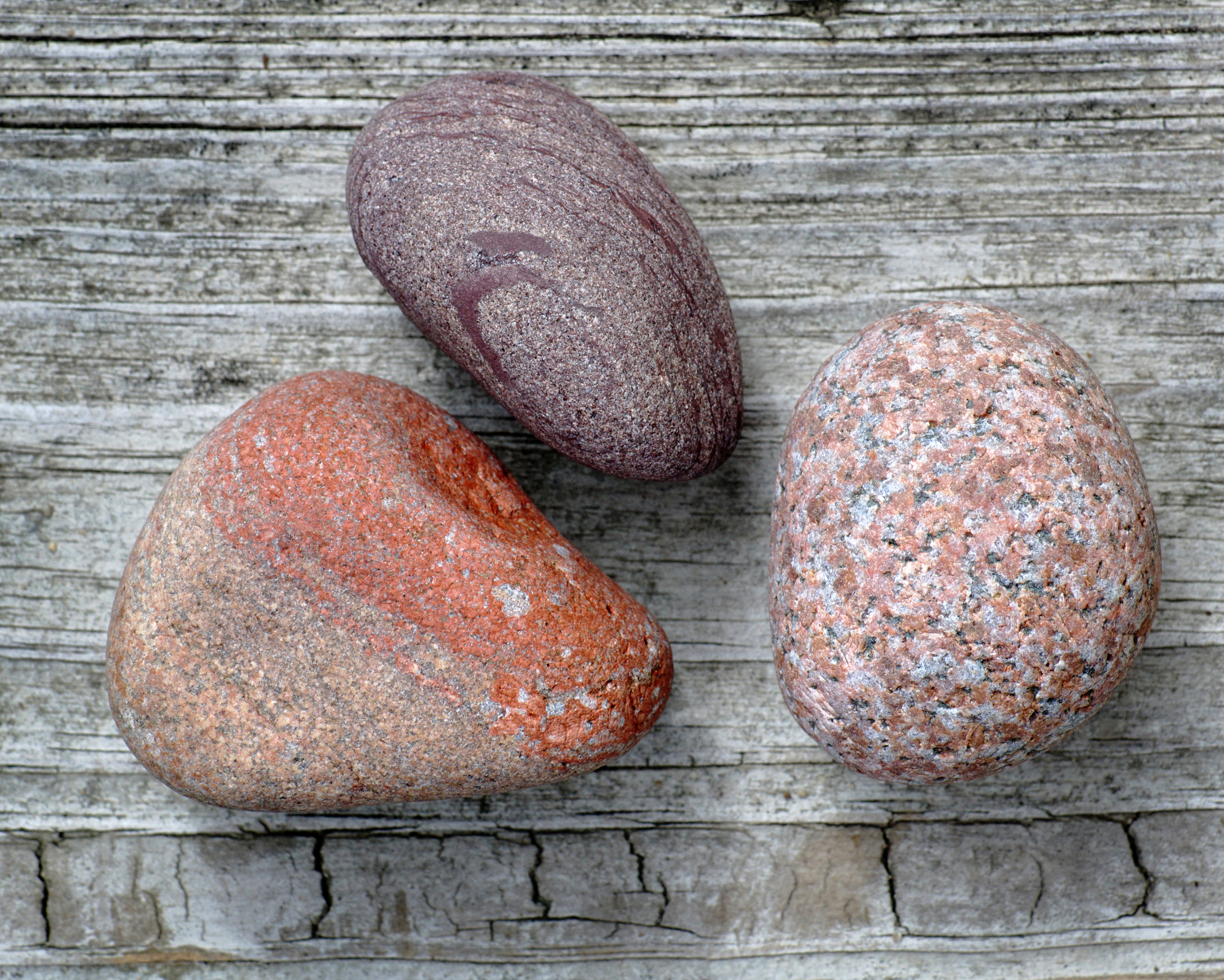
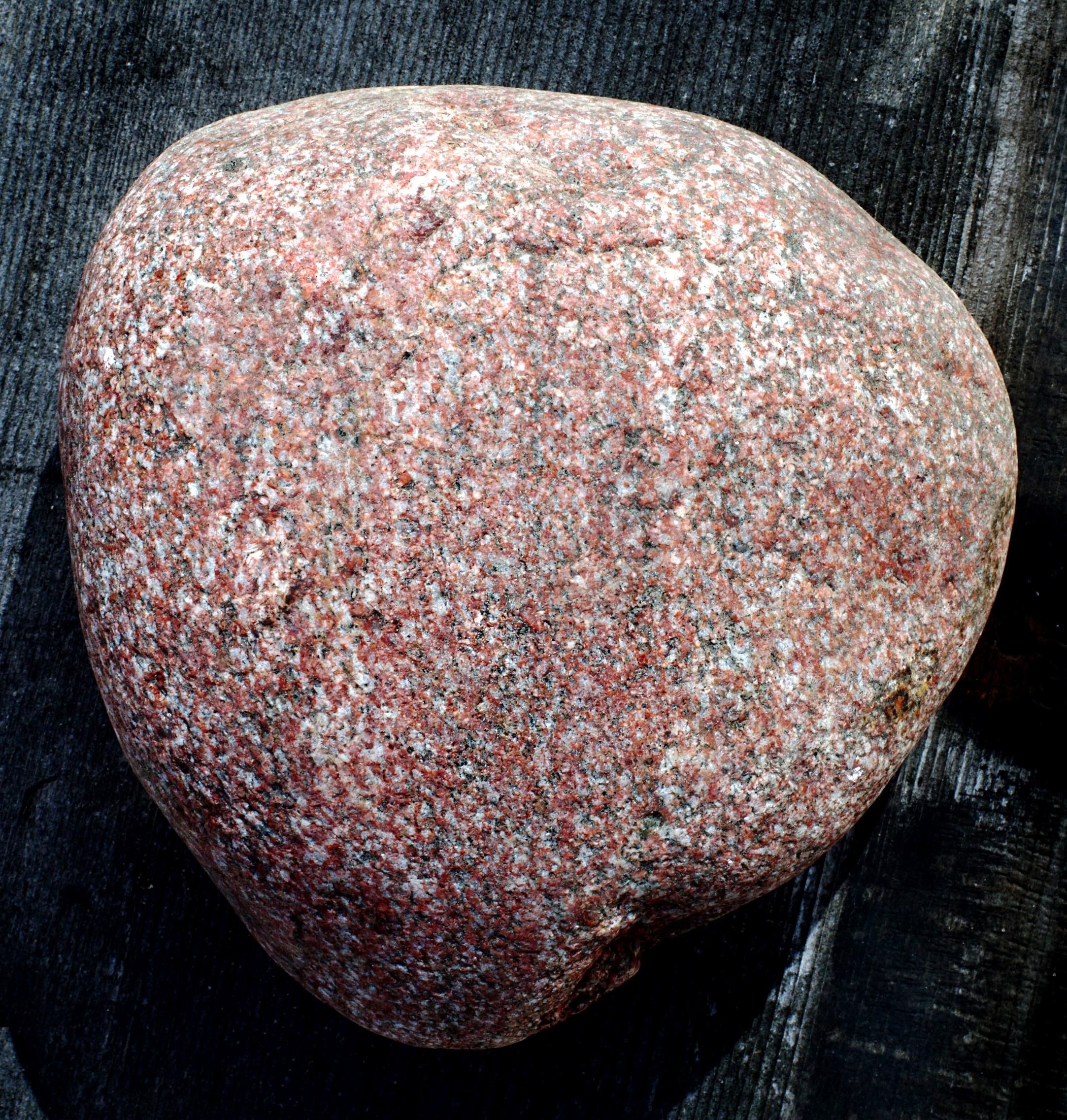
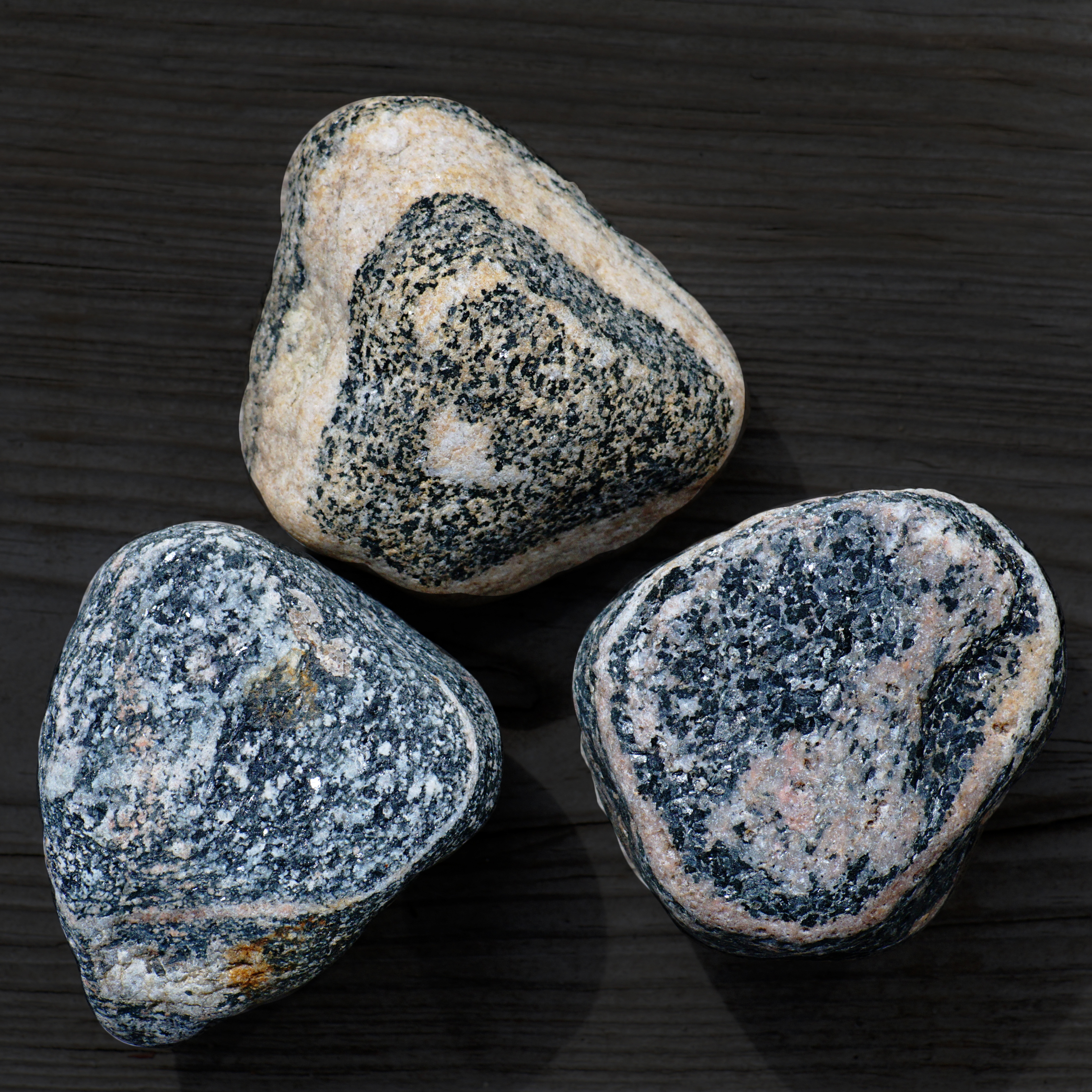
      It’s thrilling to find these round, bird-egg-shaped granite stones on the beach. With their varied colors and patterns, they create beautiful works of art. Granite is another type of rock we find quite often on our Great Lake beaches in the form of pebbles, cobblestones, and boulders.

      Granite makes up 70–80% of the Earth’s crust. It’s an igneous rock that cools slowly during its formation deep within the Earth. The slow cooling (intrustive type) allows for the process of crystallization of molten rock. The crystallized, coarse-grained minerals can easily be seen with the naked eye in each rock. Colors vary from red, pink, gray, to white with black grains, depending on the amount and mix of minerals.

      What gives granite its color?

      • Quartz – typically milky white in color
      • Plagioclase Feldspar – typically off white
      • Alkali or Potassium Feldspar – typically salmon pink
      • Biotite Mica – typically black or dark brown
      • Muscovite Mica – typically metallic gold or yellow
      • Amphibole Hornblende – typically black or dark green
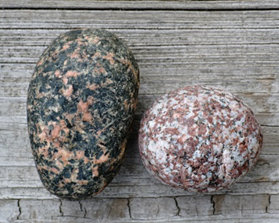
      Granite Beach Stones

      Special Granite – Above, are two samples demonstrating the variances in granite’s colors depending on mineral content. Can you guess their mineral content based on their color?

      Although granite underlies much of the Earth’s surface, it doesn’t often rise up to where we can find it. The Canadian Shield is an enormous granite formation covering most of the country. It is the nearest place to Michigan where granite is found above the crust. So how did it find its way to Michigan’s shores? If you guest the glaciers from past ice ages, you would be right. The granite stones were scraped and carried south from Canada.

      Porphyritic Granite

      Porphyritic Granite

      Porphyry or porphyritic rock is made up of a finer-grained rock mass containing larger crystals, in the case of granite, feldspar crystals. Porphyry rock is typically made up of a basalt base but sometimes it can be made up of a granite base with larger, jagged, rectangular crystals within. The larger crystals in the sample shown above have been smoothed by the wave and sand action of the shoreline. Porphyritic crystals are generally white, pink, or orange.

      Granite is more difficult to identify as porphyritc form because of its already-coarse grain, but look for stubby, square, or hexagonal crystals that are larger than the other grains within the granite rock. You can clearly see this in the samples I have provided above found on a Lake Michigan beach. Here’s how it happens: As the feldspar minerals in granite begins to crystallize, the process is disturbed when the molten rock is quickly erupted, freezing the well-formed feldspar crystals in place while the rest of the rock quickly cools and fills in around the crystals.

      Diorite

      Diorite

      Diorite is another of several types of coarse-grained igneous stones that can easily be confused with granite. Diorite’s chemical composition is intermediate between gabbro (described above) and granite.

      How to tell the difference between diorite, granite, and gabbro? The best way to tell diorite from granite is by the salt-and-pepper appearance of diorite which differs from granite’s combination of various colors. To tell diorite from gabbro, look for gabbro’s darker color. If you have in your hand a granite-looking rock with obvious pink feldspar and more than 20% quartz, you probably have granite, not diorite or gabbro. Also, diorite is composed with an almost-equal mixture of light-colored minerals, such as sodium-rich plagioclase (a certain type of feldspar mineral), to dark-colored minerals such as amphibole, hornblende, or biotite mica.

      Gneiss

      Gneiss

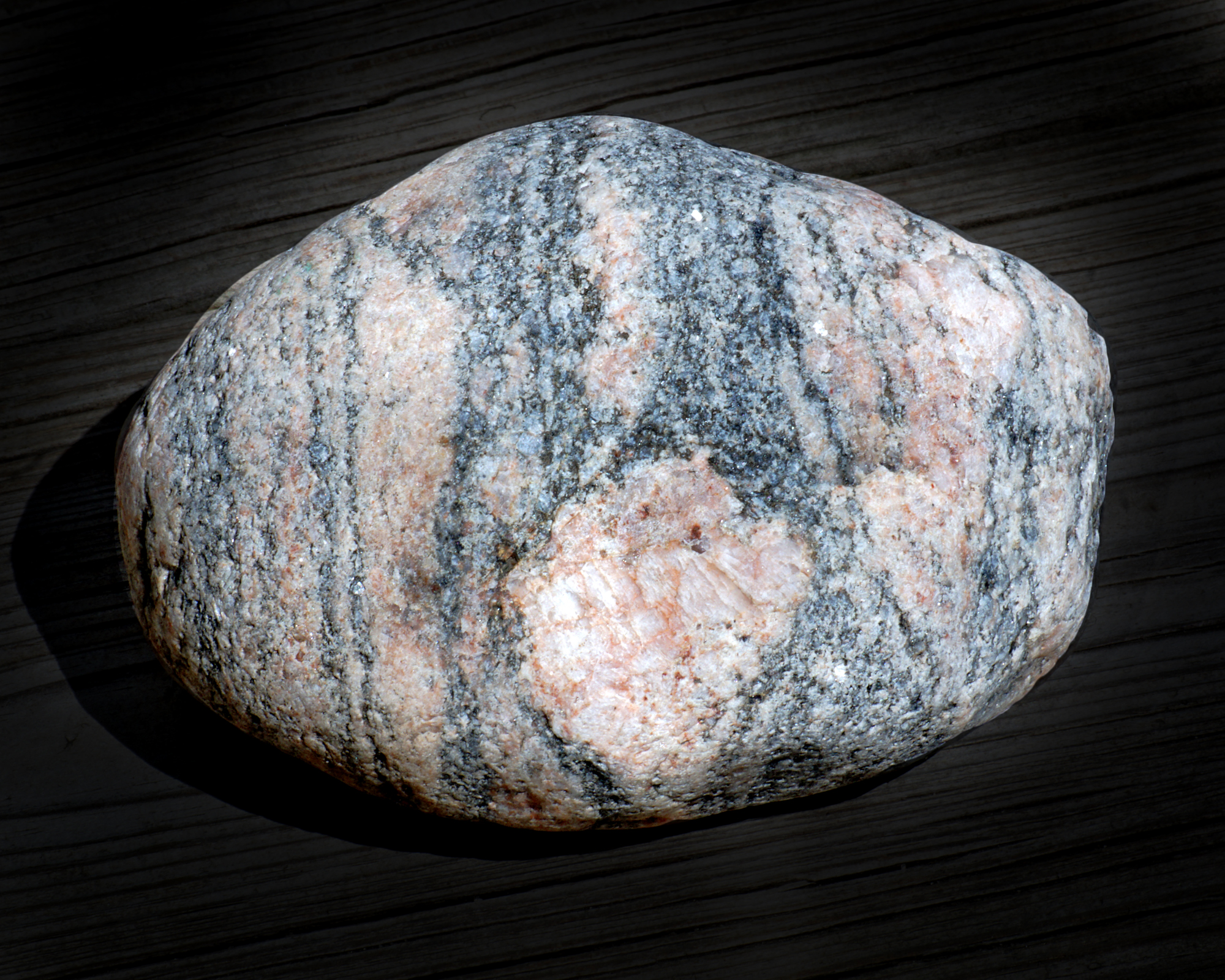
      Did you ever wonder how some rocks have bands or stripes? They are some of the most attractive stones, like gneiss for instance, which I only occasionally find on the beach.

      Gneiss (pronounced “nice”) usually forms at convergent plate boundaries. It is a high-grade metamorphic rock formed under intense heat and pressure. The original mineral grains recrystallize, enlarge, flatten, and reorganize into parallel bands which make the rock and its minerals more stable. While the chemical composition of the rock may not have changed, its physical structure will look completely different from the original parent rock.

      The bands in gneiss are often broken, can be foliated (folded), and can show different widths. Individual bands are usually 1-10 mm in thickness. Layers larger than that imply that partial melting or the introduction of new material probably took place. Such rocks are called “migmatites.” Hence, my boulder sample above would be termed “migmatized gneiss.” It is not well understood how the segregation takes place.

      Gneiss

      The granular light-colored minerals in gneiss are calcium, sodium, and potassium-rich minerals such as quartz, and also various types of feldspar. The dark-colored layers consist of iron-magnesium-rich minerals including biotite, chlorite, garnet, graphite, or hornblende. The texture is medium to coarse—coarser-grained than schist but, as with the other rock types, the gneiss we find on our beaches has been ground down until it’s somewhat smoother.

      What is the difference between gneiss and granite?

      • Granite is an igneous rock, whereas gneiss is formed after metamorphosis of granite.
      • Most—but not all—gneiss is obtained from granite. There is also diorite gneiss, biotite gneiss, garnet gneiss, and others.
      • The mineral composition of granite and gneiss are the same. However, the transformation of granite due to high pressure and temperature leads to the formation of gneiss.
      Schist

      Schist

      Schist is a medium-grade metamorphic rock formed by the metamorphosis of mudstone and shale or some type of igneous rock such as slate. As a result of high temperatures and pressures, the coarser mica minerals (biotite, chlorite, muscovite) form larger crystals. These larger crystals reflect light so that schist often has a luster (the photograph doesn’t exhibit the luster, but it’s there). Due to its extreme formation conditions, schist often reveals complex folding patterns with a tendency to exhibit split sheets or plates of mica arranged roughly parallel to each other There are many varieties of schist, and they are named for the dominant mineral comprising the rock, e.g., mica schist, green schist (green because of high chlorite content), garnet schist, and so on. I find these only occasionally on shoreline.

      Sand Stone Boulder

      Sandstone

      Sandstone is a sedimentary rock that forms when small quartz sand grains cement together under high pressure while silica, calcium carbonate (calcite), or quartz precipitates and acts like a glue around the grains. These minerals are deposited in the spaces between the grains of sand by water. Over the course of thousands, even millions of years, the minerals fill up all of the spaces. At a close look, you can see the tiny particles in the rock almost as if you were holding sand in your hand. When you’re at the beach, try examining the sand very closely to discern the tiny quartz crystals and different colors of other minerals contained in it, including feldspars, micas, calcite, and clays.

      Sandstones

      Depending on the minerals, sandstone can be white, yellow, pink, and almost any color, depending on the impurities within the minerals. For example, red sandstone results from iron oxide in the rock and often causes bands of color. Sandstone rocks form in rivers, deserts, oceans, or lakes. It feels gritty to the touch.

      Jacobsville Redstone Sandstone

      Jacobsville Redstone Sandstone

      Jacobsville Sandstone, or Redstone, is generally red due to the presence of highly oxidized iron cement which binds together the grains of quartz. The stone is typically mottled with various pinks, whites, and browns, exhibiting either many streaks or spherical spots caused by leaching and bleaching. It forms a wide belt throughout Northern and Upper Michigan and was quarried rather extensively at one time for use as building material which built the cities of Northern Michigan and elsewhere in the Great Lakes region. As with many stones that formed northward in Michigan, the big lake brings them southward to where I find them in lesser amounts. Estimates for the age of the Jacobsville Formation Range is in the late Mesoproterozoic Era about 1.05 billion years ago until the Middle Cambrian Period.

      Siltstone

      Siltstone

      After some stubborn digging around, I finally believe I understand the difference between sandstone, siltstone, mudstone, claystone, and shale. They all fall under “clastic” sedimentary rocks formed by weathering breakdown of rocks into pebbles, then into sand, then silt, then mud, then clay and last into shale, all from exposure to wind, ice and water. At each step the particles become smaller with shale having the finest grain. All the clastic sedimentary rocks are cemented very much the same way in which sandstone is pressed together described above. Silica, calcite, and iron oxides are the most common cementing minerals for siltstone. These minerals are deposited in the spaces between the silt grains by water. Over the course of thousands or millions of years, the minerals fill up all of the spaces resulting in solid rock.

      Siltstone

      Silt accumulates in sedimentary basins throughout the world. It occurs where current, wave, or wind energy cause sand and mud to accumulate. Siltstone is very similar in appearance to sandstone, but with a much finer texture. It has a slight grit texture to it and is more difficult to distinguish the mineral particles than sandstone. When handling siltstone, a residue of the same color as the stone can rub off on you hand. Siltstone is usually gray, brown, or reddish brown. It can also be white, yellow, green, red, purple, orange, black, and other colors. The colors are a response to the composition of the grains, the composition of the cement, or stains from subsurface waters.

      Left: Mudstone Right: Claystone

      Mudstone or Claystone

      I described above how mudstones and claystones are clastic sedimentary rocks formed similarly by way of sandstones and siltstones. But I will mention that we especially find the brown mudstones in abaundance on certain beaches in the southwestern regions of Michigan. They are the same type of stone that form the Septarian brown stones. The mudstones and claystones wipe off a residue when handling them due to their fine-grained texture. The last stone in the chain of the sedimentary clastic stones with the finest ground-down grains is shale, but we find very little of it, if at all on the beach. This is likely because shale easily breaks apart at parallel stratifications and due to the extreme ice, wind, and wave action of Lake Michigan, they get demolished.

      Green Chalcedony
      Green Chalcedony

      Chalcedony and Agate

      Without being totally certain, I believe these pretty little stones are one type or another of the gemstone chalcedony. They are penny-size and have a smooth, waxy texture. In order to spot these on the beach you need to look very closely along the shoreline where beach gravel is abundant, but I have found quite a few even though they are usually quite small. Michigan’s northern regions and upper peninsula are excellent places for finding chalcedony and other gemstones such as agates.

      Top: Agate Bottom: Forms of Chalcedony

      Chalcedony and Agate Explained

      Rock and minerals can be very complicated but fascinating to study. For a bit of geochemistry about chalcedony and agates, it only makes sense to begin with the microchrystalline quartz, chalcedony. Chalcedony forms where water is rich in dissolved silica and flows through weathering rock. When the solution is highly concentrated, a silica gel can form in the walls of the rock cavities. The gel will slowly crystallize to form microcrystalline quartz (very small crystals of quartz), in other words, chalcedony. Agate and many other microcrystaline quartz are a type of chalcedony all considered gemstones.

      Chalcedony can be banded, have plumes (fluffy inclusions), have branching patterns, or have delicately mottled surfaces of leafy green, honey brown, and creamy white. They might also have mossy and other colorful structural patterns within. Chalcedony is often blue but can be almost any color. It’s typically translucent but can be opaque with a milky appearance. It feels very waxy, greasy, or silky to the touch. Agate is generally translucent to semi-transparent and most often is banded. Observing bands in a specimen of chalcedony is a very good clue that you have an agate. However, some agates do not have obvious bands. These are more rare and may show branching-out, mossy inclusions. Typically, an agate is the size of a golf ball and feels heavier than it looks due to its density. It also has a waxy feel to it.

      More forms of chalcedony that are possible to find on certain Great Lake beaches, particular Northern Michigan or Wisconsin along the beaches of Lake Superior.

      • Aventurine (most often green, speckled, shimmery – opaque)
      • Bloodstone (dark green with red speckles – semi-transparent to opaque)
      • Carnelian (red to amber, vibrant, mottled patterns to banded – translucent)
      • Chrysoprase (apple green, uniform, fewer patterns – translucent to semi-opaque)
      • Onyx (solid black or white-banded black – opaque)
      • Chert (most often grey, fewer patterns, solid – opaque) Native Americans used to make arrowheads.
      • Jasper (most often red with patterns, swirls, bands, or spots – opaque)
      • Sard and Sardonyx (reddish-brown banded – transparent to translucent)
      • Tiger’s Eye (gold, banded, glistening sheen – semi translucent to opaque)

      Final Note: In early spring after the snowmelt, the movement of winter’s ice and snow tends to push and pile rocks further up onto the sandy shores; in some locations by the thousands. Later in the season, the wave action of the big lake washes many of the rocks back into the water and the steady summer winds bury some of them under the sand. Consequently, I find spring to be the best season for rock hunting. But I should mention that some beaches have very few stones, while other pockets are loaded with them.

      To end, I leave you with a lovely photo of beach stones settled on a creekbed where it flows into the shoreline of Lake Michigan!

      Share this:

      • Share on Pinterest (Opens in new window) Pinterest
      • Share on Facebook (Opens in new window) Facebook
      • Print (Opens in new window) Print
      • Email a link to a friend (Opens in new window) Email
      • Share on LinkedIn (Opens in new window) LinkedIn
      • Share on Reddit (Opens in new window) Reddit
      • Share on X (Opens in new window) X
      Like Loading...
      Rocks beach stonesgeologyLake Michigan stonesrock factsrock identificationrock photography

      Porpoise Rib Fossils and U.S. Atlantic Coastal Plain Fossiliferous Formations

      June 2, 2022 by Fossillady

      As you scroll down through the Category of Cenozoic Aquatic Fossils, you will find interesting information and identifications pertaining to six such fossil species from my collection, including:

      1. Porpoise Rib Fossil
      2. Hypural Tuna Fishtail Bone Fossil
      3. Softshell Turtle Fossil
      4. Knightia Fish Fossil
      5. Dermal Denticle Ray-Fish Fossil
      6. Billfish Bill Fossil
      Cenozoic Timescale Source

      U.S. Atlantic Coastal Plain Geological Formations in Brief

      The Cenozoic Era aquatic fossils in my collection were unearthed along of the Atlantic Coastal Plain of the United States (with one exception). The fossiliferous Miocene Epoch aged rock layers of the Atlantic Coast crops out almost continuously from southern Florida northward to Cape Cod, Massachusetts. (Gibson, 1965). Some Miocene formations (mapped bedrock units or layers) form large overlaps over older Oligocene, Eocene, and Paleocene Epoch aged rock layers (refer to timescale) as well as Mesozoic Era of the Lower and Upper Cretaceous Period rock layers (145 to 65 mya). Some Miocene formations also underlies younger Pliocene-Holocene Epoch bedrock units. I only have information as to one specific location where some of my fossils were found; the Lee Creek-Aurora mine within the Pungo River Formation in Beaufort County, North Carolina which contain various middle Miocene aged fossiliferous sediments.

      Other locations where the fossils were found, I assume, could be from the Yorktown Formation another mapped bedrock unit, Pliocene aged located in the Coastal Plain of Maryland, Virginia, North Carolina and South Carolina; the Eastover Formation, late Miocene aged located in North Carolina; the Calvert Formation located in Maryland, Virginia and Delaware, early to middle Miocene aged, one of the three formations which make up the Calvert Cliffs, all of which are part of the Chesapeake Group.

      From the southern portion of the Coastal Plain, Georgia fossils date from the Late Cretaceous, 145 mya to the present, Holocene Epoch; and Florida’s surface fossil record dates back to the Eocene Epoch when the the entire state was covered by ocean.

      When sea levels were high, a shallow seaway covered much or even all of the Coastal Plain. During times of lower sea levels, the area was dryland, with large rivers and broad floodplains. For this reason, Coastal Plain strata consist of alternating marine sediments (those deposited in the sea) and non-marine sediments (those formed on land).

      These richly fossiliferous deposits have attracted the attention of North American paleontologists since the nineteenth century, not to mention serious fossil hobbyists today.

      Porpoise Rib Fossils

      Porpoise Fossils

      Approximately the lower half of the Calvert Formation (described above) is dominated by porpoise fossils, including squalodonts (primitive shark-toothed porpoises). Modern-day type porpoise fossils, also, are consistently present there, indicating an environment of estuaries and rivers. Articulated (entire body) skeletons of porpoises are not uncommon throughout the Calvert Formation. The Pungo River Formation (described above), also, has unearthed many porpoise fossils, including the river porpoises. Pertaining to my porpoise rib fossils, with the lack of enough related evidence, it’s impossible to pin down an exact species.

      Porpoise Evolution

      Cetaceans (whales, dolphins, and porpoises) are an order of mammals that originated about 50 million years ago in the Eocene epoch. Even though all modern cetaceans are fully aquatic mammals, early cetaceans were amphibious, and their ancestors were terrestrial artiodactyls (an order of mammals that comprises the even-toed ungulates (hooved mammals). Hippos are thought to be the closest living relatives of cetaceans.

      Cetacean species are divided into two groups:

      (1) Baleen whales – these are the “great whales” and as their name suggests, they all have baleen plates that are used to filter food consisting of plankton and small species of fish.

      (2) Toothed whales – are a suborder called odontocetes and include all species of dolphin and porpoise which eat larger prey, including at times, other marine mammals.

      As a general rule of thumb, baleen whales are larger and slower than toothed whales. Additionally, all baleen whales have two blowholes, whereas toothed whales have only one.

      Dolphin and Porpoise Comparison Sketch

      Porpoise Vs Dolphin

      Porpoises and dolphins have many similarities, for example, both are highly intelligent and use echolocation, but there are several differences, as a dolphin is not a porpoise and a porpoise is not a dolphin.

      • Porpoises are quite smaller than dolphins
      • Porpoises don’t have a pronounced beak that most dolphins have
      • Porpoise teeth are spade-shaped whereas dolphin teeth are cone-shaped
      • Porpoises have a triangular dorsal fin and dolphins have a curved dorsal fin (except for those species that don’t have a dorsal fin)
      • Porpoises body form is a little more chunky than that of the leaner, more slender dolphin body form
      • Porpoises are not vocal like the talkative dolphins
      • Porpoises are more closely related to narwhals and belugas
      • Porpoises belong to the Phocoenidae family. There are only six species of porpoises in the entire world. Oceanic dolphins, however, belong to the large Delphinidae family, which consists of at least 36 species worldwide! River dolphins belong to the Iniidae family with one living genus and four extinct genera

      The Six Species of Extant Porpoises

      1. The Harbor porpoise, Phocoena phocoena, has a worldwide distribution including both eastern and western U.S. and Canada coasts within the temperate to arctic regions.

      2. Dall’s porpoises, Phocoenoides dalliand, northwestern U.S. coast to China

      3. Vaquita porpoise, Phocoena sinus, small range, Gulf of California in Mexico

      4. Finless porpoise, Neophocaena phocaenoides, wide range of Indo-Pacific regions

      5. Spectacled porpoise, Phocoena dioptrica, southern Atlantic to Indo-Pacific, sub-Antarctic regions

      6. Burmeister’s porpoise, Phocoena spinipinnis, both coasts of South America, mid to southern regions

      All rights reserved © Fossillady 2025

      Share this:

      • Share on Pinterest (Opens in new window) Pinterest
      • Share on Facebook (Opens in new window) Facebook
      • Print (Opens in new window) Print
      • Email a link to a friend (Opens in new window) Email
      • Share on LinkedIn (Opens in new window) LinkedIn
      • Share on Reddit (Opens in new window) Reddit
      • Share on X (Opens in new window) X
      Like Loading...
      Cenozoic Era Aquatic Fossils Aquatic FossilsCenozoic FossilsCenozoic TimescaleCetacean descriptionMiocene Fossilsporpoise endangeredporpoise evolutionporpoise rib fossilporpoise vs dolphinPungo River FormationUS Atlantic Coast Fossilswhale evolution 1 Comment

      Hypural Bone Fishtail Fossil Information and Interesting Related Facts

      May 14, 2022 by Fossillady
      Hypural Fishtail Fossil Bone (4.5 inches (11.4 cm)

      Hypural Bone Description, Body Location and Function

      The hypural is a fan-shaped series of bones constituting an important part of the framework of ray-finned fish. The hypural bones are sometimes fused into one or two plate-like bones, such as with the case from my fossil collection, shown above. The hypural boney-plates join the last few vertebrae of the fish’s spine to the slender bony rays of the fish’s caudal fin. Caudal fin is a fancy scientific term for the tailfin. The caudal fin is attached to the end of the fish’s caudal peduncle by the hypural bone. The caudal peduncle is the narrow part of the fish’s body. The tailfin helps the fish steer, balance and propel. (See illustration below)

      My hypural fossil was unburied in the Pungo River Formation, Aurora District, North Carolina, USA, dated from the early to middle Miocene Epoch around 23 to 14 million-years-ago. It is a large sample. I found a close match to the fossil of a tuna fish, Thynnus sp. posted by the Fossil Guy from the same location.

      Tuna Facts

      Tuna are a type of ray-finned bony fish belonging to the class or subclass of Actinopterygii. Ray-finned bony fish comprise over 50% of all living vertebrate species. The ray-finned fishes are so-called because their fins compromise webs of skin supported by slender bony spines (rays), as opposed to the fleshy, lobed fins that characterize the class Sarcopterygii (lobe-finned fish).

      Tunas are teleost fish identified by their symmetrical forked tails with the upper and lower halves both exhibiting identical size.

      Check out the list of a few common east Atlantic USA tuna species beginning with the largest and possible matches to the hypural fossil. You can check out the links from NOAA, National Oceanic and Atmospheric Administration, for information about their range, life cycle, population status, appearance etc.

      • Western Atlantic Bluefin reaching up to13 feet (4 meters) long, weighing 2000 lbs (900 kg)
      • Atlantic Big Eye reaching up to 8 feet (2.5 meters) long, weighing 400 lbs (181 kg) or more
      • Atlantic Yellowfin reaching up to 7 feet (2 meters) long, weighing 300 lbs (181 kg) or more
      • North Atlantic Albacore reaching up to 4 feet (1.2 meters) long, weighing 88 lbs (40 kg) or more
      • Atlantic Skipjack reaching up to 3 feet (.9 meteres) long, weighing 40 lbs (18 kg) or more
      Atlantic Yellow Finned Tuna (Thunnus albacares)

      Tuna Interesting Facts

      In addition to the caudal fin, these high performance tuna fishes are equipped with finlets and keels. The finlets are small fins along the trunk that help the fish cut through the water. The keels can be described as a pair of lateral structures that rise slightly forward along the caudal peduncle which are a remarkable specialization in tunas, which, by the way, have also arisen in other fast-swimming marine animals.

      Tuna are formidable predators with the ability to outmaneuver, outswim, and eat just about anything they can fit into their mouths.

      Tuna can not only swim fast, but can reach remarkable distances as they migrate.

      Western Atlantic Blue Fin Tuna (Thunnus thynnus)

      Origins of the Bluefin Tuna and Evolution Development

      The bluefin tuna originated from an exothermic ancestor. Exothermic means acquired heat source from the environment to stay warm. Earliest tuna fossils have been found in the Late Paleocene (65-55 mya) and Early Eocene (55-50 mya) epochs in the Tethys Sea deposits from the Middle East, southern Europe and the London clay formation. A close relative of the tuna, the earliest bonito fish, identified as Sarda palaeocenica were found in the region from the Early Paleocene. The extinct tuna-like fish, Paleothunnus parvidentatus, displayed characteristics common to both the tuna and the bonito, suggesting that the split of the tuna and bonito did not occur until the Early Eocene Epoch. Within 8-10 million years the two species diverged, forming the tuna genus Thunnus (Dickson and Graham).

      Development of Endothermy in Tuna

      As the oceans began to cool, warm waters began to compress into the tropics. In the Cenozoic Period, waters were the warmest at the end of Paleocene Epoch. The Tethys Seaway, a large tropical sea, began to shrink due to tectonic events and contributed to ocean cooling across the planet. Endothermy (body mechanisms other than shivering that generate heat internally) possibly evolved in tunas as a result of the need for migration and diving into colder waters for plentiful hunting grounds.

      Because of the evolution of endothermy (internal heat sources) within the bluefin and other tuna, the fish are able to migrate across large distances. Dickson and Graham state that this has enabled the Atlantic Northern Bluefin Tuna to greatly expand its range and take advantage of the rich feeding areas in northern waters and warm spawning areas in the tropics, effectively expanding its thermal niche.

      About Pungo River and Yorktown Formations

      The Lee Creek Mine in Aurora, NC, is an open-pit phosphate mine operated by the Potash Corporation. The mine exposes two fossiliferous geological marine layers: the Pungo River Limestone (middle Miocene, Langhian age), and the Yorktown (lower Pliocene, Zanclean age) formations. The Pungo River Limestone and base of the Yorktown Formation are richly phosphatic and are commercially mined. These two units have yielded one of the most important assemblages of Neogene (between 23 and 2.6 mya) marine vertebrates in the world, including hundreds of species of sharks, rays, skates, bony fish, birds, sea turtles, estuarine crocodiles, seals, walruses, dolphins, and baleen whales. These fossils are found on-site as well as in reworked sediments in the spoils leftover from the mining. Unfortunately, the mine has been closed to the public since 2009.

      Partial list of other Miocene bony fish fossils discovered in and around the U.S. Eastern Atlantic Coastline of South Carolina and North Carolina, as well as Maryland and Virginia.

      • Burrfish, Filefish, Tilefish, Pufferfish
      • Marlin, Sailfish, Boxfish, Sturgeon
      • Anglerfish, Bonita, Tuna, Bowfin
      • Catfish, Hake, Toadfish, Needlefish
      • Sea Robin, Bass, Bluefish, Barracuda
      • Boxfish, Goosefish, Toadfish, Pinfish

      Share this:

      • Share on Pinterest (Opens in new window) Pinterest
      • Share on Facebook (Opens in new window) Facebook
      • Print (Opens in new window) Print
      • Email a link to a friend (Opens in new window) Email
      • Share on LinkedIn (Opens in new window) LinkedIn
      • Share on Reddit (Opens in new window) Reddit
      • Share on X (Opens in new window) X
      Like Loading...
      Cenozoic Era Aquatic Fossils bluefin tunabluefin tuna evolutionCenozoic Fossilsfishbone fossilhypural bone functionhypural fishtail fossilMesozoic fossilPaleocene fossilsPungo River Formationray finned fossiltuna fish factstuna fossilUSA Atlantic fossilsyellowfin tunaYorktown formation.

      Softshell Turtle Fossils

      May 3, 2022 by Fossillady

      The two softshell turtle fossils from my collection (shown above) are broken-off pieces from the animal’s carapace (shell covering). The fossils were unearthed with other Miocene-Pliocene Epoch (23 – 2.6 mya) fossils from the rich fossiliferous east coast of the USA. Below is an excellent softshell fossil specimen from Florida!

      Brief Origin of Softshell Turtles

      The earliest known turtles date to the Late Permian Epoch around 260 million-years-ago. Whereas living turtles are toothless, many ancestral forms possessed teeth. Many of the oldest and most primitive forms lacked a shell, however, they possessed precursors to the shell structures.

      Researchers led by members at the University of Pennsylvania’s Department of Earth and Environmental Sciences describe one of the earliest known species of softshell turtle. The animal lived 66.5 million-years-ago in what is today North Dakota and was unearthed back in 1975. Hutchemys walkerorum, softshell turtle lived at the same time as some very large and well-known species of dinosaurs, including Tyrannosaurus rex and Triceratops. A phylogenetic analysis suggests that the roots of softshell turtles formed in Asia, from where the animals migrated into today’s North America sometime in the Late Cretaceous (105 mya).

      Photo Courtesy of Harry Pristis The Fossil Forum

      Turtle Shell Structures

      Turtle shells have a top (carapace) and a bottom (plastron). The carapace and plastron are bony structures that usually join one another along each side of the body, creating a rigid skeletal box. While most turtles have hard shells composed of scutes or scales, softshell turtles have a cartilaginous carapace covered in leathery skin. The central part of the carapace in softshell turtles has a layer of solid bone beneath the leathery skin, but the bone is absent at the outer edges.

      The light and flexible shells of the these turtles allow them to move more easily in open water or in muddy lake bottoms. Having a soft shell also allows them to move much faster on land than most turtles.

      Softshell Turtle Description

      Softshell turtles are especially recognizable by their flattened, leathery shells with flexible edges and lack of bony scutes (scales) as with hard shell turtles, and also, by a snorkel-like neck and protruding snout. Softshell turtle snouts possess a ridge around the margin of each nostril, which allows the turtle to remain beneath the water surface with just the snout exposed. Their feet are webbed with three claws giving to the family name, Trionychid, which literally means “three-clawed”. 

      Male Spiny Softshell Turtle (Apalone spinifera) Rendering

      Three Extant Softshell Turtle Species

      The three softshell turtle species described below show a wide U.S. distribution within the Central to South Central regions, and Florida, except the Florida Smooth Softshell turtle is restricted to Florida and lower Georgia. Due to their fossil record age and location, these are possible matches to my fossils.

      The Spiny Softshell turtle, Apalone spinifera, is distinguished with tubercles or “spines” along the front edge of the carapace above the neck. Largest of the three, the Spiny Softshell turtle adult female carapace measures from 7 to 20 inches (18 to 50 cm) in length and the turtle can weigh up to 25 pounds, while the male carapace is much smaller from 5 to 10 inches (13 to 25 cm) in length.

      The two other species are called smooth softshell turtles, the Florida Smooth Softshell turtle, Apalone ferox (fossil sample above) and the Smooth Softshell turtle, Apalone mutica. Both turtle species are medium to large size. Females are bigger with shells measuring approximately 6.5 to 14 inches (16.5 to 35.6 cm) in length, whereas the male shells measure 4.5 to 10.5 inches (11.5 to 26.6 cm) in length.

      The Smooth Softshell turtle, Apalone mutica, is the most aquatic of the softshell turtles and is often referred to as a “swimmer”.

      The Florida Smooth Softshell turtle, Apalone ferox, colors range from olive green to dark brown, it has the darkest coloration of the three softshell species.

      Florida Softshell Turtle Apalone ferox Photo by Johnskate17 on Wikipedia

      More Interesting Softshell Turtle Facts

      Male and female softshell turtles carapace can differ slightly in color and patterns, but these features also often differ at various stages of development.

      Softshell turtles spend most of their lives in the water. They lead a solitary life and are active during the day. They spend their days foraging or basking in the sun on river banks or logs, as they are obviously cold-blooded creatures.

      Softshell turtles hibernate in mud for about half of the year from October to March depending on their range.

      Trioncychids (softshell turtles) are strict carnivores feeding mainly on fish, amphibians, shrimp, snails, insects and even birds. Adults have few natural predators, just humans. Young softshell turtles are eaten by raccoons, herons, and large fish.

      Extinct Giant Softshell turtle (Axestemys byssinus) fossil from the famous Green River Formation in Wyoming, USA spans 6 feet (1.8 m) long and is the largest specimen of its type discovered in this important locality. It was undoubtedly one of the apex predators of Fossil Lake. Age: Early Eocene – 52 million-years-old.

      You can find softshell turtles in or near various types of freshwater sources, from small rivers, lakes and swamps to tiny waterholes or bogs.

      All rights reserved © Fossillady 2025

      Share this:

      • Share on Pinterest (Opens in new window) Pinterest
      • Share on Facebook (Opens in new window) Facebook
      • Print (Opens in new window) Print
      • Email a link to a friend (Opens in new window) Email
      • Share on LinkedIn (Opens in new window) LinkedIn
      • Share on Reddit (Opens in new window) Reddit
      • Share on X (Opens in new window) X
      Like Loading...
      Cenozoic Era Aquatic Fossils Miocene turtle fossilPliocene turtle fossilsmooth softshell turtlesoftshell turtle drawingsoftshell turtle factssoftshell turtle fossilsspiny softshell turtle

      Fossil Fish Knightia

      April 25, 2022 by Fossillady
      Fish Fossil Knightia Skeleton (3.5 inches (9 cm) long)

      This Knightia fish skeleton was preserved by sediments dating around 50 million-years-ago during the sub-tropical to temperate Eocene Epoch when a large inland lake located near Kemmer, Wyoming, part of the Green River Formation, dried up. It was discovered by splitting the sandy layers of shale to expose it, then trimming and preparing it. The final step was to darken the skeleton and put a preservative on it to keep the skeleton from flaking off.

      Extinct Knightia Fish Interesting Facts

      Thousands of specimens of the small 6 to 10 inch (15 to 25 cm) long, prehistoric fish, Knighta, have been discovered in Wyoming’s Green River formation and in fact, Knightia, is Wyoming’s official state fossil. In life, the fish assembled in vast schools throughout the fresh water lakes and rivers of Eocene North America, and placed near the bottom of the aquatic food chain. The scarcer and larger Diplomytus and Mioplosus, mentioned below, were likely sustained by Knightia’s abundance, evident from stomach analysis. Befitting its small size, Knightia fed on tiny marine organisms such as plankton, insect larvae and diatoms.

      I may have been a little too imaginative when I color penciled what I thought my fossil fish may have looked like in life, but I like how it turned out, anyway. At least the basic shape is accurate including its forward lower jaw and forked tail!

      Fish Fossil Knightia Rendering Drawing

      The Green River Formation

      The following species are some of the most common extinct fish from the Green River Formation of Wyoming including, Knightia, similar to present day herring; Diplomystus, a large rib caged fish; Prisacara, a sun fish type fish; Mioplosus, a fierce bass like fish and Phareodus, a toothy piranha like fish. You can get a picture of all of these doing an internet search, very cool!

      About the Green River Formation: Class Actinopterygii, the ray-finned bony fishes, comprise almost half of all known species of vertebrates, some 20,000 extant species. There are numerous locations worldwide that are noted for wondrous preservation of bony fishes, and the Green River formation that covers some 25,000 square miles of SW Wyoming, west Colorado and east Utah is one of the premier examples. The formation is one of the largest lacustrine (growing in lakes) sedimentary accumulations in the world, and spans the period from 40 to 50 million years ago during the Eocene Epoch.

      All rights reserved © Fossillady 2025

      Share this:

      • Share on Pinterest (Opens in new window) Pinterest
      • Share on Facebook (Opens in new window) Facebook
      • Print (Opens in new window) Print
      • Email a link to a friend (Opens in new window) Email
      • Share on LinkedIn (Opens in new window) LinkedIn
      • Share on Reddit (Opens in new window) Reddit
      • Share on X (Opens in new window) X
      Like Loading...
      Cenozoic Era Aquatic Fossils Eocene fishEocene North Americafossil fish skeletonGreen River FormationKnightia fossil fishKnightia rendering 1 Comment

      Ray Fish Fossil; Dermal Denticle

      April 17, 2022 by Fossillady
      Ray Fish Dermal Denticle Fossil (2.5 inches (6.35 cm) Long

      What Are Dermal Denticles?

      Chondrichthyans (Class of Cartilage Fish) including sharks, rays and skates, interestingly enough, have tooth-like scales called dermal denticles embedded in the skin. But in older texts, the term, placoid scales, literally meaning (plate-like) is customarily used. Today, most scientists prefer the more descriptive expression, dermal denticles, meaning (tiny skin teeth).

      Denticles are similar to scales, but are actually just modified teeth with hard enamel coverings. These structures are often packed tightly together and grow with their tips facing to the rear of the fish. If you were to run your fingers from tail to head, it would feel very rough, but from head to tail, it would feel smooth. Dermal denticles provide protection for the fish, and in most cases, less resistance in the water.

      Ray Fish Dermal Denticle Fossil (2.5 inches (6.35 cm) Long, Underside

      Dermal denticles enfolding sharks are tiny and closely packed together resembling diamond shapes. My fossil is a large dermal denticle and is from a large ray fish such as a Roughtail Stingray which can grow 7 feet (2.1 m) across from wing tip to wing tip and 14 feet (4.2 m) long, including the tail. It can weigh as much as 660 lbs.

      Dermal denticles on ray fish are typically located along the mid-body lines and tails, plus around the eyes or on the wing tips, but also can be placed more sporadically. Shape and size of dermal denticles can vary greatly. Some may be quite thick, and some may be quite bumpy with furrowed edges, while others compose tiny sharp claw-like spines etc.

      It is debated in the scientific community whether oral teeth evolved from dermal denticles that migrated into the mouth or the other way around. The earliest vertebrates, such as placoderm fish, possessed boney blades rather than teeth.

      Various Dermal Denticle Fossils

      Special Credit: The thefossilforum.com is a great site to help identify and learn about fossils. The above photo was provided by seasoned member “digit”.

      Difficulty In Identifying

      Dermal denticles are difficult to pin a specific ray family/genera/specie unless they are found in association with other identifiable ray fossils such as teeth or dental plates. Also, dermal denticles can vary widely on a specific individual ray depending on the location over the body. And, there are a lot of similarities between the dermal denticles of various extant ray fish which also make it very difficult to determine a specific genera/specie, let alone extinct species.

      Possible Match with my Fossil

      Below, I listed a few extinct ray fish possibly a match with my fossil shown at the beginning of this article according to age and location. These extinct species range in age from the Oligocene Epoch beginning 33 mya through the Miocene beginning 23 mya to the Pliocene Epoch beginning 5.3 mya. Two localities from where these extinct species fossils have been found include the Chandler Bridge Formation, Dorchester County, Southern Carolina and/or the Pungo River Formation, Beaufort County, North Carolina. Here are some possibilities:

      • Mobula, pectinata or Mobula loupianensis “Giant Devil Rays” also called “Flying Rays”
      • Paramobula, fragilis “Eagle Ray”
      • Dasyastis cavernosa or Dasyastis rugos “Stingrays”
      • Plinthicus stenodon “Eagle Ray”
      • Raja dux “Giant Skate”

      Additionally, stingrays first appeared in the fossil record around 60 million years ago during the Paleocene Epoch and the large roughtail stingray, Dasyatis centroura, mentioned above, also occurred in the range where my fossil was unearthed making it another possibility.

      Ray Fish Interesting Facts

      Ray fish belong to the superorder Batoidea with about 600 species and 26 families. Rays are the largest group of cartilage fishes. They are distinguished by their flattened disc-like bodies, very large pectoral, wing-like fins that are fused to the head, and by how the mouth and gill slits are situated on the fishes’ underside. A few extant and extinct families include electric rays, sting rays, skates, sawfish, spotted eagle ray, fiddler rays, or manta rays.
      Rather than breathing through the mouth, ray fish breathe by taking water in through openings near the eyes called spiracles and passing it outward through the gills. More Facts below . . .

      Ray Fish Rendering Drawing

      Ray Fish Interesting Facts Cont…

      The ray’s tail is generally long and slender and many species bear one or more sharp, saw-edged, venomous spines that can be used to inflict painful wounds. But, rays are docile creatures and very rarely have caused human death. If threatened, their base reaction is to quickly swim away. However, a defensive reaction, such as being stepped on or a predator attack, will cause them to whip up their stingers. 

      Rays are predominantly marine and are found in all oceans. Many are slow-moving bottom dwellers. The well-known manta rays feed on plankton and small animals; others feed on various fishes and invertebrates. Other than skates, all rays bear living young.

      Large rays live about 70 years, some live for more than 100 years.

      All rights reserved © Fossillady 2025

      Share this:

      • Share on Pinterest (Opens in new window) Pinterest
      • Share on Facebook (Opens in new window) Facebook
      • Print (Opens in new window) Print
      • Email a link to a friend (Opens in new window) Email
      • Share on LinkedIn (Opens in new window) LinkedIn
      • Share on Reddit (Opens in new window) Reddit
      • Share on X (Opens in new window) X
      Like Loading...
      Cenozoic Era Aquatic Fossils

      Post navigation

      ← Older posts

      Category of Fossil Facts

      • Algae Fossils
      • Ammonite Fossils
      • Brachiopod Fossils
      • Bryozoan Fossils
      • Cenozoic Era Aquatic Fossils
      • Cephalopod Nautiloid Fossils
      • Clam Fossils
      • Clam Seashells
      • Coral Fossils Extinct
      • Corals Florida
      • Crinoids Fossils
      • General Comment
      • Horseshoe Crabs
      • Lake Michigan Fossil Finds
      • Millipede Fossils
      • Oysters Fossils
      • Plant/Tree Fossils
      • Rocks
      • Shark Teeth Fossils
      • Sponges Fossils
      • Stromatolite Fossils
      • Trilobite Fossils
      • Tube Worms Fossils
      Advertisements

      Fossillady Links

      • Kathi's Photography Site
      Advertisements

      Join 145 other subscribers
      Advertisements
      Blog at WordPress.com.
      Fossil Lady
      Blog at WordPress.com.
      Privacy & Cookies: This site uses cookies. By continuing to use this website, you agree to their use.
      To find out more, including how to control cookies, see here: Cookie Policy
      • Subscribe Subscribed
        • Fossil Lady
        • Join 145 other subscribers
        • Already have a WordPress.com account? Log in now.
        • Fossil Lady
        • Subscribe Subscribed
        • Sign up
        • Log in
        • Report this content
        • View site in Reader
        • Manage subscriptions
        • Collapse this bar
       

      Loading Comments...
       

        %d